We’re in Good Company
When you have a significant underperformance period, investors have a good reason for wondering if you've lost your investing mojo. Among respected value managers, there is nobody more respected than the Oracle of Omaha, Warren Buffett. Has he ever been doubted during his career? What were the circumstances associated with his most significant underperformance episode? Lastly, what was the outcome of his most miserable underperformance stretch?
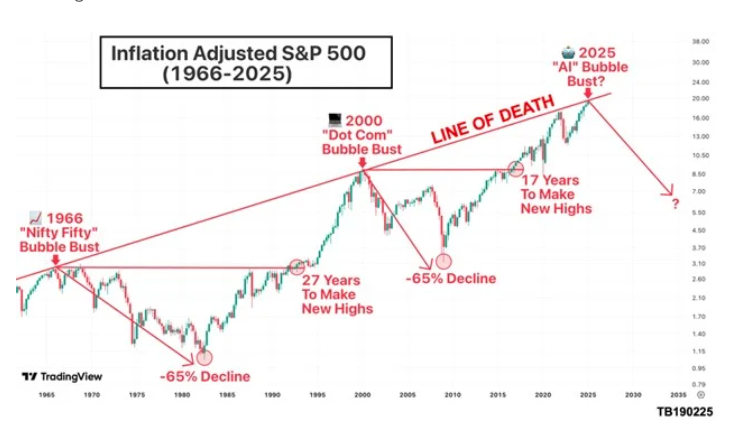
First, the most likely cause of significant and lengthy underperformance of a respected value manager is a wildly successful stretch of outperformance of momentum and growth stock investing relative to value investing:

Buffett was 67 years old in 1998. Value-oriented stocks peaked in April of that year when Citigroup and Travelers merged and effectively broke the back of the Glass-Steagall Act, which separated banking from investments. The euphoria on financial stocks peaked the value index and the performance in the broader stock market. Rather than being affected by the correction beginning in financials, the S&P 500 Index powered forward on excitement about the companies that were the centerpiece of the mania over the internet and how it would change our lives (which it did).
The center of the excitement in 1998-2000 included Cisco Systems (CSCO) for routers, Intel (INTC) for semiconductors and Microsoft (MSFT) for software. Along with this were major players like Lucent, NTT DoCoMo, Nippon Telegraph and Deutsche Telecom among the 10 largest worldwide market cap stocks at the end of 1999. These were owned by most amateurs and professionals and were one of the only major parts of the S&P 500 Index that worked from 1998 to 2000. If you are wondering, Microsoft took 15 years to get back to its 1999 peak, while Cisco and Intel never have. This is despite succeeding as a much larger and more financially successful operating business.
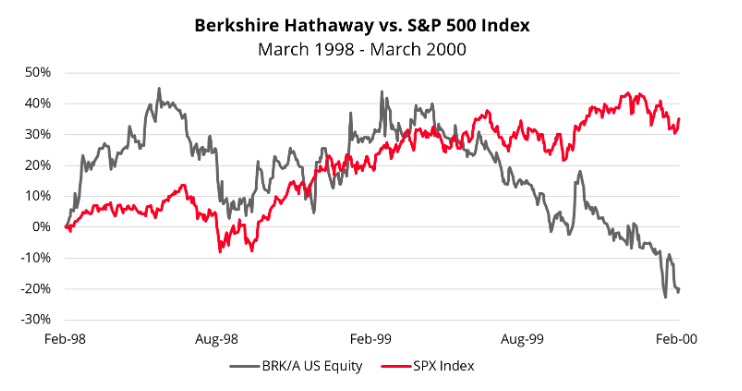
Here is how things went for Buffett and Munger in the shares of Berkshire Hathaway (BRK) from February of 1998 to February of 2000:
During my time running separate accounts at Smith Barney, I was going through this same tribulation. As I remember, we made no gains in that same stretch versus that 35% gain in the S&P 500 Index. Our only 50% decline occurred in the first 14 months of the strategy’s existence, from the second trading day of 2008 to the bottom of the bear market in 2009. Our relative performance is what is bothering us today, not the loss of capital. There have been numerous drawdowns in the value of the portfolio over its 17-year history, including a 40% drawdown when COVID-19 shut everything down.
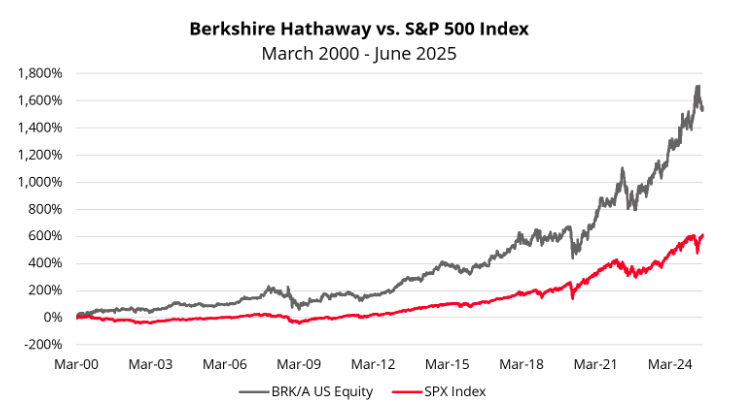
Now you get to look at the flip side of this album. How did Buffett and Berkshire Hathaway do since that woeful performance stretch when everyone wondered if the “old man” had lost his prowess?
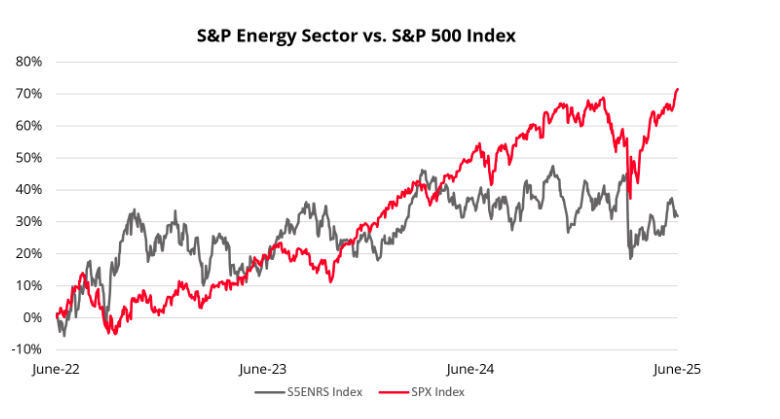
Why are we excited about the future results of our portfolio relative to other investors? First, we are overweight oil and gas stocks, and historically in this situation their performance has been relatively strong on a going forward basis.
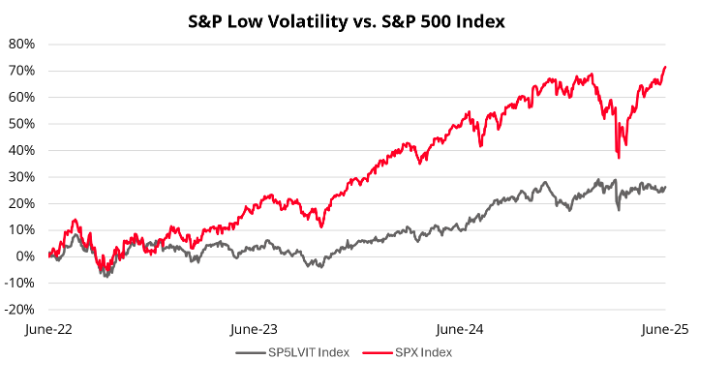
Second, we are not participating in the most popular Magnificent Seven stocks and are not going to make the case that it is different this time. We own numerous companies that fall in the S&P 500 low-volatility group, and you can see from the chart below how much more defensive stocks have underperformed.
Lastly, we know that not everyone understands why Buffett is holding so much cash when he is the world’s greatest stock picker. He says to be fearful when others are greedy and greedy when others are fearful. We own and are greedy with home builders, pharma/biotech stocks and a variety of wonderful companies that have been neglected while all the money poured into the S&P 500 and the Mag 7 stocks.
In conclusion, we are very positive about our portfolio, especially on how we believe it will perform versus the S&P 500 Index. Thank you for coming along with us on our journey to play the long game.
Play the Long Game,
Bill Smead. Cole Smead
A message from Advisor Perspectives and VettaFi: To learn more about this and other topics, check out some of our webcasts.
The recent growth in the stock market has helped to produce short-term returns for some asset classes that are not typical and may not continue in the future. Margin of safety is the difference between the intrinsic value of a stock and its market price. The price-earnings ratio (P/E Ratio or P/E Multiple) measures a company’s current share price relative to its per-share earnings. Alpha is a measure of performance on a risk-adjusted basis. Beta is a measure of the volatility of a security or a portfolio in comparison to the market. FAANG is an acronym for the market’s five most popular and best-performing tech stocks, namely Facebook, Apple, Amazon, Netflix and Alphabet’s Google. Growth investing is focused on the growth of an investor’s capital. Leverage is using borrowed money to increase the potential return of an investment. Momentum is the rate of acceleration of a security’s price or volume. The earnings yield refers to the earnings per share for the most recent 12-month period divided by the current market price per share. Profit margin is calculated by dividing net profits by net sales. Quality is assessed based on soft (e.g. management credibility) and hard criteria (e.g. balance sheet stability). Value is an investment tactic where stocks are selected which appear to trade for less than their intrinsic values. The dividend yield is the ratio of a company’s annual dividend compared to its share price.
The information contained herein represents the opinion of Smead Capital Management and is not intended to be a forecast of future events, a guarantee of future results, nor investment advice.
Smead Capital Management, Inc.(“SCM”) is an SEC registered investment adviser with its principal place of business in the State of Arizona. SCM and its representatives are in compliance with the current registration and notice filing requirements imposed upon registered investment advisers by those states in which SCM maintains clients. SCM may only transact business in those states in which it is notice filed or qualifies for an exemption or exclusion from notice filing requirements. Registered investment adviser does not imply a certain level of skill or training.
This newsletter contains general information that is not suitable for everyone. Any information contained in this newsletter represents SCM’s opinions, and should not be construed as personalized or individualized investment advice. Past performance is no guarantee of future results. There is no guarantee that the views and opinions expressed in this newsletter will come to pass. Investing in the stock market involves gains and losses and may not be suitable for all investors. Information presented herein is subject to change without notice and should not be considered as a solicitation to buy or sell any security. SCM cannot assess, verify or guarantee the suitability of any particular investment to any particular situation and the reader of this newsletter bears complete responsibility for its own investment research and should seek the advice of a qualified investment professional that provides individualized advice prior to making any investment decisions. All opinions expressed and information and data provided therein are subject to change without notice. SCM, its officers, directors, employees and/or affiliates, may have positions in, and may, from time-to-time make purchases or sales of the securities discussed or mentioned in the publications.
© Smead Capital Management
Read more commentaries by Smead Capital Management