Thematic investing has experienced cycles of popularity over time. In less cautious market environments, investors often turn their attention to ambitious ideas — such as disruptive technologies or other transformative future trends — looking beyond traditional equity ETFs. However, this surge in interest is often accompanied by misconceptions about what thematic investing really is.
While it is often appealing for speculative and aspirational investing, many of the largest thematic ETFs (and some of the newest launches) are actually grounded in more tangible and pragmatic themes, such as infrastructure, defense technology, and cybersecurity. This note provides a look at some of the basics behind thematic investing, current issuers and ETFs in the thematic space, and what 2025 and beyond holds for new thematic products.
What is thematic investing?
Thematic investing involves targeting specific investment themes or disruptive trends with the potential to drive the economy. These trends tend to be long-term structural changes and illustrate a shift from an old technology or life style to a new one. These trends typically emerge from a top-down view, driven by global demand. They may not yet be fully reflected in individual companies (which is why they may have higher growth potential).
As a result, companies within this space share several characteristics, including:
- Early-stage companies with only a few available for public investment
- Pre-revenue, or in some cases, minimal/no profit
- Potentially high growth, but also high risk of loss
Beyond broader demand trends, thematic investing often reflects investors’ personal interests and values. Themes can be based on hobbies or passions — ranging from electric vehicles and video games to digital assets — and may fall into an “aspirational” part of the portfolio. For example, while interest in the metaverse has faded, a tech enthusiast who believes in the long-term potential of the metaverse might still choose to allocate a small portion of their portfolio to that theme in case of a future resurgence.
Why ETFs for thematics?
Investors can gain exposure to a thematic trend through individual stocks. But many prefer using exchange-traded funds (ETFs) to access these themes.
- Because many of these companies are in early stages with limited analyst research, successful stock picking is difficult. Indexed ETFs can more easily screen for the appropriate stocks. Active ETFs rely on professional managers to make well-thought-out selections.
- ETFs offer diversification, which reduces the risk associated with a single stock.
- ETFs can provide a comprehensive view of the trend. For example, instead of investing in a single electric vehicle stock, an investor can use an electric vehicle ETF to invest in automakers, autonomous software, and battery producers all in one product.
What does the thematic ETF market look like?
The thematic ETF market is difficult to define. I estimate there are around 400 ETFs with about $300 billion in assets. I am estimating this based on information found on asset manager websites. But individual issuer definitions of “thematics” vary, which makes themes difficult to define. For the purpose of this note, I used issuer definitions (when available). So the figures below may not be a like-for-like comparison. For example, one issuer may consider a spot bitcoin ETF as part of their thematic lineup. Another issuer might only consider something like a blockchain ETF as part of the digital asset theme.
In my opinion, thematics is typically a multisector investment idea that doesn’t fit into traditional sector definitions. And while many thematic ETFs are within disruptive the technology space, they not only hold technology stocks, but also adjacent categories like communication services, and consumer discretionary.
However, in real-world applications, I typically see industries classified as thematic even if they follow traditional industry definitions. For example, while an industrials sector ETF is typically not considered a thematic ETF, an industry within industrials — like defense — is often considered a thematic ETF.
Thematics in a portfolio: Examples
With that in mind, the definition of thematics isn’t as important as its use cases within a portfolio. There’s not one answer for this, but generally thematics is used in small allocations in a portfolio to:
- Gain access to a specific area of a broader trend — for example, going a step beyond technology to cybersecurity or artificial intelligence
- Express an emotion or personal view — for example, a music enthusiast investing in a music/entertainment ETF
- Add a small allocation of a high-return/high-risk investment to enhance portfolio returns — for example, using a crypto mining ETF to access the volatility of bitcoin prices
Considering the above, here’s a look at real-life examples, including some of the biggest asset managers in the space and their largest offerings, some smaller asset managers that focus on thematics, and new thematic ETF launches in 2025 and beyond.
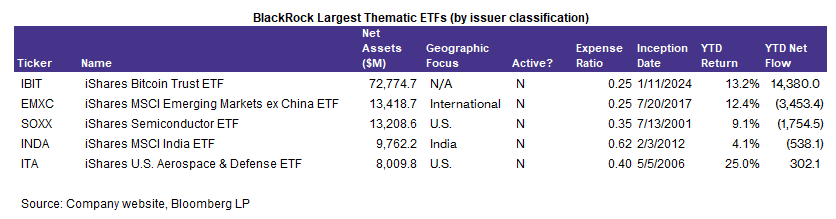
BlackRock: BlackRock’s thematic product suite through its iShares brand is a good example of diversified thematics. BlackRock lists 46 different thematic products, with $155 billion in assets on its website. However, many of its products are listed under multiple categories. For example, its largest thematic product listed is the iShares Bitcoin Trust ETF (IBIT), with $72 billion in assets. That’s followed by a significant gap by the iShares MSCI Emerging Markets ex China ETF (EMXC), with $13 billion in assets. IBIT is also listed as a digital assets ETF, while EMXC is also listed as in international equity ETF. Its largest “pure-play” thematic ETF would likely be the iShares U.S. Thematic Rotation Active ETF (THRO), which isn’t cross-listed under any other categories. THRO dynamically rotates through market themes to complement an U.S. core allocation.

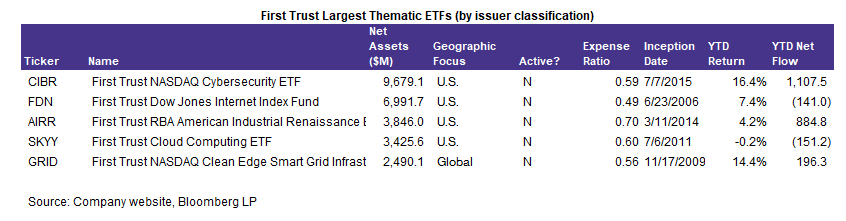
First Trust: First Trust has been a well-known name in the thematic space, having 30 thematic ETFs with $31 billion in assets. Its largest ETF is the First Trust NASDAQ Cybersecurity ETF (CIBR), which holds companies in the technology and industrials sectors. While its larger ETFs play in the tech and industrials space, it has thematic ETFs in other categories like healthcare, retail, and natural resources.
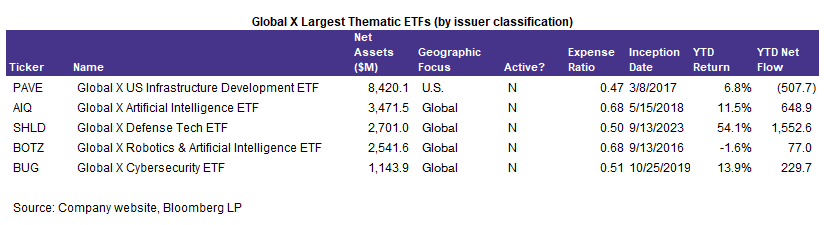
Global X: Many issuers like Global X, for example, focus closely on thematics. Global X has 32 ETFs and $21 billion in its thematic lineup. Five of these have net assets over $1 billion and are a good mix of themes: infrastructure, AI, defense, and cybersecurity. Its largest ETF is the Global X US Infrastructure Development ETF (PAVE). PAVE is a good example of a thematic ETF that does not focus on a pure disruptive technology, but a long-term structural trend in infrastructure which can seem more tangible to an investor looking for a lower risk trend.
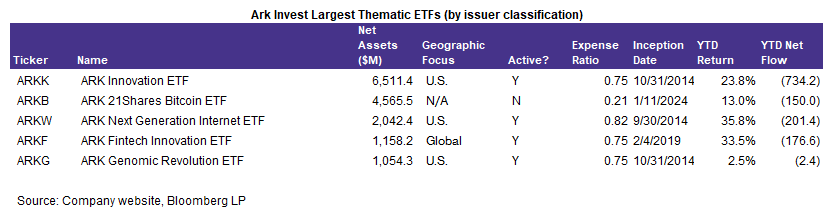
ARK Invest: ARK specializes in innovation and digital assets (its digital assets product are offered in conjunction with 21Shares). It has 12 ETFs total, with almost $17 billion in assets. Its largest product is the ARK Innovation ETF (ARKK). This is a well-known thematic ETF that has seen ebbs and flows over the past few years but currently has over $6 billion in assets.
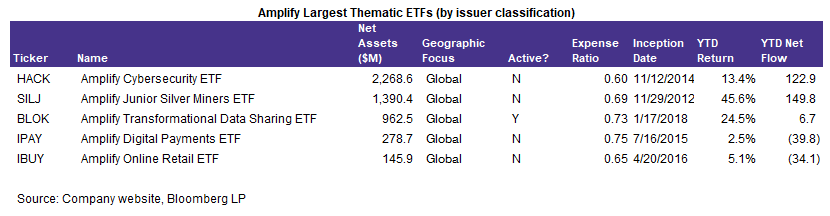
Amplify: Amplify lists 16 thematic products on its website, with over $5 billion in assets. About three of its products are in the $1 billion range or higher, with a wider gap between their lower asset products. Like many of the other issuers discussed above, its top ETF is a cybersecurity ETF — the Amplify Cybersecurity ETF (HACK). But Amplify also has products in a wide range of themes including online retail, cannabis, and travel.
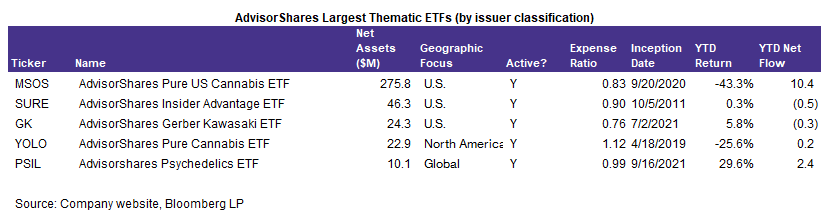
AdvisorShares: AdvisorShares is an example of an asset manager with a smaller amount of assets but a relatively large number of ETFs — 10 ETFs, but only around $400 million in assets. Its most popular ETF is the AdvisorShares Pure US Cannabis ETF (MSOS), but it also has another cannabis ETF and a psychedelics ETF rounding out its top five largest funds.
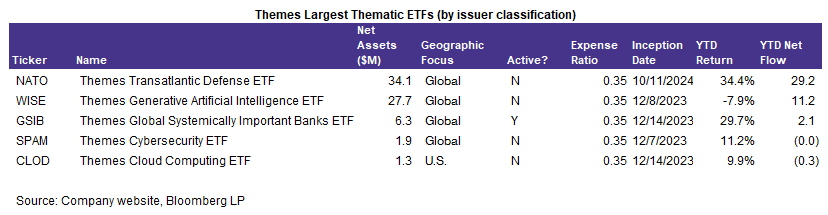
Themes: Themes ETFs offers 35 ETFs with total AUM of $211 million including 18 thematic ETFs with a total of $113 million. The majority of its assets are in two ETFs. Its largest ETF is the Themes Transatlantic Defense ETF (NATO), with $34 million in assets. That’s followed by the Themes Generative Artificial Intelligence ETF (WISE), with $28 million in assets. Themes also offers a broad range of commodities miners ETFs and leveraged single stock ETFs as part of their thematic universe.
Thematics in 2025 and beyond: More than technology
About 20 thematic ETFs have been launched so far this year. Many of these big themes are adjacent to the disruptive technology space. But there are a wide range of themes that so far include: crypto equity ETFs (see this previous note), AI infrastructure and electrification ETFs, and defense industry ETFs.
Artificial intelligence ETFs continue to push boundaries in technology in disruptive spaces like the KraneShares Global Humanoid and Embodied Intelligence ETF (KOID). But more often, these launches are now starting to focus on AI infrastructure that is more tangible to many investors rather than pure AI technology. The most recent launch in this space was the ALPS Electrification Infrastructure ETF (ELFY). But there were also recent launches from Global X and Tema. Grayscale also plans to launch the Grayscale Artificial Intelligence Infrastructure ETF (GRAI) in July, which is a departure from Grayscale’s typical focus on cryptocurrencies.
While defense ETFs have typically been classified as industry ETFs, recent outperformance in international defense — particularly the Select STOXX Europe Aerospace & Defense ETF (EUAD) — and an increase in the NATO defense spending target have rekindled interest in the area. Many investors are viewing the space thematically as a mix of industrials and technology. Several notable launches in this space include the iShares Defense Industrial Active ETF (IDEF) and the PLUS Korea Defense Industry Index ETF (KDEF).
Bottom Line: The breadth of thematic ETFs goes beyond disruptive technology. Many of the largest existing thematic ETFs — and some of the newer ETF launches — are more grounded in rational themes. But innovation and creativity will always be a part of thematics, so I expect to continue to see smaller, niche categories emerge.
For more news, information, and analysis, visit VettaFi | ETF Trends.
VettaFi LLC (“VettaFi”) is the index administrator and calculation agent for ELFY, for which it receives a fee. However, ELFY is not issued, sponsored, endorsed, or sold by VettaFi, and VettaFi has no obligation or liability in connection with the issuance, administration, marketing, or trading of ELFY.
A message from Advisor Perspectives and VettaFi: To learn more about this and other topics, check out some of our webcasts.
Read more commentaries by VettaFi