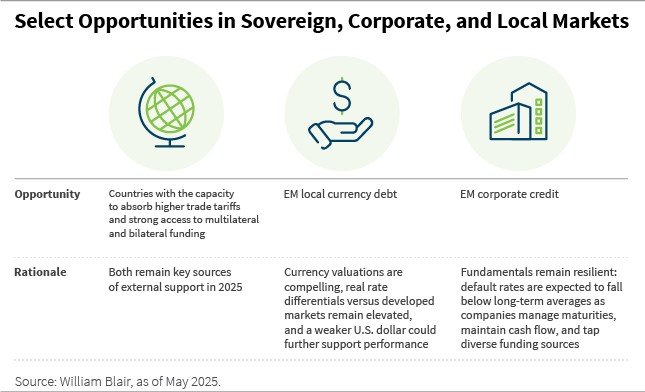
The United States’ tariff announcement on April 2, 2025, created significant market volatility, as the tariffs were perceived as higher, broader, and more punitive than expected, and the implementation sooner. Since then, the tariff war with many countries has de-escalated, but uncertainty is keeping market volatility alive. On the bright side, we believe the market selloff has provided investors with attractive opportunities to increase allocations to emerging markets (EM) debt.
1. No Shift in Base Case
While policy risks have risen, our outlook is unchanged. We expect a global slowdown—not a recession—and believe disinflation will continue, giving central banks room to normalize policy gradually. As a result, we still expect a slow but steady improvement in global liquidity. And EM debt performance is generally driven by global growth and liquidity.
2. EM Resilience
EMs appear better positioned than many developed markets to weather a global trade war, thanks in part to the rise of intra-EM trade, which has reduced direct exposure to U.S. tariffs.

3. Pivoting in China
In China, we expect a mix of monetary and fiscal stimulus, alongside currency weakening, as the government works to cushion the impact of tariffs. China is also likely to accelerate its pivot away from U.S. exports. EMs now account for nearly half of Chinese outbound trade, and that could increase as it expands trade with both EM and developed market partners.
4. Strong Fundamentals, Supportive Technicals
EM debt fundamentals remain solid, with a healthy growth premium over developed markets likely to persist through 2026, in our opinion. Sovereign credit risk appears contained, with no new defaults expected over the next year, leaving EM credit on stronger footing than its developed market peers. On the technical side, we expect continued support from limited net new issuance in 2025, even amid near-term uncertainty over investment flows.
5. Compelling Valuations
Recent credit-spread widening has improved valuations, particularly in high yield, where spreads now sit above long-term averages, so we remain positioned for compression of high-yield and investment-grade spreads. Despite concerns over inflation from potential tariffs, our positive outlook for the 10-year U.S. Treasury yield is unchanged. We see an opportunity for investors to add long-duration exposure to lock in attractive real and nominal yields.
Marcelo Assalin, CFA, partner, is the head of William Blair’s emerging markets debt team, on which he also serves as a portfolio manager.
Want more insights on the economy and investment landscape? Subscribe to our blog.
A message from Advisor Perspectives and VettaFi: To learn more about this and other topics, check out some of our webcasts.
This content is for informational and educational purposes only and not intended as investment advice or a recommendation to buy or sell any security. Investment advice and recommendations can be provided only after careful consideration of an investor’s objectives, guidelines, and restrictions.
Information and opinions expressed are those of the authors and may not reflect the opinions of other investment teams within William Blair Investment Management, LLC, or affiliates. Factual information has been taken from sources we believe to be reliable, but its accuracy, completeness or interpretation cannot be guaranteed. Information is current as of the date appearing in this material only and subject to change without notice. Statements concerning financial market trends are based on current market conditions, which will fluctuate. This material may include estimates, outlooks, projections, and other forward-looking statements. Due to a variety of factors, actual events may differ significantly from those presented.
Investing involves risks, including the possible loss of principal. Equity securities may decline in value due to both real and perceived general market, economic, and industry conditions. The securities of smaller companies may be more volatile and less liquid than securities of larger companies. Investing in foreign denominated and/or domiciled securities may involve heightened risk due to currency fluctuations, and economic and political risks. These risks may be enhanced in emerging markets and frontier markets. Different investment styles may shift in and out of favor depending on market conditions. Individual securities may not perform as expected or a strategy used by the Adviser may fail to produce its intended result.
Investing in the bond market is subject to certain risks including market, interest rate, issuer, credit, and inflation risk. Rising interest rates generally cause bond prices to fall. High-yield, lower-rated, securities involve greater risk than higher-rated securities. Sovereign debt securities are subject to the risk that an entity may delay or refuse to pay interest or principal on its sovereign debt because of cash flow problems, insufficient foreign reserves, or political or other considerations. Derivatives may involve certain risks such as counterparty, liquidity, interest rate, market, credit, management, and the risk that a position could not be closed when most advantageous. Diversification does not ensure against loss. The inclusion of Environmental, Social and Governance (ESG) factors beyond traditional financial information in the selection of securities could result in a strategy's performance deviating from other strategies or benchmarks, depending on whether such factors are in or out of favor. ESG analysis may rely on certain values based criteria to eliminate exposures found in similar strategies or benchmarks, which could result in performance deviating.
Collective Investment Trusts (CITs) are available to qualified retirement plans. For non-U.S. citizens or residents, William Blair offers a series of Luxembourg-domiciled SICAV products.
There can be no assurance that investment objectives will be met. Any investment or strategy mentioned herein may not be appropriate for every investor. References to specific companies are for illustrative purposes only and should not be construed as investment advice or a recommendation to buy or sell any security. Past performance is not indicative of future returns.
| | | |
Read more commentaries by William Blair