As widely expected, the Federal Reserve's Federal Open Market Committee (FOMC) decided to hold its policy rate steady at its June meeting. The target range for the federal funds rate—the rate banks charge each other for overnight loans—remains at 4.25% to 4.5%. The quarterly Summary of Economic Projections still indicates a median estimate of two rate cuts this year, but with inflation expected to remain elevated, that projection may be reduced to one or even none over the course of the next few meetings.
The statement accompanying the policy announcement emphasized that uncertainty about the economic outlook has diminished, but the risks of higher inflation and potentially higher unemployment are "still elevated." The Fed, along with markets, continues to wait for clarity on trade policy and the federal budget, and is assessing the impact of immigration limits on the labor market.
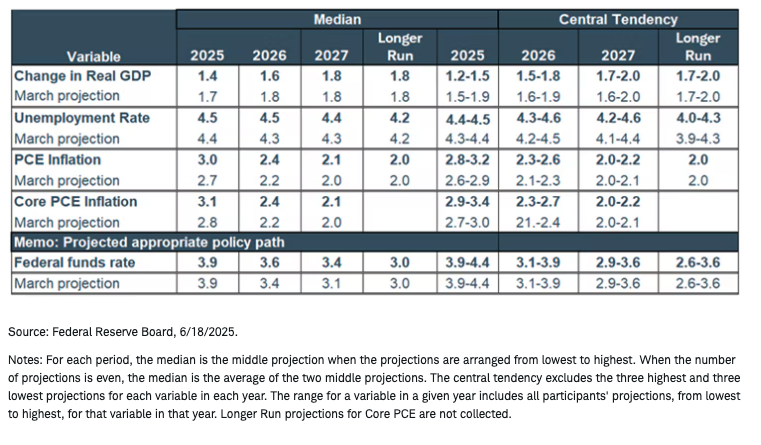
The Fed's economic projections have an air of stagflation—stagnant economic growth with inflation—given gross domestic product (GDP) growth was revised lower for the next two years while inflation estimates were revised up. Real (or inflation-adjusted) GDP for 2025 was reduced to 1.4% compared to 1.7% in March, and for 2026 it was lowered to 1.6% from 1.8%. The unemployment rate projection was revised up by a modest one-tenth of a percent to 4.5% for this year and 4.4% next year.
Economic projections

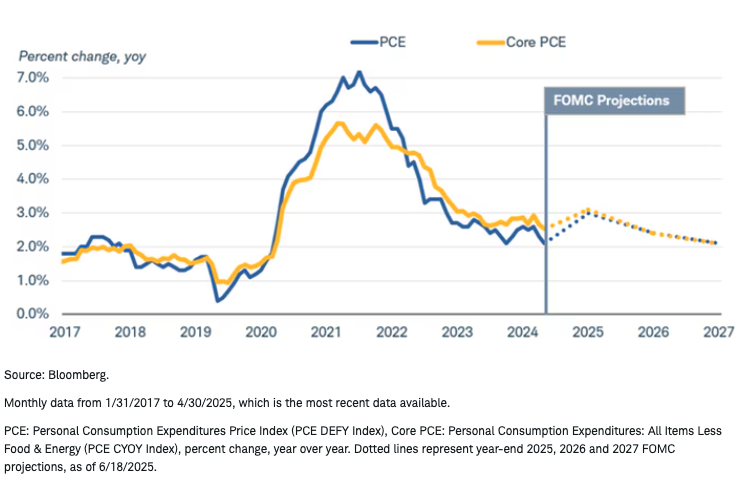
However, inflation projections were revised up significantly for next year. The personal consumption expenditures (PCE) index and "core" PCE (excluding food and energy prices) are now estimated to come in at 3.0% in 2025 from 2.7% amid the risks coming from trade policy and expansive fiscal policy. As long as the Fed sees inflation heading higher, it will be difficult to see much in the way of rate cuts in the near term.
Inflation is projected to be above the Fed's 2% target
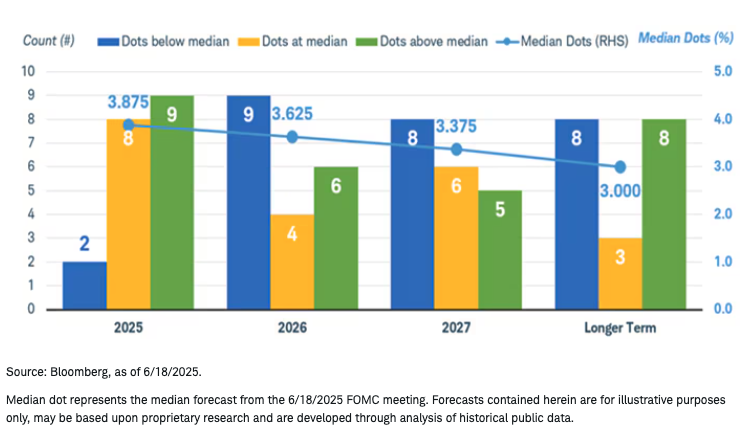
Based on the "dot plot," seven members of the committee see no change in policy for this year and two expect only one cut. Consequently, we would not be surprised if the Fed kept policy on hold even longer than the market has been anticipating. The number of dots—each representing a Fed official's projection for the federal funds rate—above the median is greater than the number below.
Fed members are still projecting two rate cuts this year
Uncertainty means less easing and a steeper yield curve
The markets and central banks are grappling with a complicated mix of policies. Tariffs can raise inflation and slow growth. The budget proposals making their way through Congress could boost the prospects for some consumers but diminish them for others. Immigration limits may shrink the size of the labor force, pushing up wages while causing small and medium-sized businesses to falter. Layer in wars in Europe and the Middle East, and the potential for higher energy prices along with the outlook for the economy suggest a potential growth slowdown and higher inflation.
For the bond market, those risks suggest a steeper yield curve, with long-term yields staying elevated relative to short-term yields. The risk premium for holding longer-term bonds is likely to remain high or rise, while short-term rates are anchored by expectations for Fed rate cuts.
In the press conference that followed the meeting, Fed Chair Jerome Powell commented that the level of uncertainty is high, from a "trade standpoint, from an immigration standpoint. You see this not just here [meaning the U.S.] but everywhere." As these changes play out, we anticipate volatility in the bond market will remain elevated.
For investors, volatility can mean opportunity. We favor an intermediate-term average duration for portfolios and focusing on high credit quality bonds.
Gain clarity on H1 & strategize for the remainder of the year. Register now for the Midyear Market Outlook Symposium on June 26 at 11 am ET.
The information provided here is for general informational purposes only and should not be considered an individualized recommendation or personalized investment advice. The investment strategies mentioned here may not be suitable for everyone. Each investor needs to review an investment strategy for his or her own particular situation before making any investment decision. All expressions of opinion are subject to change without notice in reaction to shifting market conditions. Data contained herein from third-party providers is obtained from what are considered reliable sources. However, its accuracy, completeness, or reliability cannot be guaranteed. Examples provided are for illustrative purposes only and not intended to be reflective of results you can expect to achieve.
Past performance is no guarantee of future results, and the opinions presented cannot be viewed as an indicator of future performance.
Investing involves risk, including loss of principal.
Fixed income securities are subject to increased loss of principal during periods of rising interest rates. Fixed income investments are subject to various other risks including changes in credit quality, market valuations, liquidity, prepayments, early redemption, corporate events, tax ramifications, and other factors. Lower rated securities are subject to greater credit risk, default risk, and liquidity risk.
Futures and futures options trading involves substantial risk and is not suitable for all investors. Please read the Risk Disclosure Statement for Futures and Options prior to trading futures products.
Forecasts contained herein are for illustrative purposes only, may be based upon proprietary research and are developed through analysis of historical public data.
The policy analysis provided by the Charles Schwab & Co., Inc., does not constitute and should not be interpreted as an endorsement of any political party.
Indexes are unmanaged, do not incur management fees, costs, and expenses and cannot be invested in directly. For more information on indexes, please see schwab.com/indexdefinitions.
The Schwab Center for Financial Research is a division of Charles Schwab & Co., Inc.
Source: Bloomberg Index Services Limited. BLOOMBERG® is a trademark and service mark of Bloomberg Finance L.P. and its affiliates (collectively "Bloomberg"). Bloomberg or Bloomberg's licensors own all proprietary rights in the Bloomberg Indices. Neither Bloomberg nor Bloomberg's licensors approves or endorses this material, or guarantees the accuracy or completeness of any information herein, or makes any warranty, express or implied, as to the results to be obtained therefrom and, to the maximum extent allowed by law, neither shall have any liability or responsibility for injury or damages arising in connection therewith.
The Charles Schwab Corporation provides a full range of brokerage, banking and financial advisory services through its operating subsidiaries. Its broker-dealer subsidiary, Charles Schwab & Co. Inc. (Member SIPC), and its affiliates offer investment services and products. Its banking subsidiary, Charles Schwab Bank, SSB (member FDIC and an Equal Housing Lender), provides deposit and lending services and products.
This site is designed for U.S. residents. Non-U.S. residents are subject to country-specific restrictions. Learn more about our services for non-U.S. residents, Charles Schwab Hong Kong clients, Charles Schwab U.K. clients.
© 2025 Charles Schwab & Co., Inc. All rights reserved. Member SIPC. Unauthorized access is prohibited. Usage will be monitored.
© Charles Schwab
Read more commentaries by Charles Schwab