SUMMARY
- The All Asset strategies have access to a few sources of long-term real return potential, which arise from our ability to a) systematically execute contrarian trades through a disciplined contra-trading approach that gradually averages into our positions; and b) consistently access the alpha potential from underlying PIMCO mutual funds.
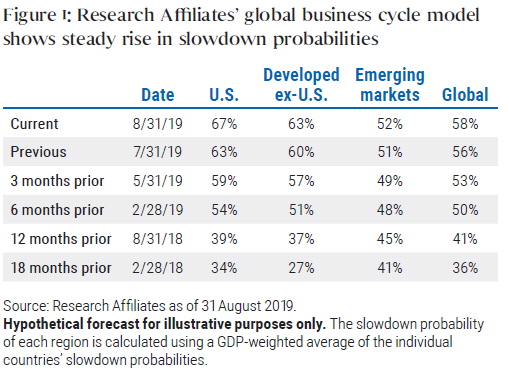
- Research Affiliates’ global business cycle model estimates a substantially higher probability of a slowdown in the U.S. and other developed markets today than 12 months ago. For emerging markets, Research Affiliates’ modeled slowdown probabilities have risen since 12 months ago but are significantly lower than for developed economies.
- Positioning in the All Asset strategies is more constructive on emerging markets within equity allocations, light on credit (both investment grade and high yield bonds), and with some appetite for long bonds (30-year U.S. Treasuries), as well as a preference for plenty of dry powder in the form of short-term and absolute return strategies.
Rob Arnott, founder and chairman of Research Affiliates, discusses why the All Asset strategies’ systematic global tactical asset allocation using active PIMCO funds may offer investors long-term value. Omid Shakernia, senior vice president of asset allocation at Research Affiliates, discusses the growing likelihood of a global economic slowdown signaled by the All Asset strategies’ business cycle model and how this informs positioning. As always, their insights are in the context of the PIMCO All Asset and All Asset All Authority funds.
Q: The All Asset strategies execute a contrarian philosophy, using a systematic global tactical asset allocation approach that allocates exclusively to actively managed PIMCO funds. What gives you confidence that this approach may add value in the long run?
Arnott: In my 40 years as a contrarian investor, I’ve observed that a few principles have tended to drive the long-term value added from a contrarian approach. I’ve often said that what is comfortable is rarely profitable, and that the markets do not reward comfortable investment choices. How does this view work over time? First, mean reversion in prices tends to be “unreliably reliable.” It works in the long run, but fails often enough in the short run to keep performance-chasers in the game. Securities prices essentially represent an unknowable “true” fair value plus or minus an often large and volatile margin of error (noise), which the market is always trying to correct. Because the market is inherently trying to find the true value for every asset, this “noise” essentially mean-reverts to zero.1 Second, I’ve often said that true bargains cannot exist without fear – and that fear cannot exist without a plausible narrative suggesting that things will get worse before they get better.2 Finally, investor behavior creates anomalies in the capital markets that can be systematically exploited by the patient investor. Successful contrarian investing takes time, because fair value may require a very long time to assert its ultimately dominant influence.
“Buy low and sell high” is easy to say, but very hard to do on a consistent basis. Most people fail miserably at it. Why? Because whatever is cheap likely got there by inflicting pain and losses, while whatever is newly expensive got there by giving some investors joy and profits. It’s human nature to want more of whatever has given us joy, and to shun whatever has been painful. This is why people continue to buy high and sell low. Performance-chasers, preferring the comfort of conformity over discomfort, are on the other side of the trades of long-term contrarian investors.
Expressing these principles within a systematic global tactical asset allocation process – as we aim to do in the All Asset strategies – is critical, because it ensures we take the uncomfortable contrarian positioning required for investors to potentially profit from mean reversion. So, the All Asset strategies have access to a few sources of long-term real return potential, which arise from our ability to a) systematically execute contrarian trades through a disciplined contra-trading approach that gradually averages into our positions, rather than responding to every market twitch; and b) consistently access the alpha potential from underlying PIMCO mutual funds.
To institutionalize the discipline – and courage – necessary to potentially benefit from contrarian behavior, the All Asset strategies rely on a systematic global tactical asset allocation approach. Recall that markets are driven by relative value in the long run, and our goal is to add value over a fiduciary horizon. To ensure we execute the uncomfortable trades of a contrarian positioning, our strategies’ contra-trading engine continually rebalances across a vast span of markets. We seek higher return potential in fundamentally attractive asset classes that are currently feared and shunned, while tilting away from what we view as overvalued markets that are beloved and expensive. A rebalancing discipline allows us to seek incremental return over the long run.
Importantly, let’s not forget the underlying PIMCO funds’ potential to add value across a wide array of markets.
While past is not prologue, two observations inspire our forward-looking confidence. First, PIMCO continues to invest in its wide and deep bench of research capabilities, with over 255 portfolio managers with an average of 16 years of experience and over 150 analysts and analytics/asset experts and 14 specialty desks as of 30 September 2019. Second, most of the PIMCO funds in which we invest are designed to combine multiple sources of potential value-add. As one example, the RAE suite of funds blend smart beta-based structural excess return potential (a combination of Research Affiliates’ Fundamental Index weights and factor investing) plus PIMCO bond-based alpha potential.
In this prolonged bull market for U.S. large cap equities, it's been tough to be a contrarian investor, let alone a contrarian value investor! Even against these headwinds, our strategies have fared reasonably well against competitors in Morningstar’s Tactical Allocation category, despite the fact that most anchor heavily on U.S. stocks and bonds (often in a classic 60/40 fashion), while the All Asset strategies provide a source of diversification away from these “two pillar” strategies. We look forward to seeing how the All Asset strategies fare when the market turns and provides a potential tailwind to value and “Third Pillar” diversifying and inflation-related markets.
Q: According to Research Affiliates’ country-specific business cycle model, what is the likelihood of a global economic slowdown? And what do these signals mean for positioning in the All Asset strategies?
Shakernia: Our global business cycle model is an important component of the investment process for the All Asset strategies. Let’s begin with an overview of the model’s purpose and key attributes, and then delve into what the model’s current forecasts imply and how these signals influence the positioning of our strategies.
Research Affiliates’ business cycle model forecasts global macroeconomic conditions to improve its calibrations of near-term estimates of capital market returns and risks. Unlike the more common approach of forecasting probabilities of recessions (periods of negative GDP growth), Research Affiliates’ model seeks to forecast probabilities of business cycle slowdowns: periods when GDP growth is decelerating relative to recent trends.
Why does Research Affiliates model slowdowns instead of recessions? First, slowdowns describe a wide array of empirical relationships across capital markets, including the procyclical variation of valuations (e.g., equity Shiller price/earnings (P/E) ratios are lower and credit spreads are wider during slowdowns), and the countercyclical variation of risk (i.e., asset class volatilities and cross-correlations are higher during slowdowns). Second, slowdowns occur more frequently than recessions, thereby providing many more observations, which in turn lead to more-robust estimates. Finally, since the economy generally slows down before going into a contraction, slowdowns have tended to lead recessions.
Let’s now turn to how Research Affiliates’ model works in practice. In modeling slowdowns (and accelerations) versus recessions (and expansions), we decompose GDP into two key components: the multiyear trend growth rate and shorter-term cyclical deviations from that trend. In other words, we are looking to forecast changes in the trajectory of growth, which market prices are likely to respond to, as opposed to focusing exclusively on forecasting recessions, which could be viewed as just an extreme slowdown scenario. Then, to capture the dispersion in macroeconomic conditions across the globe, we apply our business cycle forecasting methodology to 10 major developed market and 10 major emerging market countries.
Because turning points in the business cycle can often only be determined several months after they have occurred, Research Affiliates’ model includes a forecasting component that gauges the probability of being in a slowdown in the next quarter. We forecast country-specific slowdown probabilities using leading indicators based on economic activity (for example, purchasing managers’ indices (PMIs), new orders, and inventories) and monetary policy (slope of the yield curve3) for each country.
Lastly, Research Affiliates’ business cycle model estimates the sensitivity of asset class valuations to changes in our slowdown probability forecasts, which helps us to calibrate our tactical allocations. These tactical views are based on adjustments to both expected return (through adjustments to asset class fair valuations) and risk (through adjustments to volatilities and correlations) across the business cycle. So rising slowdown probabilities tend to reduce our near-term estimated returns for risk assets while increasing our expectations of risk, causing our portfolio to take on a more defensive posture; and vice versa.
What is our model forecasting now? It should be no surprise that the inversion of the U.S. Treasury yield curve has driven a dramatic rise in Research Affiliates’ modeled slowdown probability for the U.S. (see Figure 1). In both the U.S. and other developed markets, the probability of slowdown estimated by our model has risen from under 40% 12 months ago to above 60% today (as of 31 August 2019). In contrast, our modeled slowdown probabilities in emerging markets hover around 50%, having risen less than 10 percentage points over the past year.

Finally, let’s reflect on how these signals inform the All Asset strategies’ positioning. Within equities, we prefer emerging markets, which we view as relatively attractive not only from a business cycle perspective, but also from a valuation perspective.4 In contrast, we are light on credit (both investment grade and high yield bonds) given that spreads are tight and modeled slowdown probabilities are elevated. Research Affiliates’ models still show some appetite for long bonds (30-year U.S. Treasuries) despite their depressed yields, given their diversification benefits and role as a flight-to-quality hedge against market downturns. Finally, as part of the more defensive posture, Research Affiliates’ models are calling for plenty of dry powder in the form of short-term and absolute return strategies. We believe that when a downturn comes, the All Asset strategies will be well positioned to deploy funds into what we deem to be newly cheap assets.
The All Asset strategies represent a joint effort between PIMCO and Research Affiliates. PIMCO provides the broad range of underlying strategies – spanning global stocks, global bonds, commodities, real estate, and liquid alternative strategies – each actively managed to maximize potential alpha. Research Affiliates, an investment advisory firm founded in 2002 by Rob Arnott and a global leader in asset allocation, serves as the sub-advisor responsible for the asset allocation decisions. Research Affiliates uses their deep research focus to develop a series of value-oriented, contrarian models that determine the appropriate mix of underlying PIMCO strategies in seeking All Asset’s return and risk goals.
1 Our 2011 academic paper published with Harry Markowitz and Jun Liu, “Does Noise Create the Size and Value Effects?” asserts that if 90% of stock price movement is due to changes in that long-term true fair value, and only 10% is due to mean-reverting pricing errors, that would be enough to explain the entire size and value effect; it would also pull down the return for capitalization weighting by roughly 200 basis points relative to any weighting scheme that’s independent of price, like Fundamental Index weighting or equal weighting (or darts, for that matter!).
2 Reciprocally, we believe true bubbles cannot form without complacency. When there’s more fear of missing out on some future growth than fear of an investment’s volatility and downside risk, then we think it’s only natural that the risk premium should become negative! See our 2018 and 2019 white papers, “Yes. It’s a Bubble. So What” and “Bubble, Bubble, Toil and Trouble,” respectively, in which we provide perhaps the first definition of bubbles that might be used to identify them long before they burst!
3 For more on this topic, see our RA Conversations video “The Inverted Yield Curve and Stock Returns” with Campbell R. Harvey, available on the Research Affiliates website.
4 As of 31 August 2019, the cyclically adjusted price/earnings (CAPE) ratio of emerging market stocks (as proxied by the MSCI EM Index) is 12.2x, which ranks within the lowest 12th percentile rank since 1995. In contrast, U.S. stocks (as proxied by the S&P 500) are trading at a CAPE ratio of 28.5x, which falls in the highest 94th percentile rank since 1871. Source: Research Affiliates based on data from MSCI and Shiller.
DISCLOSURES
Investors should consider the investment objectives, risks, charges and expenses of the funds carefully before investing. This and other information are contained in the fund’s prospectus and summary prospectus, if available, which may be obtained by contacting your investment professional or PIMCO representative or by visiting www.pimco.com. Please read them carefully before you invest or send money.
The terms “cheap” and “rich” as used herein generally refer to a security or asset class that is deemed to be substantially under- or overpriced compared to both its historical average as well as to the investment manager’s future expectations. There is no guarantee of future results or that a security’s valuation will ensure a profit or protect against a loss.
A word about risk:
The fund invests in other PIMCO funds and performance is subject to underlying investment weightings which will vary. Investing in the bond market is subject to risks, including market, interest rate, issuer, credit, inflation risk, and liquidity risk. The value of most bonds and bond strategies are impacted by changes in interest rates. Bonds and bond strategies with longer durations tend to be more sensitive and volatile than those with shorter durations; bond prices generally fall as interest rates rise, and the current low interest rate environment increases this risk. Current reductions in bond counterparty capacity may contribute to decreased market liquidity and increased price volatility. Bond investments may be worth more or less than the original cost when redeemed. Investing in foreign denominated and/or domiciled securities may involve heightened risk due to currency fluctuations, and economic and political risks, which may be enhanced in emerging markets. Commodities contain heightened risk including market, political, regulatory, and natural conditions, and may not be suitable for all investors. Mortgage and asset-backed securities may be sensitive to changes in interest rates, subject to early repayment risk, and their value may fluctuate in response to the market’s perception of issuer creditworthiness; while generally supported by some form of government or private guarantee there is no assurance that private guarantors will meet their obligations. High-yield, lower-rated, securities involve greater risk than higher-rated securities; portfolios that invest in them may be subject to greater levels of credit and liquidity risk than portfolios that do not. Investing in securities of smaller companies tends to be more volatile and less liquid than securities of larger companies. Inflation-linked bonds (ILBs) issued by a government are fixed-income securities whose principal value is periodically adjusted according to the rate of inflation; ILBs decline in value when real interest rates rise. Treasury Inflation-Protected Securities (TIPS) are ILBs issued by the U.S. government. Equities may decline in value due to both real and perceived general market, economic, and industry conditions. Entering into short sales includes the potential for loss of more money than the actual cost of the investment, and the risk that the third party to the short sale may fail to honor its contract terms, causing a loss to the portfolio. The use of leverage may cause a portfolio to liquidate positions when it may not be advantageous to do so to satisfy its obligations or to meet segregation requirements. Leverage, including borrowing, may cause a portfolio to be more volatile than if the portfolio had not been leveraged. Derivatives and commodity-linked derivatives may involve certain costs and risks such as liquidity, interest rate, market, credit, management and the risk that a position could not be closed when most advantageous. Commodity-linked derivative instruments may involve additional costs and risks such as changes in commodity index volatility or factors affecting a particular industry or commodity, such as drought, floods, weather, livestock disease, embargoes, tariffs and international economic, political and regulatory developments. Investing in derivatives could lose more than the amount invested. The cost of investing in the Fund will generally be higher than the cost of investing in a fund that invests directly in individual stocks and bonds. Diversification does not ensure against loss.
There is no guarantee that these investment strategies will work under all market conditions or are suitable for all investors and each investor should evaluate their ability to invest long-term, especially during periods of downturn in the market. Investors should consult their investment professional prior to making an investment decision.
All Asset All Authority Fund Morningstar Rankings: 1Yr. 82 out of 265; 3Yrs. 188 out of 231; 5Yrs. 159 out of 186; and 10 Yrs. 51 out of 56. All Asset Fund Morningstar Rankings: 1Yr. 48 out of 265; 3Yrs. 101 out of 231; 5Yrs. 106 out of 186; and 10 Yrs. 28 out of 56. Morningstar Ranking for the Tactical Allocation category as of 30 September 2019 for the Institutional Class Shares; other classes may have different performance characteristics. The Morningstar Rankings are calculated by Morningstar and are based on the total return performance, with distributions reinvested and operating expenses deducted. Morningstar does not take into account sales charges. Past rankings are no guarantee of future rankings.
All Asset All Authority Fund Morningstar Rankings (Institutional Share Class):1Yr. 28 out of 82; 3Yrs. 62 out of 71; 5Yrs. 49 out of 57; and 10 Yrs. 12 out of 13. All Asset Fund Morningstar Rankings (Institutional Share Class):1Yr. 18 out of 82; 3Yrs. 38 out of 71; 5Yrs. 35 out of 57; and 10 Yrs. 7 out of 13. Morningstar Ranking for the Tactical Allocation category as of 30 September 2019 for the Institutional Share Class; other classes may have different performance characteristics. The Morningstar Rankings are calculated by Morningstar and are based on the total return performance, with distributions reinvested and operating expenses deducted. Morningstar does not take into account sales charges. Past rankings are no guarantee of future rankings.
Hypothetical and simulated examples have many inherent limitations and are generally prepared with the benefit of hindsight. There are frequently sharp differences between simulated results and the actual results. There are numerous factors related to the markets in general or the implementation of any specific investment strategy, which cannot be fully accounted for in the preparation of simulated results and all of which can adversely affect actual results. No guarantee is being made that the stated results will be achieved.
Alpha is a measure of performance on a risk-adjusted basis calculated by comparing the volatility (price risk) of a portfolio vs. its risk-adjusted performance to a benchmark index; the excess return relative to the benchmark is alpha. Smart beta refers to a benchmark designed to deliver a better risk and return trade-off than conventional market cap weighted indices. Correlation is a statistical measure of how two securities move in relation to each other.
This material contains the opinions of the manager and such opinions are subject to change without notice. This material has been distributed for informational purposes only and should not be considered as investment advice or a recommendation of any particular security, strategy or investment product. Information contained herein has been obtained from sources believed to be reliable, but not guaranteed. No part of this material may be reproduced in any form, or referred to in any other publication, without express written permission. PIMCO is a trademark of Allianz Asset Management of America L.P. in the United States and throughout the world.
©2019, PIMCO.
PIMCO Investments LLC, distributor, 1633 Broadway, New York, NY, 10019 is a company of PIMCO.
Investment Products
Not FDIC Insured | May Lose Value | Not Bank Guaranteed
CMR2019-0925-416246
© PIMCO
More Active Management Topics >