We believe a disciplined approach to bond investing is critical to achieving desired return and risk objectives. Model portfolios may help.
SUMMARY
- Lower starting yields and the potential for renewed volatility make fixed income portfolio construction particularly challenging today.
- Investors have a tendency to fall into “timing traps,” including selling core bond allocations after rates have risen or selling credit allocations after spreads widen – even though that is often when future return prospects are brightening and may be an advantageous time to buy.
- PIMCO’s fixed income model portfolios may help financial advisors position their client portfolios for the road ahead through a disciplined approach that emphasizes forward-looking return potential when allocating across fixed income sectors.
“Buy the dips” is a refrain often heard after equity market sell-offs. The logic is sound: If your outlook hasn’t changed and equities suddenly become cheaper, it may make sense to consider adding to your allocation. However, we don’t often hear a similar response in fixed income markets when yields rise or spreads widen – even though that is often when we find future return prospects are brightening and it may be an advantageous time to buy. In reality, the reaction is typically quite the opposite: We often see investors selling core bond allocations after rates have risen or selling credit allocations after spreads widen. Model portfolios that emphasize forward-looking return potential when allocating across fixed income sectors may help avoid this tendency.
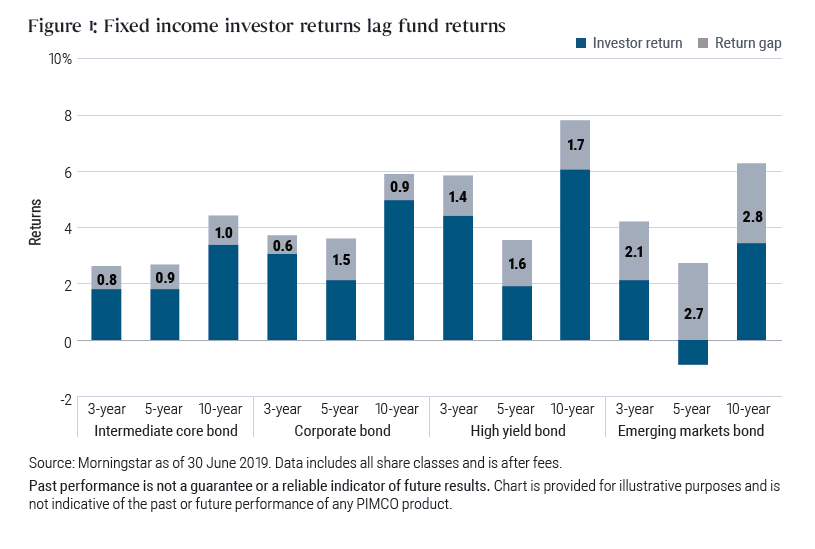
“Timing traps” are hard to resist, and can potentially have significant implications for returns. Flow data from Morningstar bears this out: Across a variety of fixed income sectors and time periods, the performance of the average fund in a given category beat the average investor’s return, inclusive of flows (see Figure 1). This means investors’ timing decisions cost them on average anywhere from one to three percentage points of returns annualized – a meaningful portion of the total return potential of their fixed income allocations.

Poor timing decisions may dent returns
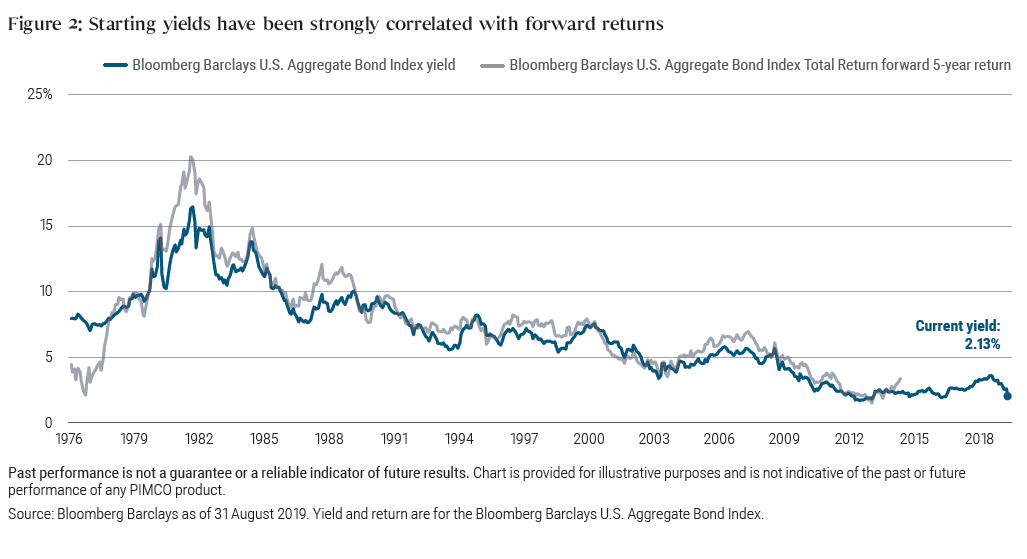
Part of the challenge is that investor flows into fixed income typically follow attractive trailing returns, after yields have fallen and spreads have tightened. However, lower yields and tighter spreads have often been indicators of weaker returns to come. For example, the long-term forward returns of the Bloomberg Barclays U.S. Aggregate Bond Index have been tightly tied to starting yields, regardless of the path of interest rates (see Figure 2). While the 10.17% one-year trailing return on the aggregate index as of 31 August may look quite attractive (as 10-year Treasury yields fell 123 basis points (bps) over the same period), today’s starting yield of 2.13% is likely a much better indicator of long-term future returns, if historical trends hold.
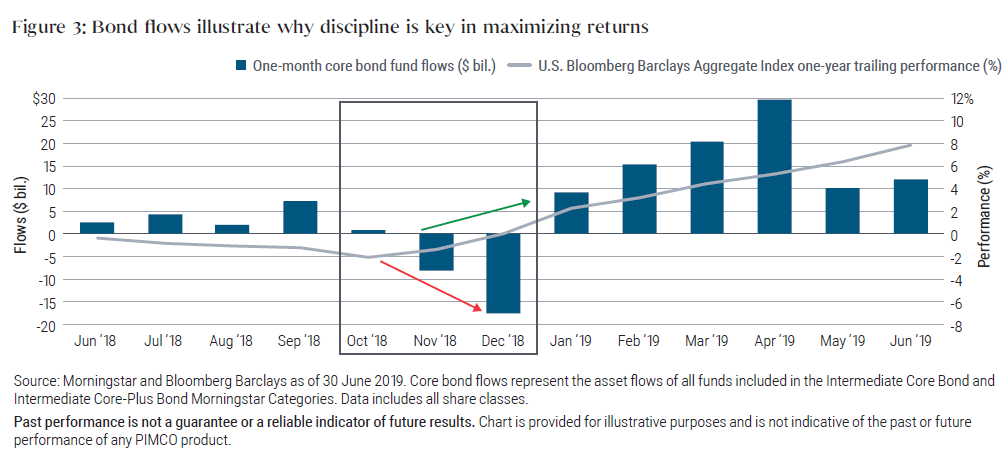
Breaking down the flow patterns demonstrates how some investors may have missed out on the full upside of core bonds over the past year. As Figure 3 shows, investor flows started to turn negative just after yields reached their peak in September 2018 (and trailing returns reached their low point), and continued to flow out even as equity markets began to sell off in December. Inflows then returned in 2019 after performance had already rebounded. The result of this behavior, according to Morningstar, is that returns for the average core bond investor were just 8.33% inclusive of flows over the past year, versus the 10.17% return for the U.S. aggregate index.
A similar pattern occurs in credit markets. As credit spreads widen (and bond prices decline), performance often suffers, making trailing returns look weak. However, future return prospects typically improve as investors receive greater compensation for taking on risk. The oil crash in late 2015 provides an instructive example. Following the December 2015 oil price plunge, high yield spreads widened 370 bps to reach 839 bps as of 11 February 2016, and one- and three-year trailing returns fell to -10.90% and -0.44%, respectively (as measured by the Bloomberg Barclays US Corporate High Yield Index). However, forward return prospects were brighter, given the wider starting spreads. As markets recovered from the 11 February 2016 trough, forward returns followed, with a one-year return of 25.96% and a three-year annualized return of 10.89%. Of course, past performance is not a guarantee of future returns.
Model portfolios promote discipline
That said, knowing that it may be advantageous to invest in sectors with negative trailing returns and actually doing it are two different things: It takes discipline to invest in assets that have underperformed. Recognizing this, PIMCO’s fixed income model portfolios are designed to help financial advisors position their client portfolios for the road ahead by emphasizing forward-looking return potential when allocating across fixed income sectors. In this way, our model portfolios promote a strategic approach to fixed income that may help avoid the tendency to jump into or out of positions in ways that could potentially hurt future returns.
Our capital market assumptions process recognizes that starting yields have historically been useful indicators of long-term future returns. However, we also model the path of interest rates and credit spreads that can lead to deviations from this central tendency over shorter periods of time. This approach helps us in our efforts to take advantage of market dislocations while seeking to reallocate toward sectors with higher starting yields and wider spreads and away from those that may have strong trailing returns but more muted future prospects.
Lower starting yields and the potential for renewed volatility make fixed income portfolio construction particularly challenging today, and missteps can be costly. The right tools and a sound framework may be able to help financial advisors navigate the current fixed income environment and seek to avoid the timing traps that may cut into their clients’ returns.
©2019, PIMCO.
© PIMCO
Read more commentaries by PIMCO