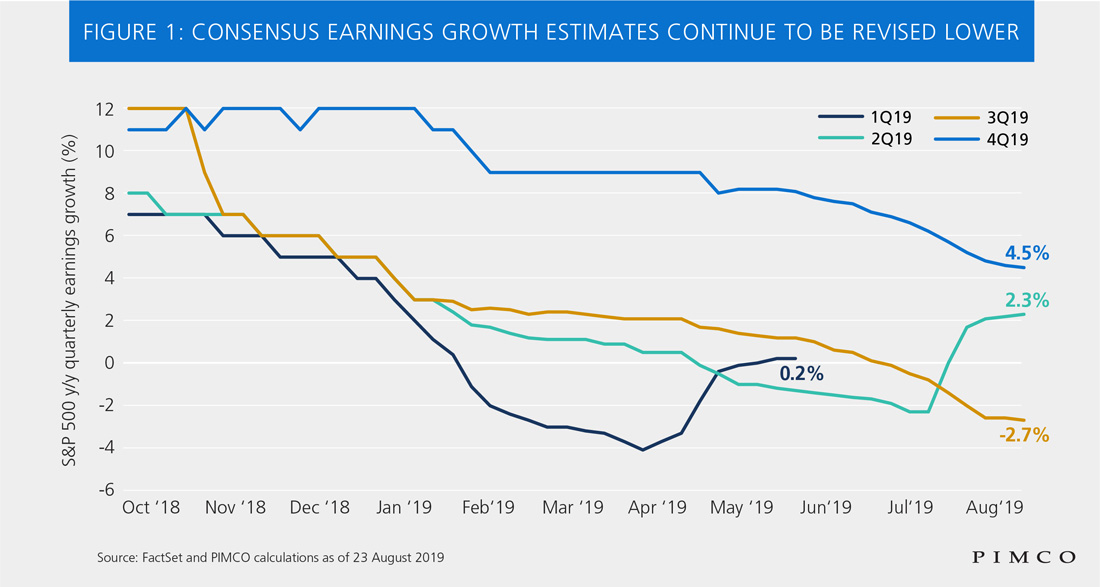
With most S&P 500 companies having now reported second-quarter earnings, the season looks better than feared but still far from good: Low-single-digit growth, downbeat guidance, and negative revisions are weighing on sentiment in a market where valuations remain elevated. Last year’s 20% pace of earnings growth is set to slow to 3% in 2019, depressing CEO confidence readings and corporate animal spirits. This negativity could threaten business capital spending and the labor market, and has spurred downward earnings revisions for subsequent quarters (see Figure 1).
What does the lackluster earnings season mean for investing in risk assets? While slowing growth is a broad headwind for both corporate debt and equities, it also tends to increase performance dispersion. This means investors may benefit from an active and flexible approach that seeks opportunities across the capital structure.
Some of the more indebted BBB companies, for instance, have successfully deleveraged and kept their credit profiles competitive, while others in more cyclical sectors or with weaker commitments to investment grade status are facing downgrades to high-yield territory. Moreover, the reaction to negative earnings surprises has been much more muted for corporate credit than for equities this season – an important reminder that despite some degree of correlation between the two markets, they can behave quite differently at times.
Idiosyncratic stories
Notwithstanding the negative earnings signals, corporate fundamentals are marginally improving from a credit perspective: Profit margins remain high, gross leverage is stable, and capital spending remains on target. The ratings trajectory for investment-grade credits has been positive to date this year, and we think the chance of large-scale downgrades of BBB companies to high yield is low absent a near-term recession, which is not our baseline given a backdrop of supportive global central banks (at least in the G20). However, we note idiosyncratic downgrade risks that warrant close monitoring, and we believe credit profiles will exhibit significant dispersion.
Looking at technical factors, the subdued supply of U.S. dollar-denominated corporate bonds as issuers diversify out of the dollar provides support; so do maturity extensions as issuers tender short-dated paper for longer-dated issuance. The record-high amount of negative-yielding sovereign debt provides a further technical tailwind, especially for high-quality U.S. issuers with improving fundamentals.
That said, less-attractive overall valuations counterbalance the positive fundamental and technical factors and suggest that volatility will persist.
Investor takeaways
Against this backdrop, investing actively in risk assets and flexibly tapping opportunities across the capital structure may be appealing to investors, especially those who have experienced choppy returns in passive credit strategies. Given expectations for weak economic growth, we favor a modest underweight to equity and a focus on high quality and defensive growth while avoiding high-beta, low-quality cyclical growth stocks. We believe active investors can continue to seek a defensive selection of corporate credits, focusing on companies in industries with high barriers to entry and management that is committed to maintaining strong ratings and meeting the needs of debtholders.

Lillian Lin is a portfolio manager focused on investment grade credit, and Bill Smith is a portfolio manager focused on global equities. Both are contributors to the PIMCO Blog.
DISCLOSURES
Past performance is not a guarantee or a reliable indicator of future results. All investments contain risk and may lose value. Investing in the bond market is subject to risks, including market, interest rate, issuer, credit, inflation risk, and liquidity risk. The value of most bonds and bond strategies are impacted by changes in interest rates. Bonds and bond strategies with longer durations tend to be more sensitive and volatile than those with shorter durations; bond prices generally fall as interest rates rise, and low interest rate environments increase this risk. Reductions in bond counterparty capacity may contribute to decreased market liquidity and increased price volatility. Bond investments may be worth more or less than the original cost when redeemed. Equities may decline in value due to both real and perceived general market, economic and industry conditions. There is no guarantee that these investment strategies will work under all market conditions or are suitable for all investors and each investor should evaluate their ability to invest long-term, especially during periods of downturn in the market. Investors should consult their investment professional prior to making an investment decision.
© PIMCO
© PIMCO
Read more commentaries by PIMCO