SUMMARY
- Major fundamental changes in the leveraged finance markets have resulted in improved credit quality in high yield bonds and greater dispersion in credit quality in bank loans.
- The changes have important implications for investors, especially as we enter a period of slower growth that presents its own challenges in terms of avoiding potential pitfalls.
- While active management will become even more important given these shifts, it is also critical that individual credit managers have a thorough understanding of both asset classes since relative value opportunities between the two can be a meaningful source of alpha and total return.
Major fundamental changes in the leveraged finance markets since the financial crisis have resulted in improved credit quality in high yield bonds and greater dispersion in credit quality in bank loans. For investors today, this is a crucial development: In the later stages of the business cycle, it’s more important than ever to distinguish between improving credits and weaker credits that are likely to underperform in an economic downturn.
We think these shifts in the leveraged finance markets underscore the importance of active management in seeking attractive credits with improving prospects and potentially avoiding pitfalls. It is also critical that credit portfolio managers have a thorough understanding of both asset classes since relative value opportunities between the two can be an important source of both alpha and total return.
The changing composition of leveraged finance markets
Historically, the bank loan market was much smaller than the high yield market but looked much like it in terms of industries represented − automotive, media, telecom and energy − although higher-risk issuers, such as highly levered LBOs (leveraged buyouts) and those in sectors undergoing secular challenges (such as newspapers and yellow pages) gravitated toward high yield.

Recently, however, the re-emergence of collateralized loan obligations (CLOs) as the main buyer of bank loans starting in 2012 has acted as a catalyst for renewed growth in syndicated loans, and in 2018, the notional amount of loans outstanding surpassed $1 trillion (see Figure 1). CLOs now hold almost two-thirds of the market (according to S&P LCD, as of 30 September 2018), and demand from loan mutual funds has also increased thanks to strong fund inflows in response to rising interest rates.
By contrast, the high yield market in the U.S. has been shrinking modestly since 2014. The majority of high yield issuance has centered around refinancing as many new issuers, LBOs in particular, have been issuing in the loan market in response to stronger demand and the prepayment optionality it offers them.
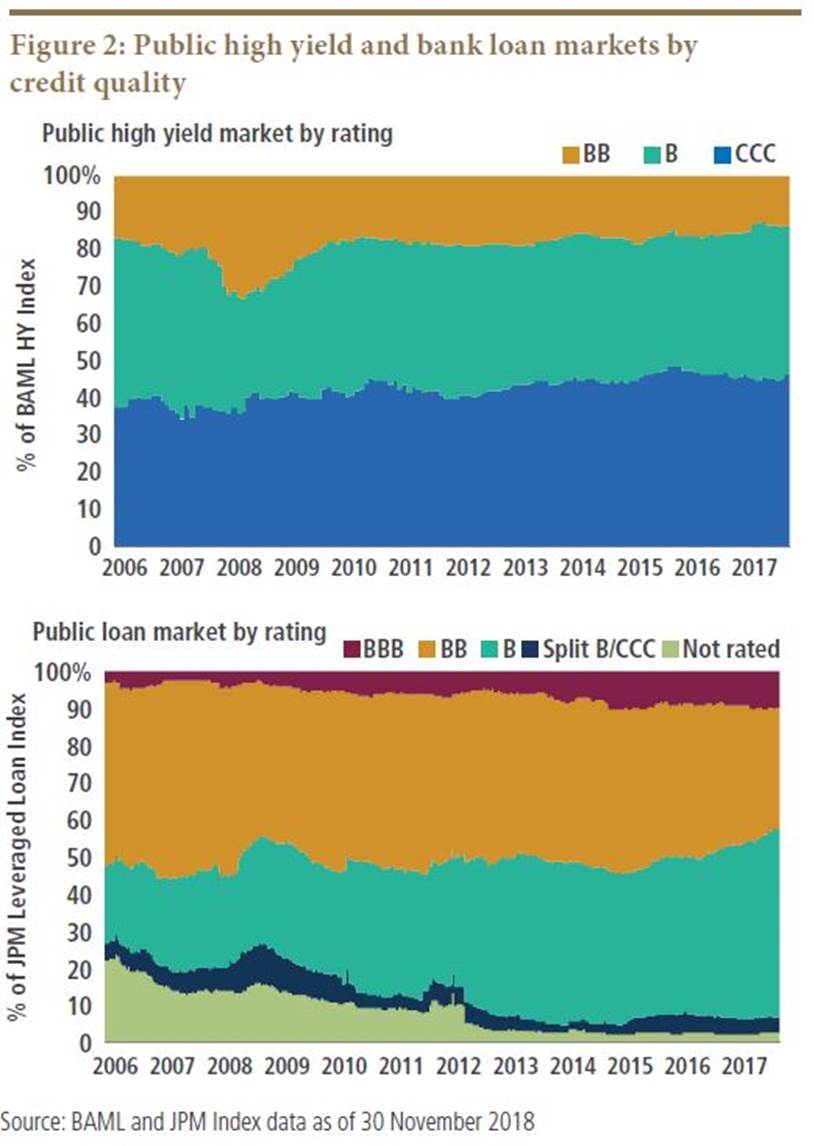
As a result of these shifts, the two markets look very different today compared with the pre-financial-crisis period. Notably, high yield has seen growth in BB rated debt (referring to the debt itself, not the corporate or issuer rating) and a reduction in the amount of CCC rated debt, while the loan market has experienced an increase in B rated debt and a decline in BB rated debt (see Figure 2).
Beyond the increase in B rated loans, a number of other changes in the markets have also eroded overall credit quality in bank loans. The most important of these has been the increase in “covenant-lite” loans and “loan-only” issuers (to 80% and 70% of the market respectively, from about 20% and 59% in 2008, according to data from JPMorgan). With the former eroding investor protections and the latter diminishing subordination – a layer of high yield bonds designed to absorb first losses and serve as credit protection for loan investors ‒ Moody’s forecasts a decline in first-lien loan recoveries from over 70% historically to 60% in the future.
Why the composition and investor base matter
As the proportion of lower-rated issuers in the loan market increases, we think investors should take notice. Single-B rated companies tend to have weaker business profiles, more tenuous competitive positioning or insufficient diversification compared with BB rated companies. Moreover, according to Moody’s, these companies also tend to be smaller and have more leverage than their higher-rated peers.
We see three additional risks associated with loans from B rated issuers in particular:
- The single-B segment of the loan market has a high concentration of “loan-only” issues, based on data from JP Morgan. Recovery values on loans without high yield bond subordination have historically been lower than for those with high yield bonds beneath them.
- Issuance of highly leveraged loans resulting from M&A (merger-and-acquisition) and LBO activity has increased to post-financial-crisis highs in 2018, according to BofA Merrill Lynch, and these likely represent more risk than loans issued for general corporate purposes or refinancing.
- Single-B loans constitute almost half of the total leveraged loan market and are dominated by the technology, services, and healthcare industries, BAML data show. Both technology and services issuers typically lack hard assets and, in the event of default, they have the potential for lower recovery values as a result.
In addition, an incremental technical risk is likely to arise if a significant number of single-B loans are downgraded to CCC when the credit cycle turns. CLOs have been the primary buyers of single-B loans; estimates from Citi Research, LPC, and Moody’s suggest approximately 70% of CLO holdings consist of single-B loans. Rating agencies typically require that when CCC holdings exceed 7.5% of assets, CLOs must begin marking those loans to market rather than at face value, potentially activating an automatic deleveraging mechanism. With the average CLO already holding 4% in loans rated CCC or lower, the implications are clear: Downgrades of loans to single-B-minus or lower may result in sales of those loans, which could exacerbate declining prices. Currently, issuers rated below single-B with a negative outlook (known as the “weakest links”) are at their highest level since the inception of this metric in 2013 (source: S&P LCD).
Yet despite these concerns, the first-lien senior-secured status of bank loans should continue to ensure that recoveries will, on average, remain higher than in the high yield bond market, where much of the debt is unsecured and structural protections in bond documentation have also been weakening. Additionally, bank loans secured with strong assets and supported with bond subordination still offer potentially attractive risk-adjusted returns combined with low duration.
Opportunities for active management
For investors, the impact of the changes in the leveraged finance markets is twofold. First, historical comparisons of valuations in and between the high yield and bank loan markets should take these changes into account. Second, managing credit exposure within these markets has become more important.
Many single-B issuers, especially those with weaker business profiles, high leverage, and loan-only capital structures, could face challenges in servicing or refinancing their debt when the economy slows and contracts. Moreover, price declines for downgraded loans could be exacerbated by potential forced selling by CLOs to meet the rating agencies’ collateral quality requirements.
Given this range of risk among leveraged finance credits, robust fundamental credit analysis is crucial to select borrowers with the business flexibility and access to future capital to withstand economically volatile periods. Accordingly, we favor issuers in industries with stable or improving secular trends, strong competitive positioning, strong asset coverage, and loan-and-bond capital structures.
In both markets, active managers with a deep bench of research analysts can conduct the fundamental credit research to identify and understand the risks. Choosing the investments that not only offer attractive return potential but also potentially avoid the risks in today’s leveraged finance market requires expertise in both high yield and bank loan markets, which, despite their differences, are still inextricably intertwined.
DISCLOSURES
Statements concerning financial market trends or portfolio strategies are based on current market conditions, which will fluctuate. There is no guarantee that these investment strategies will work under all market conditions or are suitable for all investors and each investor should evaluate their ability to invest for the long term, especially during periods of downturn in the market. Outlook and strategies are subject to change without notice.
Investing in the bond market is subject to risks, including market, interest rate, issuer, credit, inflation risk, and liquidity risk. The value of most bonds and bond strategies are impacted by changes in interest rates. Bonds and bond strategies with longer durations tend to be more sensitive and volatile than those with shorter durations; bond prices generally fall as interest rates rise, and the current low interest rate environment increases this risk. Current reductions in bond counterparty capacity may contribute to decreased market liquidity and increased price volatility. Bond investments may be worth more or less than the original cost when redeemed. Derivatives may involve certain costs and risks, such as liquidity, interest rate, market, credit, management and the risk that a position could not be closed when most advantageous. Investing in derivatives could lose more than the amount invested. High yield, lower-rated securities involve greater risk than higher-rated securities; portfolios that invest in them may be subject to greater levels of credit and liquidity risk than portfolios that do not. Bank loans are often less liquid than other types of debt instruments and general market and financial conditions may affect the prepayment of bank loans, as such the prepayments cannot be predicted with accuracy. There is no assurance that the liquidation of any collateral from a secured bank loan would satisfy the borrower’s obligation, or that such collateral could be liquidated.
This material contains the opinions of the manager and such opinions are subject to change without notice. This material has been distributed for informational purposes only and should not be considered as investment advice or a recommendation of any particular security, strategy or investment product. Information contained herein has been obtained from sources believed to be reliable, but not guaranteed. No part of this material may be reproduced in any form, or referred to in any other publication, without express written permission. PIMCO is a trademark of Allianz Asset Management of America L.P. in the United States and throughout the world.
©2018, PIMCO.
© PIMCO
Read more commentaries by PIMCO