All Asset All Access, December 2018
Membership required
Membership is now required to use this feature. To learn more:
View Membership BenefitsSUMMARY
- The immediate short-term market reaction to the midterm elections (soaring U.S. stocks and a sharp drop in volatility expectations) was not especially surprising, but the longer-term dynamics between policy regulation, capital markets and economic growth tend to be less appreciated.
- Stocks and bonds of existing companies may look more attractive when investors are uneasy about the regulatory and tax regime and shy about deploying capital into risky long-horizon ventures; conversely, investors are likely to pull money out of these assets to fund their preferred new initiatives when deregulation and falling taxes are expected.
- All Asset’s “home base” is in many ways an inversion of traditional positioning: The majority of allocations are to diversifying and inflation-related strategies (including real assets, emerging markets and high yield bonds), with satellite positions in developed market stocks and bonds.
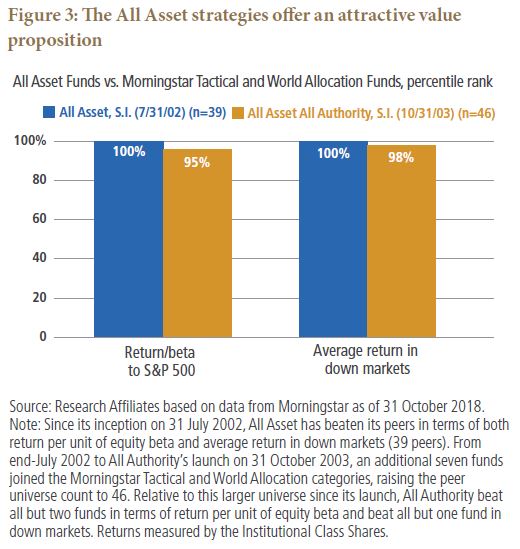
- In Research Affiliates’ view, in addition to a more diversified risk profile, the All Asset funds offer a distinct value proposition for returns, as measured by returns per unit of beta and the average return in down markets.
Rob Arnott, founding chairman and head of Research Affiliates, discusses how a split Congress following the U.S. midterm elections could affect markets, while Brandon Kunz, senior vice president of multi-asset strategies, discusses the All Asset strategies’ “home base” positioning relative to that of its peers. As always, their insights are in the context of the PIMCO All Asset and All Asset All Authority funds.
Q: What are your thoughts on the market impact of the U.S. midterm election outcomes?
Arnott: Investors tend to focus more on downside risk than on upside opportunity, which is one of the main reasons that markets hate uncertainty. As history has shown us repeatedly, markets generally benefit when uncertainty eases. Elections are date-certain events that generally lift uncertainty.1 So even when elections are particularly contentious, the initial effect – no matter the political outcome – is generally a quick boost to markets. Then the markets begin sorting out the longer-term implications.
The recent experience was no different. In the early days following the midterm elections, U.S. stocks soared and volatility expectations fell: Notably, the S&P 500’s 2.1% surge on the day after the midterm election was the highest day-after-midterm gain since 1982, and the VIX Index dropped to its lowest level in weeks, from 25.2 on 24 October to 16.4 on 7 November. These recent short-term market outcomes are not especially surprising.
What tend to be less appreciated and not as well understood are the longer-term dynamics between policy regulation, capital markets and economic growth. The “left” may say that markets do better when they’re in charge. The “right” may say the economy responds to deregulation with lasting growth. We believe that to a modest extent, they’re both correct, though the differences are less stark than either side would like to admit.
While the impact of a divided Congress on regulation and fiscal stimulus remains to be seen, most investors may not realize that heightened regulation and a generally suspicious view of capitalism can simultaneously hurt the economy and boost the stock market. Why did French stocks fare surprisingly well under socialist presidents Francois Mitterrand and Francois Hollande? If investors are uneasy about an uncertain regulatory and tax regime, and are shy about entrepreneurialism or deployment of capital into risky long-horizon ventures, then the stocks and bonds of existing companies become the only game in town.
Conversely, in a regime in which deregulation and falling taxes are expected, investors are likely to pull money out of the stocks and bonds of existing businesses to fund their preferred new initiatives. A vibrant bout of entrepreneurial capitalism usually offers greater incentives, in the form of higher return expectations, which tends to curtail investment in existing enterprises. We believe this is one of the most powerful – and least understood – dynamics in the capital markets.
Q: What differentiates the All Asset strategies from other tactical asset allocation strategies?
Kunz: We believe the biggest difference between the All Asset strategies and their peers in Morningstar’s Tactical Allocation2category, as well as strategies in the World Allocation3 category, is in the “home base” positioning around which exposures are tactically managed. The typical fund in these categories is anchored on what many investors view as the traditional allocation approach, with a focus on mainstream, developed market stocks and bonds. This can result in higher average correlations with U.S. equities and therefore the potential for relative underperformance amid equity market weakness or renewed inflation. Investors who use these asset allocation funds in hopes of increasing portfolio diversification may find the results disappointing, as many of these funds may have the same attributes (and vulnerabilities) exhibited by their own mainstream stock/bond-centric policy portfolios.
Morningstar’s benchmark for both the Tactical Allocation and World Allocation categories reinforces the lack of diversification among constituent funds: The “Morningstar Moderate Target Risk TR USD Index” is basically a conventional 60% stock/40% bond mix, featuring only minimal levels of global or asset class diversification.4 By contrast, we believe the All Asset funds are highly differentiated within these Morningstar allocation categories. Most notably, the All Asset funds’ “home base” positioning is considerably different, which contributes to what we believe to be their distinctive value proposition to investors.
Specifically, the All Asset strategies seek to deliver attractive long-term real return potential while simultaneously diversifying investors away from key attributes of conventional 60/40-style portfolios: high levels of equity risk and vulnerability to inflation. In seeking these differentiated outcomes, we anchor the All Asset funds to a “home base” allocation that could be described as an inversion of Morningstar’s category benchmark. As Figure 1 illustrates, rather than allocating the majority of the portfolio to developed market stocks and bonds while holding only satellite positions in diversifying and inflation-related strategies, the All Asset funds do the opposite – we allocate the majority of our portfolios to diversifying and inflation-related strategies (i.e., the “Third Pillar” markets, including real assets, emerging markets and high yield bonds) while generally holding only satellite positions in developed market stocks and bonds.
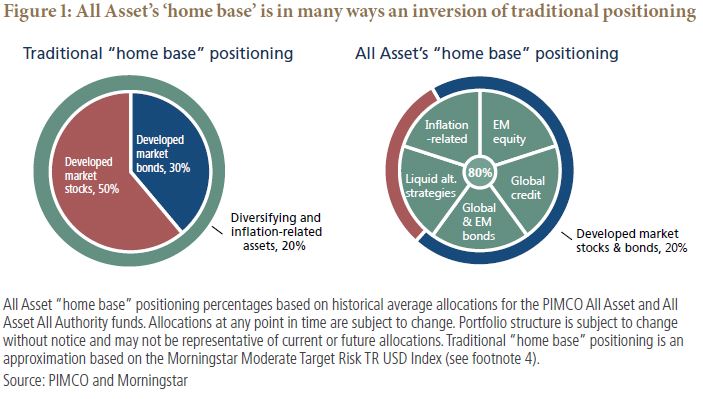
This approach should lead to a highly differentiated portfolio – from both a risk and return standpoint – relative to the typical Tactical Allocation and World Allocation peer.
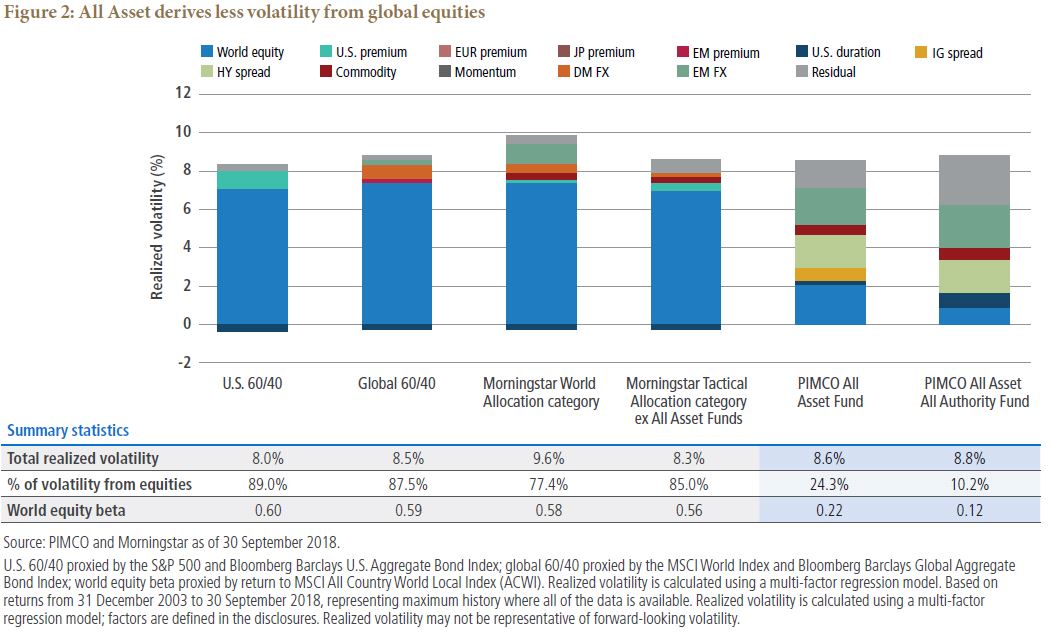
Figure 2 vividly highlights this contrast in risk composition. While each category has displayed similar levels of total volatility (the height of each column), the composition of that volatility is very different. The average fund in the World Allocation and Tactical Allocation categories gets most of its risk from equities – 81% on average – and most of that is from world (developed) equity exposure (the bright blue color). That’s a risk profile strikingly similar to that of a conventional U.S. or global 60/40 index mix.
In contrast, the All Asset and All Asset All Authority funds derive only 24.3% and 10.2% of their total volatility from equity risk, respectively. Instead, risk is more broadly allocated across diversifying risk factors and is further complemented by the potential for active management alpha on the underlying PIMCO funds (shown here as the “residual” category, in gray). So for those investors looking to reduce their reliance on mainstream equity risk as a driver of returns, the All Asset funds may be a compelling option.
In addition to a more diversified risk profile, we believe the All Asset funds also offer a distinct value proposition from the return vantage point. We believe the following key metrics best highlight the All Asset suite’s value as a diversifying return driver:
- Returns per unit of beta: How well does the fund deliver relative to its average (i.e., “home base”) level of U.S. equity exposure, as compared to category peers? This is a measure of both return efficiency and diversification potency.
- Average return in down markets: How well does the fund do in months when the S&P 500 is down, compared to category peers? This is a measure of both diversification from equities and downside protection.
As indicated in Figure 3 below, the All Asset and All Asset All Authority funds have delivered attractive results by each of these measures. Since their inception, the funds’ respective net-of-fee returns per unit of beta to the S&P 500 are in the highest and the 95th percentiles relative to funds in Morningstar’s World and Tactical Allocation categories. Furthermore, over the same span, their average returns in down months for the S&P 500 are in the highest and the 98th percentiles, respectively, relative to those same funds. Given these metrics, we believe their relative value proposition becomes increasingly clear.
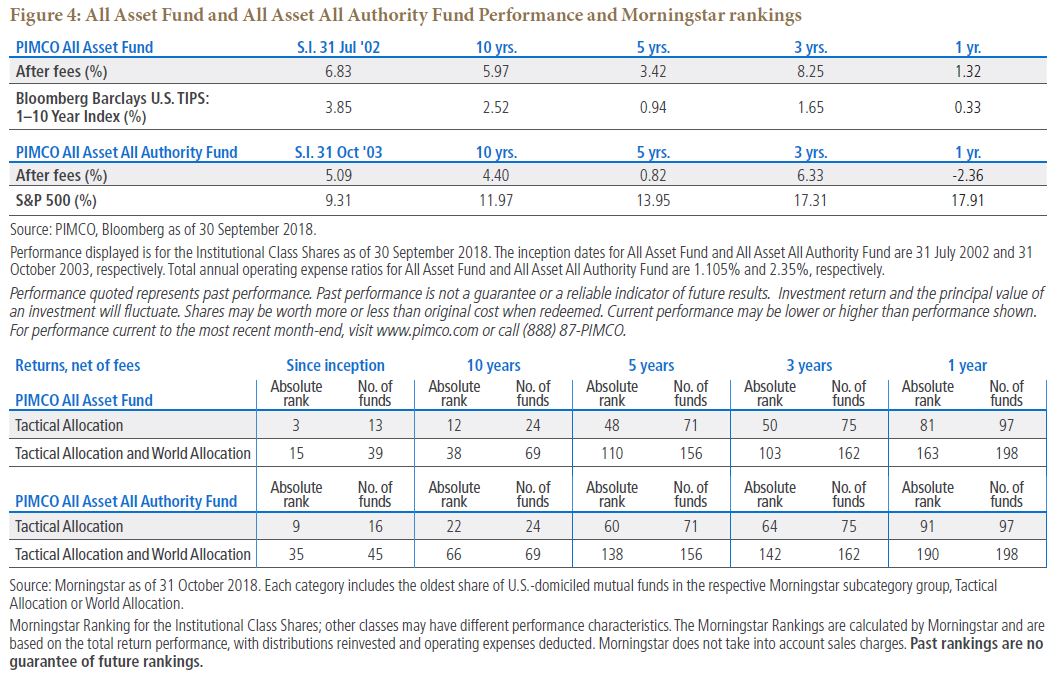
Bottom line? In addition to having provided a compelling value proposition for investors seeking diversifying attributes, we believe the All Asset funds have exhibited attractive results relative to their category peers since their inception over 15 years ago. At this point in the cycle, we believe the All Asset funds are poised to continue to offer a strong value proposition. This is driven by three key factors: 1) “home base” Third Pillar markets that our long-term capital market forecasts suggest are primed for strong five- to seven-year returns; 2) the potential to add additional value through tactical asset allocation; and 3) the potential to add alpha from the underlying PIMCO funds. In combination, we believe this has the potential to result in attractive outcomes for All Asset and All Asset All Authority, both in absolute terms and relative to fully valued U.S. stocks and bonds.
The All Asset strategies represent a joint effort between PIMCO and Research Affiliates. PIMCO provides the broad range of underlying strategies – spanning global stocks, global bonds, commodities, real estate and liquid alternative strategies – each actively managed to maximize potential alpha. Research Affiliates, an investment advisory firm founded in 2002 by Rob Arnott and a global leader in asset allocation, serves as the sub-advisor responsible for the asset allocation decisions. Research Affiliates uses their deep research focus to develop a series of value-oriented, contrarian models that determine the appropriate mix of underlying PIMCO strategies in seeking All Asset’s return and risk goals.
1 One exception is the 2000 election, a date-not-so-certain event where the outcome was unknown until the Supreme Court intervened.
2 Morningstar’s category definition for the Tactical Allocation category is as follows: Tactical Allocation portfolios seek to provide capital appreciation and income by actively shifting allocations across investments. These portfolios have material shifts across equity regions, and bond sectors on a frequent basis. To qualify for the tactical allocation category, the fund must have minimum exposures of 10% in bonds and 20% in equity. Next the fund must historically demonstrate material shifts in sector or regional allocations either through a gradual shift over three years or through a series of materials shifts on a quarterly basis. With a three-year period, typically the average quarterly changes between equity regions and bond sectors exceeds 15% or the difference between the maximum and minimum exposure to a single equity region or bond sector exceeds 50%.
3 We include the World Allocation category in the All Asset funds’ peer group because these strategies also invest in a broad array of the world’s asset classes and can add value through tactically changing their asset mix. Morningstar’s category definition for the World Allocation category is as follows: World-allocation portfolios seek to provide both capital appreciation and income by investing in three major areas: stocks, bonds, and cash. While these portfolios do explore the whole world, most of them focus on the U.S., Canada, Japan, and the larger markets in Europe. It is rare for such portfolios to invest more than 10% of their assets in emerging markets. These portfolios typically have at least 10% of assets in bonds, less than 70% of asset in stocks, and at least 40% of assets in non-U.S. stocks or bonds.
4 Source: Morningstar. The Morningstar Moderate Target Risk TR USD Index comprises 60% stocks (37% U.S., 16% developed non-U.S., 7% emerging markets), and 37% bonds (33% U.S., 0% developed non-U.S., 4% emerging markets), 2% inflation hedge (TIPS) and 1% cash. (Developed market stocks (ex REITs): 51%; developed market bonds: 33%; diversifying and inflation-related assets (REITs, TIPS, commodities, EM stocks): 16%.)
DISCLOSURES
Figure 2 Factor Definitions
World equity (beta): Beta to world equity market returns. Long exposure: Return to MSCI All Country World Local Index (ACWI). Description: For a 1.0 World Equity Beta, each 1% increase in the MSCI ACWI Index will lead to a 1% increase in portfolio return.
U.S. premium (beta): Beta to U.S. equity market returns net of world equity market returns. Long exposure: Return to MSCI USA Index. Short exposure: Return to MSCI All Country World Local Index (ACWI). Description: For a 1.0 U.S. Equity Beta, a 1% increase in the MSCI USA Index over the MSCI ACWI Index will lead to a 1% increase in portfolio return.
EUR premium (beta): Beta to European equity market returns net of world equity market returns. Long exposure: Return to MSCI Europe Local Index. Short exposure: Return to MSCI All Country World Local Index (ACWI). Description: For a 1.0 EU Equity Beta, a 1% increase in the MSCI Europe Local Index over the MSCI ACWI Index will lead to a 1% increase in portfolio return.
JP premium (beta): Beta to Japanese equity market returns net of world equity market returns. Long exposure: Return to MSCI Japan Local Index. Short exposure: Return to MSCI All Country World Local Index (ACWI). Description: For a 1.0 JP Equity Beta, a 1% increase in the MSCI Japan Local Index over the MSCI ACWI Index will lead to a 1% increase in portfolio return.
EM premium (beta): Beta to EM equity market returns net of world equity market returns. Long exposure: Return to MSCI EM Local Index. Short exposure: Return to MSCI All Country World Local Index (ACWI). Description: For a 1.0 EM Equity Beta, a 1% increase in the MSCI EM Index over the MSCI ACWI Index will lead to a 1% increase in portfolio return.
U.S. duration (years): Duration to U.S. nominal interest rates. Long exposure: Change in 10Y U.S. Nominal yield. Description: For each year of duration, a 1% instantaneous increase in nominal yields will lead to a 1% instantaneous decline in portfolio return.
IG spread (years): Duration to investment grade credit spread. Long exposure: Change in Barclays Global Aggregate Corporate Avg. OAS. Description: For each year of IG credit spread duration, a 1% instantaneous increase in IG credit spreads will lead to a 1% instantaneous decline in portfolio return.
HY spread (years): Duration to high yield credit spreads. Long exposure: Change in Barclays Global Corporate High Yield Avg. OAS. Description: For each year of HY credit spread duration, a 1% instantaneous increase in HY credit spreads will lead to a 1% instantaneous decline in the portfolio.
Commodity (beta): Beta to commodity returns. Long exposure: Return to Bloomberg Commodity Index. Description: For a 1.0 Commodity Beta, a 1% increase in the Bloomberg Commodity Index will lead to a 1% increase in portfolio return.
Momentum (beta): Beta to a multi-asset trend-following (momentum) strategy. Long exposure: Return to S&P Diversified Trends Indicator. Description: For a 1.0 Trend Following Beta, a 1% increase in the S&P Diversified Trends Indicator Index will lead to a 1% increase in portfolio return.
DM FX (beta): Beta to developed market currencies. Long exposure: Inverse return of the DXY Index. Description: For a 1.0 DM FX beta, a 1% increase in DM FX will lead to a 1% increase in portfolio return.
EM FX (beta): Beta to emerging market currencies. Long exposure: Return to JP Morgan ELMI+ Index. Description: For a 1.0 EM FX beta, a 1% increase in EM FX will lead to a 1% increase in portfolio return.
Investors should consider the investment objectives, risks, charges and expenses of the funds carefully before investing. This and other information are contained in the fund’s prospectus and summary prospectus, if available, which may be obtained by contacting your investment professional or PIMCO representative or by visiting www.pimco.com. Please read them carefully before you invest or send money.
Past performance is not a guarantee or a reliable indicator of future results. The performance figures presented reflect the total return performance for the Institutional Class shares (after fees) and reflect changes in share price and reinvestment of dividend and capital gain distributions. All periods longer than one year are annualized. The minimum initial investment for Institutional class shares is $1 million; however, it may be modified for certain financial intermediaries who submit trades on behalf of eligible investors.
Investments made by a Fund and the results achieved by a Fund are not expected to be the same as those made by any other PIMCO-advised Fund, including those with a similar name, investment objective or policies. A new or smaller Fund’s performance may not represent how the Fund is expected to or may perform in the long-term. New Funds have limited operating histories for investors to evaluate and new and smaller Funds may not attract sufficient assets to achieve investment and trading efficiencies. A Fund may be forced to sell a comparatively large portion of its portfolio to meet significant shareholder redemptions for cash, or hold a comparatively large portion of its portfolio in cash due to significant share purchases for cash, in each case when the Fund otherwise would not seek to do so, which may adversely affect performance.
Differences in the Fund’s performance versus the index and related attribution information with respect to particular categories of securities or individual positions may be attributable, in part, to differences in the pricing methodologies used by the Fund and the index.
There is no assurance that any fund, including any fund that has experienced high or unusual performance for one or more periods, will experience similar levels of performance in the future. High performance is defined as a significant increase in either 1) a fund’s total return in excess of that of the fund’s benchmark between reporting periods or 2) a fund’s total return in excess of the fund’s historical returns between reporting periods. Unusual performance is defined as a significant change in a fund’s performance as compared to one or more previous reporting periods.
A word about risk:
The fund invests in other PIMCO funds and performance is subject to underlying investment weightings which will vary. Investing in the bond market is subject to risks, including market, interest rate, issuer, credit, inflation risk, and liquidity risk. The value of most bonds and bond strategies are impacted by changes in interest rates. Bonds and bond strategies with longer durations tend to be more sensitive and volatile than those with shorter durations; bond prices generally fall as interest rates rise, and the current low interest rate environment increases this risk. Current reductions in bond counterparty capacity may contribute to decreased market liquidity and increased price volatility. Bond investments may be worth more or less than the original cost when redeemed. Investing in foreign denominated and/or domiciled securities may involve heightened risk due to currency fluctuations, and economic and political risks, which may be enhanced in emerging markets. Commodities contain heightened risk including market, political, regulatory, and natural conditions, and may not be suitable for all investors. Mortgage and asset-backed securities may be sensitive to changes in interest rates, subject to early repayment risk, and their value may fluctuate in response to the market’s perception of issuer creditworthiness; while generally supported by some form of government or private guarantee there is no assurance that private guarantors will meet their obligations. High-yield, lower-rated, securities involve greater risk than higher-rated securities; portfolios that invest in them may be subject to greater levels of credit and liquidity risk than portfolios that do not. Investing in securities of smaller companies tends to be more volatile and less liquid than securities of larger companies. Inflation-linked bonds (ILBs) issued by a government are fixed-income securities whose principal value is periodically adjusted according to the rate of inflation; ILBs decline in value when real interest rates rise. Equities may decline in value due to both real and perceived general market, economic, and industry conditions. Entering into short sales includes the potential for loss of more money than the actual cost of the investment, and the risk that the third party to the short sale may fail to honor its contract terms, causing a loss to the portfolio. The use of leverage may cause a portfolio to liquidate positions when it may not be advantageous to do so to satisfy its obligations or to meet segregation requirements. Leverage, including borrowing, may cause a portfolio to be more volatile than if the portfolio had not been leveraged. Derivatives and commodity-linked derivatives may involve certain costs and risks such as liquidity, interest rate, market, credit, management and the risk that a position could not be closed when most advantageous. Commodity-linked derivative instruments may involve additional costs and risks such as changes in commodity index volatility or factors affecting a particular industry or commodity, such as drought, floods, weather, livestock disease, embargoes, tariffs and international economic, political and regulatory developments. Investing in derivatives could lose more than the amount invested. The cost of investing in the Fund will generally be higher than the cost of investing in a fund that invests directly in individual stocks and bonds. Diversification does not ensure against loss.
There is no guarantee that these investment strategies will work under all market conditions or are suitable for all investors and each investor should evaluate their ability to invest long-term, especially during periods of downturn in the market. Investors should consult their investment professional prior to making an investment decision.
The Bloomberg Barclays Global Aggregate Index provides a broad-based measure of the global investment-grade fixed income markets. The three major components of this index are the U.S. Aggregate, the Pan-European Aggregate, and the Asian-Pacific Aggregate Indices. The index also includes Eurodollar and Euro-Yen corporate bonds, Canadian Government securities, and USD investment grade 144A securities. Bloomberg Barclays U.S. Aggregate Index represents securities that are SEC-registered, taxable, and dollar denominated. The index covers the U.S. investment grade fixed rate bond market, with index components for government and corporate securities, mortgage pass-through securities, and asset-backed securities. These major sectors are subdivided into more specific indices that are calculated and reported on a regular basis. Bloomberg Barclays U.S. TIPS: 1-10 Year Index is an unmanaged market index comprised of U.S. Treasury Inflation-Protected Securities having a maturity of at least 1 year and less than 10 years. The MSCI World Index is a free float-adjusted market capitalization weighted index that is designed to measure the equity market performance of developed markets. The MSCI World Index consists of the following 24 developed market country indices: Australia, Austria, Belgium, Canada, Denmark, Finland, France, Germany, Greece, Hong Kong, Ireland, Israel, Italy, Japan, Netherlands, New Zealand, Norway, Portugal, Singapore, Spain, Sweden, Switzerland, the United Kingdom, and the United States. The S&P 500 Index is an unmanaged market index generally considered representative of the stock market as a whole. The index focuses on the Large-Cap segment of the U.S. equities market. It is not possible to invest directly in an unmanaged index.
This material contains the opinions of the manager and such opinions are subject to change without notice. This material has been distributed for informational purposes only and should not be considered as investment advice or a recommendation of any particular security, strategy or investment product. Information contained herein has been obtained from sources believed to be reliable, but not guaranteed. No part of this material may be reproduced in any form, or referred to in any other publication, without express written permission. PIMCO is a trademark of Allianz Asset Management of America L.P. in the United States and throughout the world.
PIMCO Investments LLC, distributor, 1633 Broadway, New York, NY, 10019 is a company of PIMCO.
Investment Products
Not FDIC Insured | May Lose Value | Not Bank Guaranteed
CMR2018-1121-366692
© PIMCO
Membership required
Membership is now required to use this feature. To learn more:
View Membership BenefitsSponsored Content
Upcoming Virtual Events View All












