Many investment portfolios that rely heavily on stock-bond diversification to manage risks may not be protected against inflation surprises. Real assets offer a solution.
Inflation in the U.S. has accelerated from near zero in 2015 to 2.5% in 2018 (according to the Consumer Price Index or CPI), propelled by trade tensions, strong consumer spending, the tight labor market, and a boost in growth from tax reform and other fiscal stimulus. After so many years of low inflation, the rise in 2018 points to the possibility of an inflation surprise.
Such a surprise could be damaging because many investors may be too reliant on diversification achieved by investing in a portfolio of stocks and bonds, which is predicated on the historical negative correlation between the two asset classes. However, this diversification may not work as well going forward because correlation between stocks and bonds tends to rise when inflation is elevated. Therefore, we suggest investors consider real assets (inflation fighters) to make portfolio diversification more robust and hedge against the risk of higher inflation.
Will stocks and bonds deliver the same diversification at higher inflation rates?
The correlation between U.S. stocks and bonds has been low or negative when inflation has been low to moderate. Over the past couple of decades of low inflation, portfolios that were diversified across nominal bonds and stocks therefore tended to fare well on a risk-adjusted basis. It is this positive experience that is shaping most investors’ approach to inflation today.
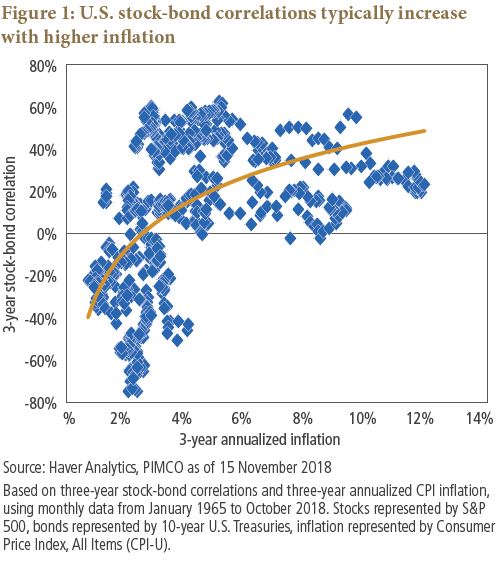
However, this might not be the best way to address inflation risk going forward: Stock-bond correlations tend to increase when inflation is either high or rising, as shown in Figure 1. This could be a big problem for investors worried about inflation because positive correlations essentially mean less effective portfolio diversification.

We believe inflation in the near future will be higher than in the recent past. U.S. CPI inflation has been above 2% for 12 consecutive months, and core personal consumption expenditures (PCE) is at the threshold of the Federal Reserve’s target of 2%. Since inflation is a lagging economic indicator, one may reasonably expect inflation to remain elevated in the next few quarters, reflecting the current acceleration in U.S. economic growth. PIMCO’s latest Cyclical Outlook forecasts U.S. inflation in the 2.0%–2.5% range in 2019. Furthermore, the possibility for inflation surprises has increased as the Federal Reserve, along with other major central banks, appears more comfortable with inflation running at or above the target, meaning that central banks are less likely to hit the brakes on growth even if inflation overshoots for some time.
Protecting portfolios from higher inflation and uncertain stock-bond correlations
PIMCO’s midyear asset allocation outlook, “Late-Cycle Investing,” notes that inflation is one of the four key investment themes at this stage of the business cycle. Yet, most investment portfolios may not be protected against inflation surprises (defined as the difference between realized inflation and inflation expectations from a year ago).
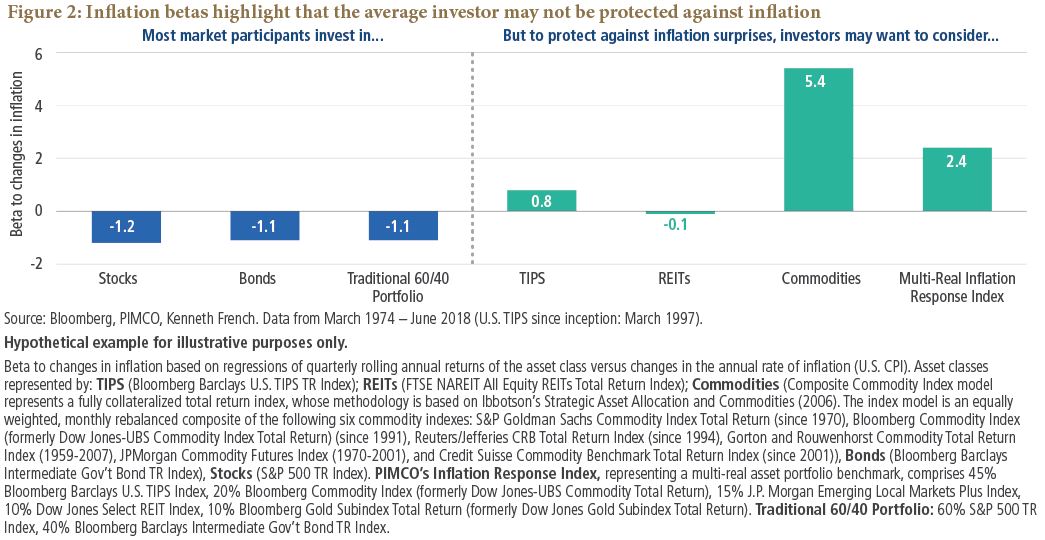
As Figure 2 shows, stocks, bonds and the traditional 60/40 stock/bond portfolio all have negative inflation betas such that when inflation surprises by 1%, the traditional 60/40 portfolio would lose 1.1%. Over the last several years, inflation has been surprising on the downside, and equities have been positively correlated with inflation surprises. Figure 2 shows how this recent trend hasn’t been the case over the long term. It is noteworthy that inflation surprises are not rare; in fact, we estimate that the probability for an upside inflation surprise today significantly exceeds the probability for a downside surprise, given recent new tariffs, continued trade tensions, late-cycle fiscal stimulus and robust consumer spending.
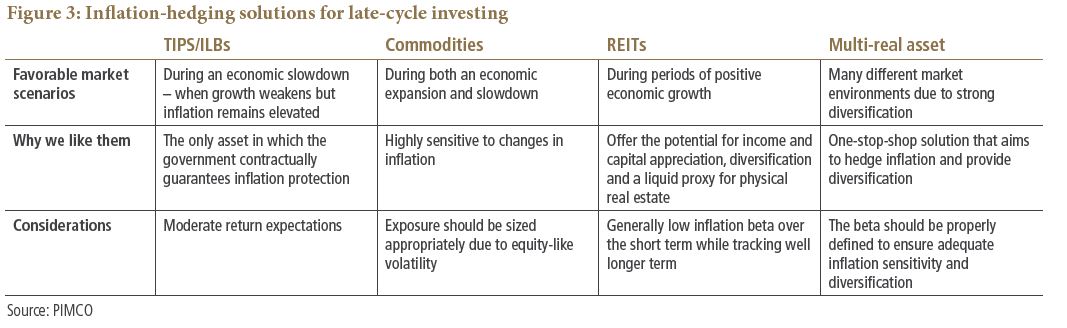
In today’s environment of elevated inflation, with risks skewed to the upside, we think investors should consider an allocation to the real assets shown on the right side of Figure 2: TIPS (U.S. Treasury Inflation-Protected Securities) or other sovereign inflation-linked bonds (ILBs), commodities, REITs (real estate investment trusts) and multi-real asset portfolios that have the potential to perform better during times of rising inflation. Figure 3 and the following sections delve further into these four potential inflation-hedging solutions.
TIPS/Inflation-linked bonds (ILBs)
These fixed income assets are generally expected to perform well when growth slows, and they are the only assets where inflation protection is contractually guaranteed: Their principal rises in line with inflation. We think two TIPS/ILB solutions merit special attention:
-
Levered TIPS/ILBs: One drawback of TIPS/ILBs, typical of the highest-quality or “safe-haven” assets, is that returns are typically moderate. However, they are attractive assets to lever (due to low financing costs and collateral haircuts, on par with U.S. Treasury bonds); a levered approach can magnify return potential, while increasing inflation hedging. Further, an allocation to levered shorter-duration TIPS has the potential to achieve these with only modest volatility or increased risk. Note that investing in the front end of the TIPS yield curve does not reduce the inflation-hedging because that comes from any adjustments in the principal, no matter the maturity; the inflation-hedging properties of five- and 10-year TIPS are the same.
-
TIPS/ILB overlays: An overlay of TIPS, ILBs or CPI swaps (instruments that transfer inflation risk from one party to another through an exchange of cash flows) can boost inflation protection, and using existing high quality, liquid portfolio assets as collateral means that only limited new cash/assets are required to fund the strategy. We find this to be a capital-efficient way to hedge inflation risk without having to choose between return potential and inflation protection.
Commodities
Commodities typically perform well in the late stages of an economic expansion. They are highly sensitive to changes in inflation, and in some cases, they are the source of inflation surprises. For example, food and energy prices represent 23% of the headline U.S. CPI basket but drive 88% of CPI volatility (as of 30 June 2018). Not surprisingly, commodities have an inflation beta of more than five. Additionally, we believe that commodities will perform well in the near term as the sector has historically peaked only after an expansion ends.
Sizing of commodity exposure is important since the asset class typically has high volatility. There are many types of commodities strategies; we seek those that deliver high roll yield and continuously evolve to provide the potential for diversified sources of risk premia (alpha) and better beta. Similar to TIPS, commodities are an excellent asset class to consider for overlays and increased capital efficiency.
REITs
Real estate investment trusts derive the majority of their revenues from rental income and distribute 90% of their taxable net income as dividends (according to the IRS). Over the short term, REIT prices are correlated to equities and have low inflation beta. Over the long term, however, REITs can be an effective liquid proxy for physical real estate and tend to track inflation more closely; real estate rents and values tend to increase with inflation, which eventually passes through to REIT dividends and valuations. Furthermore, REITs have a low correlation to TIPS and to commodities (0.24 to both, as measured by correlation of monthly index returns for REITs, TIPS and commodities 1 from March 1997 to June 2018), making them a potentially attractive addition to a balanced portfolio of real assets.
Multi-real asset solutions
A thoughtfully diversified mix of real assets can be a “one-stop-shop” solution for investors seeking a dynamic, responsive inflation-hedging allocation. The potential benefits of this approach are reduced volatility, higher return potential and meaningful positive inflation beta if the allocations perform as expected.
By investing in a mix of TIPS/ILBs, commodities, REITs, currencies and gold, investors can potentially increase diversification and benefit from multiple sources of alpha, derived by actively managing withineach inflation-fighting asset class and making tactical moves acrossasset classes.
Key takeaways: seek to reduce inflation risk without sacrificing return potential
Milton Friedman once said, “Inflation is the one form of taxation that can be imposed without legislation.”
We at PIMCO spend countless hours studying and forecasting inflation and designing solutions that aim to protect investment returns from inflation “taxation.” We view inflation not only as a challenge, but also as an opportunity to generate strong absolute returns and alpha.
If inflation surprises to the upside in the years ahead, stock-bond correlations may increase, which would likely upset the inflation hedge that today’s dominant portfolio construction frameworks have derived from diversification in recent years. Drawing on the breadth and depth of PIMCO’s investment expertise, we have pinpointed four forward-looking inflation solutions that invest in real assets. Investing in single real asset classes, such as TIPS, commodities and REITS, or a multi-real asset solution, could provide a measure of protection for investors by hedging against inflation surprises, while also enhancing diversification and boosting return potential.
Please visit our inflation page for more of PIMCO’s views on the complex drivers of inflation globally.
1 REITs represented by DJ U.S. Select REIT Index; TIPS represented by Bloomberg Barclays U.S. TIPS Index; commodities represented by Bloomberg Commodity TR Index. Source: PIMCO, Bloomberg.
DISCLOSURES
Past performance is not a guarantee or a reliable indicator of future results.
All investments contain risk and may lose value. Commodities contain heightened risk, including market, political, regulatory and natural conditions, and may not be suitable for all investors. Inflation-linked bonds (ILBs) issued by a government are fixed income securities whose principal value is periodically adjusted according to the rate of inflation; ILBs decline in value when real interest rates rise. Treasury Inflation-Protected Securities (TIPS) are ILBs issued by the U.S. government. REITs are subject to risk, such as poor performance by the manager, adverse changes to tax laws or failure to qualify for tax-free pass-through of income. Investing in the bond market is subject to risks, including market, interest rate, issuer, credit, inflation risk, and liquidity risk. The value of most bonds and bond strategies are impacted by changes in interest rates. Bonds and bond strategies with longer durations tend to be more sensitive and volatile than those with shorter durations; bond prices generally fall as interest rates rise, and the current low interest rate environment increases this risk. Current reductions in bond counterparty capacity may contribute to decreased market liquidity and increased price volatility. Bond investments may be worth more or less than the original cost when redeemed. Equities may decline in value due to both real and perceived general market, economic and industry conditions. Investing in foreign-denominated and/or -domiciled securities may involve heightened risk due to currency fluctuations, and economic and political risks, which may be enhanced in emerging markets. The use of leverage may cause a portfolio to liquidate positions when it may not be advantageous to do so to satisfy its obligations or to meet segregation requirements. Leverage, including borrowing, may cause a portfolio to be more volatile than if the portfolio had not been leveraged. Derivatives and commodity-linked derivatives may involve certain costs and risks, such as liquidity, interest rate, market, credit, management and the risk that a position could not be closed when most advantageous. Commodity-linked derivative instruments may involve additional costs and risks such as changes in commodity index volatility or factors affecting a particular industry or commodity, such as drought, floods, weather, livestock disease, embargoes, tariffs and international economic, political and regulatory developments. Investing in derivatives could lose more than the amount invested. Swaps are a type of derivative; swaps are increasingly subject to central clearing and exchange-trading. Swaps that are not centrally cleared and exchange-traded may be less liquid than exchange-traded instruments. Diversification does not ensure against loss.
Hypothetical and simulated examples have many inherent limitations and are generally prepared with the benefit of hindsight. There are frequently sharp differences between simulated results and the actual results. There are numerous factors related to the markets in general or the implementation of any specific investment strategy, which cannot be fully accounted for in the preparation of simulated results and all of which can adversely affect actual results. No guarantee is being made that the stated results will be achieved.
Statements concerning financial market trends or portfolio strategies are based on current market conditions, which will fluctuate. There is no guarantee that these investment strategies will work under all market conditions or are suitable for all investors and each investor should evaluate their ability to invest for the long term, especially during periods of downturn in the market. Outlook and strategies are subject to change without notice. No representation is being made that any account, product, or strategy will or is likely to achieve profits, losses, or results similar to those shown.
Bloomberg Barclays U.S. TIPS Index is an unmanaged market index comprised of all U.S. Treasury Inflation Protected Securities rated investment grade (Baa3 or better), have at least one year to final maturity, and at least $250 million par amount outstanding. Performance data for this index prior to 10/97 represents returns of the Barclays Inflation Notes Index. The FTSE Nareit All Equity REITs Index is a free-float adjusted, market capitalization-weighted index of U.S. equity REITs. Constituents of the index include all tax-qualified REITs with more than 50 percent of total assets in qualifying real estate assets other than mortgages secured by real property. S&P Goldman Sachs Commodity Index Total Return (S&P GSCITR) is an unmanaged index composed of futures contracts on 25 physical commodities, designed to be a highly liquid and diversified benchmark for commodities as an asset class. The Total Return Index includes an implied T-Bill rate on the notional value of the futures contracts. Bloomberg Commodity Index (BCOM) is calculated on an excess return basis and reflects commodity futures price movements. The index rebalances annually weighted 2/3 by trading volume and 1/3 by world production and weight-caps are applied at the commodity, sector and group level for diversification. Roll period typically occurs from 6th-10th business day based on the roll schedule.
The Credit Suisse Commodity Benchmark Index is an unmanaged index composed of futures contracts on 30 physical commodities. The objective of the benchmark is to gain exposure to the broad commodity universe while maintaining sufficient liquidity. Commodities were chosen based on world production levels, sufficient open interest, and volume of trading. The index is designed to be a highly liquid and diversified benchmark for commodities as an asset class. JPMorgan Emerging Local Markets Index Plus tracks total returns for local currency-denominated money market instruments in 24 emerging markets countries with at least U.S. $10 billion of external trade. The Bloomberg Barclays Intermediate Government Bond Index is an unmanaged market-weighted index generally representative of all public obligations of the U.S. Government, its agencies and instrumentalities having maturities of up to ten years. The S&P 500 Index is an unmanaged market index generally considered representative of the stock market as a whole. The index focuses on the Large-Cap segment of the U.S. equities market.
It is not possible to invest directly in an unmanaged index.
This material contains the opinions of the manager and such opinions are subject to change without notice. This material has been distributed for informational purposes only and should not be considered as investment advice or a recommendation of any particular security, strategy or investment product. Information contained herein has been obtained from sources believed to be reliable, but not guaranteed. No part of this material may be reproduced in any form, or referred to in any other publication, without express written permission. PIMCO is a trademark of Allianz Asset Management of America L.P. in the United States and throughout the world.
©2018, PIMCO.
© PIMCO
Read more commentaries by PIMCO