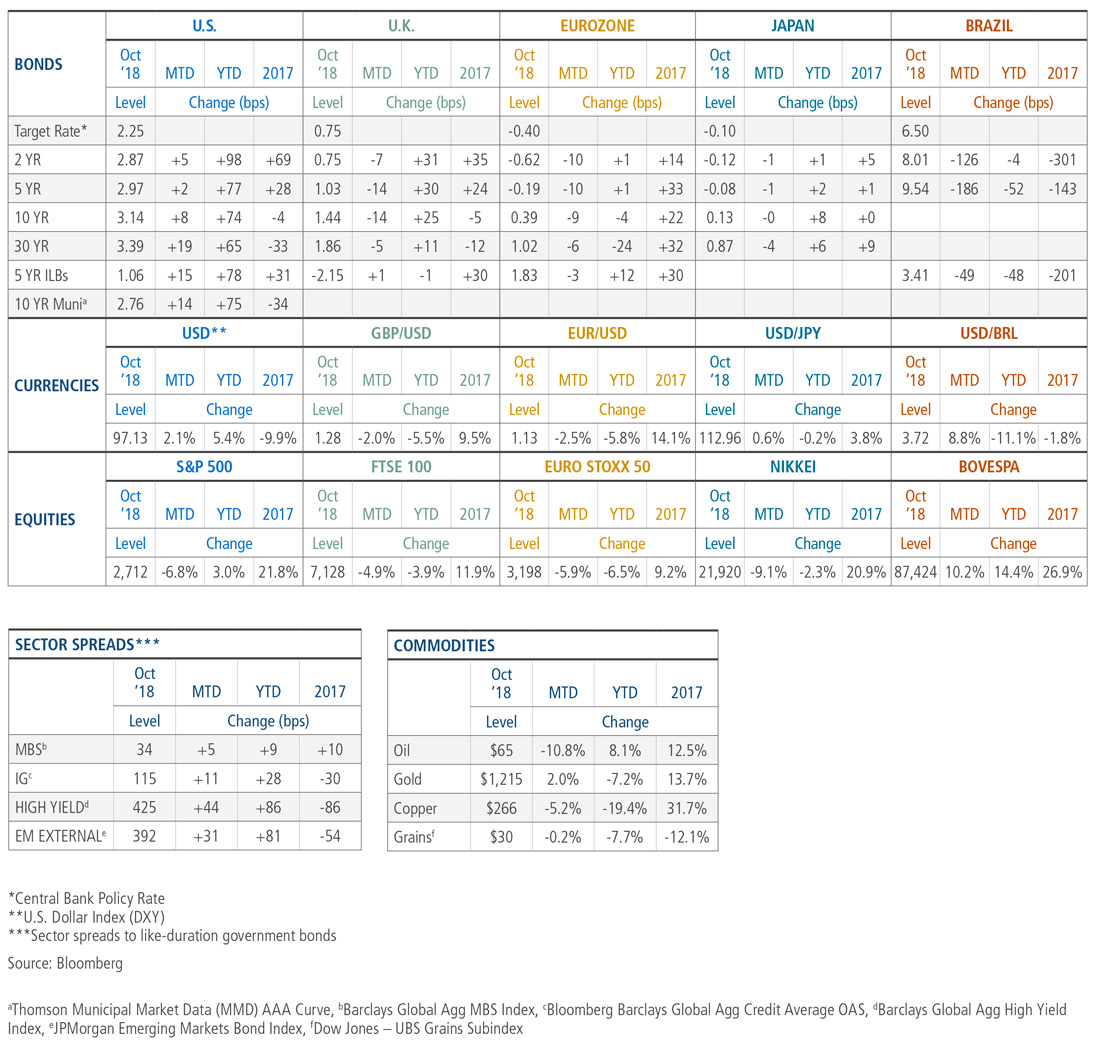
Volatility returned and pulled markets across the globe into the red. The sell-off in risk assets appeared to have several culprits: hawkish Fed comments, rising interest rates, signs of peak earnings growth and political fragility in Europe. Credit spreads widened and emerging market assets also faced challenges with a strengthening U.S. dollar. But the risk aversion appeared most acute in equities: the S&P 500 dropped 6.8% – its biggest one-month decline since September 2011. After a roller-coaster 10 months, year-to-date returns stood at just 3% only a few weeks after having been at over 10%. However, the U.S. equity market remained ahead of those in Europe, Asia and emerging markets, all of which were well in the red zone. An initial trend higher in sovereign yields early in the month appeared to reverse as bond prices rose and rates fell in response to the deepening risk sell-off. After the dust settled, U.S. yields still ended the month slightly higher with the yield curve steeper. Commodities also were not immune to the broad sell-off, as crude oil prices fell 9% on less optimistic growth expectations and forecasts for higher supply, which dragged inflation expectations lower as well.
Slowing growth momentum outside the U.S. further weighed on sentiment.Economic data softened in Europe as Q3 GDP growth slowed to 0.2% – its lowest rate in over two years – and the eurozone composite Purchasing Managers’ Index (PMI) fell to a 25-month low in October. Political uncertainty in the region added to woes, as U.K. officials floated the possibility of extending Brexit negotiations and the Italian government’s proposed spending budget appeared to be at odds with the EU’s expectations. Consequently, Moody’s downgraded Italy’s sovereign credit to the bottom rung of investment grade. Meanwhile, headwinds from the ongoing trade war weighed on China’s Q3 growth, which slowed to a 6.5% annual pace from 6.7% in the prior quarter. The People’s Bank of China took several steps in efforts to support the domestic economy, including another reserve requirement cut, the fourth this year. In contrast to the deceleration in growth momentum elsewhere, the U.S. economy expanded at an annual rate of 3.5% in the third quarter, driven by robust consumer and government spending. While U.S. growth was stronger than the 2% pace that had mostly prevailed since 2009, a cooling housing market and declining corporate investment raised some concerns about future growth.
Political developments from Latin America to Europe were a source of both uncertainty and assurance for markets. In Germany, following an unexpected defeat of the Christian Democratic Union in regional elections in the state of Hesse, Chancellor Angela Merkel announced that she will step down in December after 18 years as party leader. Merkel – who has long been seen as a champion of stability and prosperity in Germany and the eurozone broadly – also indicated she would not seek reelection in 2021. Mexican president-elect Andrés Manuel López Obrador, better known as AMLO, announced he would halt the construction of a $13 billion airport in Mexico City once he assumes the presidency in December after it was rejected in a referendum he put in front of the people. The cancellation of the partially built airport sent the Mexican peso 8% lower (the worst performing emerging currency in the month) as investors reevaluated the prospect of higher political and fiscal uncertainty under an AMLO presidency. In contrast, financial markets were more sanguine following the election of far-right populist and former army captain Jair Bolsonaro in Brazil’s presidential election, in hopes that he will focus on reducing government inefficiency and state intervention in the economy. In the U.S., reports of additional tariffs on Chinese imports circulated while the country prepared for midterm elections.
Equities chip away at ‘Recency’ bias After many years of low volatility, 2018 appears to be breaking with the recent past and delivering larger market moves than most investors may remember. The 6.8% drop in S&P 500 in October was the biggest monthly loss in five years. In fact, only one other month over that period, August 2015, suffered a loss greater than 5%. However, when the horizon is expanded to include the last 20 years, October’s loss looks less extreme: stock market declines were more severe in 14 months, or 6% of the time. While October’s sell-off was the most extreme in recent memory, it may be evidence of the continued normalization of equity volatility to levels more consistent with longer-term history.
In the Markets
EQUITIES
Despite generally strong fundamentals, developed market stocks1 fell 7.3% in October as investor concerns over the health of the global economy caused volatility to spike. In the U.S.2, stocks fell 6.8% after a handful of disappointing earnings outlooks and potential signs that trade tensions were weighing on growth. European and Japanese equities3,4 declined 5.3% and 9.1%, respectively, due to global growth concerns and escalating tensions between the EU and Italy over the country’s budget deficit.
Overall, emerging market5 stocks fell 8.7% in October, also taking their cue from the sell-off across global equity markets and the potential signs of a global economic slowdown. Defying the volatility across global markets, however, stocks in Brazil6 rose 10.2% as local markets cheered the increasing likelihood and eventual victory of right-wing populist Jair Bolsonaro in the presidential election. Chinese equities7 fell 7.7% on concerns over the impact of trade tariffs on economic growth and further depreciation in the Chinese yuan. Indian stocks8 fell 4.8% and Russian stocks9 fell 4.3% under pressure from broader market volatility and concerns over slowing global growth.
DEVELOPED MARKET DEBT
Despite rising initially, developed market yields broadly ended the month lower as a surge in equity volatility weighed on investors’ risk appetite and spurred demand for bonds. U.K. 10-year yields fell 14 basis points (bps) and German yields fell 10 bps, reflecting the swing in investor sentiment. U.S. yields displayed a similar pattern, but ended the month about 8 bps higher amid solid fundamental data: U.S. consumer confidence sustained its elevated levels in October, and 3Q GDP growth remained strong, supported by robust consumer and government spending.
INFLATION-LINKED DEBT
Global inflation expectations came under pressure amid weakness in energy markets, and global inflation-linked bonds (ILBs) posted mixed absolute returns while generally underperforming comparable nominal sovereigns. U.S. Treasury Inflation Protected Securities (TIPS) slid −1.4%, as represented by the Bloomberg Barclays U.S. TIPS Index, driven by rising real rates following Federal Reserve Chairman Jerome Powell’s comments that the policy rate was “a long way from neutral.” U.S. breakevens tumbled over the month, with the yield curve steepening, as oil prices reversed course and fell, CPI disappointed, and risk assets saw pronounced weakness. Outside the U.S., Italian real rates spiked higher and breakevens tumbled when the European Commission rejected Italy’s draft budget, deepening rancor between Rome and Brussels. In Brazil, real rates moved lower following the victory of market-friendly right-wing candidate Bolsonaro in the presidential election.
CREDIT
Global investment grade (IG) credit10 spreads widened 11 bps in October, and the sector returned −1.61%, underperforming like-duration global government bonds by 0.64%. Cyclical sectors such as housing and autos underperformed, likely driven in part by political uncertainty and concerns around the potential for tighter-than-expected policy rates in the U.S. These factors also contributed to worry that demand for U.S. assets from foreign investors could diminish, especially with hedging costs rising.
Global high yield bond11 spreads widened 54 bps in October, weighed down by market volatility. Global high yield returned −1.54%, underperforming like-duration Treasuries by 1.61% but still remained relatively resilient given strong fundamentals and moderate supply. In October, higher-quality issues outperformed lower-quality issues, and bonds rated CCC and lower returned −2.65%.
EMERGING MARKET DEBT
Emerging market (EM) debt posted negative returns across all sub-sectors in October. A steep move higher in underlying U.S. Treasury yields and widening of spreads drove negative returns in external debt. On the local side, negative performance was driven primarily by a general weakness in EM currencies. Brazil was a notable outperformer in both local and external debt due to a rally in assets when the market-friendly candidate won the presidential election. Argentina and Turkey were also outperformers versus the local index as their markets continued to stabilize, while Mexico was a notable underperformer after voters rejected a referendum on an airport already under construction, shaking market confidence in the president-elect, who put forward the referendum.
MORTGAGE-BACKED SECURITIES
Agency Mortgage-backed Securities (MBS)12 returned −0.63% and underperformed like-duration Treasuries by 37 bps during the month. The risk-off environment, combined with the first month of peak sales by the Fed as it reduced its balance sheet, weighed on the sector. Higher coupons outperformed their lower coupon counterparts; Ginnie Mae MBS underperformed conventional MBS; and 15-year MBS outperformed 30-year MBS. Gross MBS issuance decreased 6% from September while prepayment speeds decreased by 21%. Non-agency residential MBS underperformed like-duration Treasuries during October, while non-agency commercial MBS13 returned −0.56%, underperforming like-duration Treasuries by 47 bps.
MUNICIPAL BONDS
The Bloomberg Barclays Municipal Bond Index posted a return of ‒0.62% in October, bringing year-to-date returns to ‒1.01%. While munis underperformed the U.S. Treasury index over the month, the muni/Treasury yield ratio performance was mixed on a duration- and quality-matched basis: Overall, five- and 10-year ratios weakened while 30-year ratios strengthened. High yield munis returned ‒1.25%, primarily driven by negative returns in the tobacco and industrial revenue sectors, bringing the year-to-date return to 3.14%. October’s supply of $35 billion was up 41% versus the previous month but down 13% year-over-year, primarily due to the impact of U.S. tax reform. Muni fund flows were negative in October: Aggregate outflows totaled $3.96 billion for the month.
CURRENCIES
The U.S. dollar ended the month 1.9% stronger against its G10 counterparts, supported by strong economic data in the U.S. and soft growth momentum in the rest of the world. The euro fell 2.5% against the dollar on weaker-than-expected economic data and Italian budget concerns. The British pound dropped 2%, weighed down by the lack of a breakthrough in Brexit talks. However, as risk markets fell, “safe-haven” flows strengthened the Japanese yen 0.6%. Emerging market (EM) currencies came under pressure in October, although there were notable exceptions: The Argentine peso and Turkish lira strengthened by over 15% and 8%, respectively, and the Brazilian real rose as the market-friendly candidate prevailed in the presidential election.
COMMODITIES
In energy, oil prices halted their gains after rising more than 20% this year to over $86/bbl. Crude declined the most since mid-2016 as a rout in global equity markets raised concerns about economic growth and energy demand. Petroleum products followed crude lower, while natural gas rose as early-season cold weather drove demand across much of the U.S. The agricultural sector posted positive returns. Wheat prices declined amid an improving crop outlook in Russia while weak export demand weighed on soybeans. The U.S. Department of Agriculture (USDA) provided some relief to the corn market with lower-than-expected forecasts for domestic production. A rally in the Brazilian real prompted short-covering in both coffee and sugar; a stronger real tends to curb exports from the world’s largest producer of both crops. Strong demand and an expected slight supply deficit in the upcoming season drove cocoa prices higher. Base metals resumed their decline amid general risk-off sentiment, weak macro data and a stronger dollar. Heightened volatility across financial markets brought out buyers for precious metals over the month, with platinum outperforming gold and silver.
PIMCO expects world GDP growth to slow somewhat but remain above-trend at 2.75%‒3.25% in 2019. With tighter global financial conditions, increased political and economic uncertainties, and U.S. fiscal stimulus starting to fade in 2019, we think the economic divergence of 2018 – the U.S. accelerating and other regions slowing – will give way to a more synchronized deceleration, with the U.S., the eurozone and China all seeing lower growth than this year. We expect inflation globally to remain essentially unchanged from 2018 at 2.0%‒2.5%.
In the U.S., after an expansion of about 3% in 2018, we look for growth to slow to a below-consensus 2.0%–2.5% range in 2019. The drop reflects less support from fiscal stimulus, the ongoing removal of monetary accommodation, a stronger U.S. dollar and a less favorable trade and external environment. With economic growth still above potential, though, unemployment should decline further toward 3.6%. We expect inflation to peak at around 2.5% in response to tariff increases before moderating somewhat. We forecast three more increases in the fed funds rate by the end of 2019.
For the eurozone, we expect growth in a range of 1.5%‒2.0% over the next year, down significantly from 2.5% in 2017 but still above potential output growth. Recent purchasing managers indexes point to a growing divergence within the eurozone, with Italy falling behind, which bears watching given the government’s anti-euro leanings. Core inflation is expected to pick up to 1.25%‒1.75% from 1% as unemployment keeps falling, wage growth continues rising and the euro is no longer appreciating. We expect the European Central Bank to end net asset purchases by the end of 2018, and a first rate hike is more likely than not in the second half of 2019.
In the U.K., we expect above-consensus real growth in the range of 1.5%–2.0% in the next year based on our expectation that Brexit negotiations will progress and a hard Brexit will be avoided. This should help domestic demand in 2019. Our below-consensus inflation forecast calls for inflation to fall back to 1.75%‒2.25%, slipping below the 2% target over the next year as import price pressures fade and weak wage growth keeps service sector inflation subdued. We forecast two more rate hikes from the Bank of England over the next year.
Japan’s GDP growth is expected to remain steady at 1.0%–1.5% in 2019, supported by a tight labor market and accommodative fiscal stance. With inflation expectations low and improving labor productivity keeping unit wage costs in check, core inflation is likely to creep up only slightly to 0.5%‒1.0%, well below the 2% target. While we don’t expect the Bank of Japan to raise interest rates, we anticipate further tapering of bond purchases and further steepening of the yield curve.
In China, we expect 2019 growth roughly in the middle of a 5.5%‒6.5% range that reflects large uncertainties caused by trade tensions with the U.S. and an economic policy with partially conflicting targets (growth and unemployment versus financial stability and deleveraging). Our baseline assumes only the recently announced tariff increases and fiscal expansion worth about 1% of GDP. We project a moderate rebound in CPI inflation to 2.0%‒3.0% on rising energy and food prices and expect the People’s Bank of China to keep interest rates and reserve ratios unchanged. We expect only moderate depreciation of the yuan against the dollar, barring a full trade-war scenario.