SUMMARY
- We view valuations on REITs as attractive relative to the broader equity markets, based on our multi-asset real return framework.
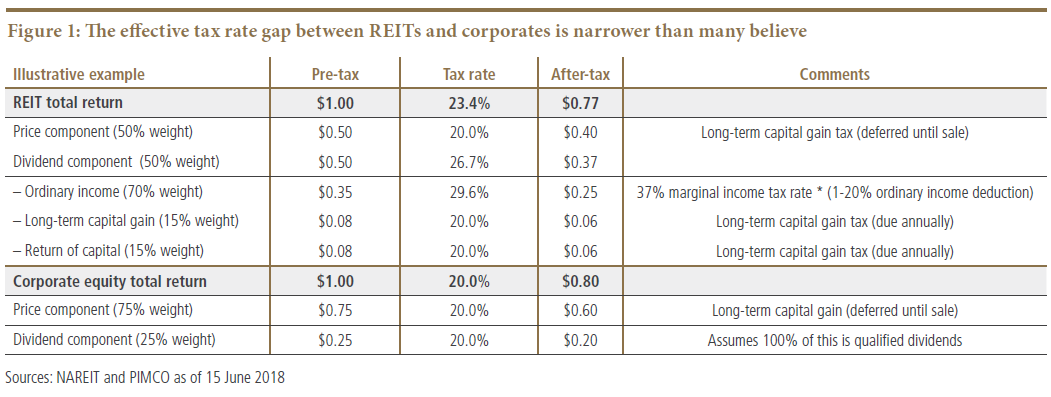
- When looking at after-tax total returns, the effective tax rate gap between REITs and corporates is, typically, much closer than generally perceived.
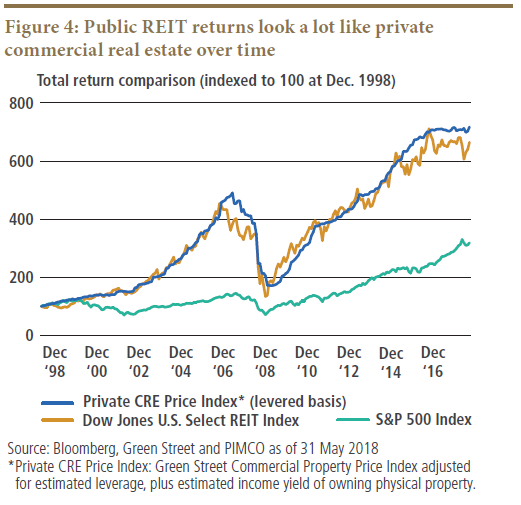
- While REITs may experience day-to-day volatility and behave like equities in the short run, over time REIT values tend to track those of the underlying real estate they hold.
Real estate investment trusts (REITs) have faced headwinds of late. Over the past two years, the Dow Jones U.S. Select REIT Index has underperformed the S&P 500 by nearly 35 percentage points as rising interest rates, moderating operating fundamentals, middling earnings growth and late-cycle fears tested the sector.
While some of this underperformance may be warranted, we believe current valuations on REITs are attractive relative to the broader equity markets based on our multi-asset real return framework. Moreover, while all investments carry risk, we see a number of factors supporting REITs today, including discounted valuations (relative to where the underlying assets would likely trade in the private commercial real estate transaction market), steady and predictable cash flows and still-rising and well-covered dividends, along with moderating growth in new supply and continued healthy tenant demand. The recent U.S. tax reform offers another key support, and we believe it is helping level the playing field with corporate equities in terms of after-tax returns to individual investors.
All told, we think it’s a good time to re-evaluate some common misperceptions about REITs’ tax efficiency and volatility relative to corporate equities and the private market.
We view tax reform as a clear positive for REIT shareholders
Both corporate equities and REITs benefited meaningfully from the U.S. Tax Cuts and Jobs Act (TCJA) , but for different reasons. REITs are exempt from taxation at the trust level as long as they distribute at least 90% of their taxable income to shareholders, which minimizes corporate-level cash flow “leakage” and allows REIT investors to realize potential tax benefits similar to those achieved by investing directly in physical commercial real estate (including the depreciation and interest expense tax shields that help limit reported gains, and therefore may result in higher after-tax retained cash flow). So while the primary benefit of the tax act for corporate equities is higher earnings and cash flow at the corporate level, for REITs – which already enjoyed favorable corporate-level tax treatment – the key incremental benefit stems from lower tax rates on dividends received by shareholders.
The TCJA includes a provision allowing for 20% of REIT dividends received as ordinary income to be tax deductible. This means that an investor who used to be in the highest tax bracket of 39.6% will see this rate drop to 29.6% on REIT dividends (see Figure 1). In addition, the TCJA left the existing REIT structure and other key benefits alone, including Section 1031 provisions (to defer taxes on qualifying exchanges of like-kind real estate), full interest expense deductibility and the disallowance of immediate expensing of real property (the reversal of which could have driven heightened construction activity and supply growth). The act also may indirectly benefit REITs via spillover effects from REIT tenants’ greater after-tax cash flow.
Re-evaluating the tax-efficiency gap
From a shareholder’s perspective, REIT dividends are classified into ordinary income, long-term capital gain, and return of capital. A common misperception about REITs is that they are tax-inefficient for the typical retail investor given the higher tax rate on ordinary income – the largest component of REIT dividends – compared to the 20% tax rate on traditional corporate dividends. However, the new tax deduction is helping offset this, and it’s also important to remember that dividends account for only about half of a typical REIT’s total return: 1 Price (i.e., appreciation of the underlying assets) is a roughly equal component, and is taxed at the lower 20% rate. So when we look at after-tax total returns, the overall effective tax-rate differential between REITs and corporates is, typically, much closer than generally perceived.
Let’s break this down. Using the historical 50% price, 50% dividends total return breakout for REITs (the approximate average dating back to 1995), 1 further decomposing REIT dividends into ordinary income (70% of the historical average), capital gain (15%) and return of capital (15%), and then factoring in the new 20% ordinary income deduction, we derive an effective REIT tax rate of roughly 23% for an individual shareholder – only marginally higher than the 20% tax rate on an investment in a typical dividend-paying common stock (see Figure 1). Note that this assumes each investment is held for longer than a year and is therefore subject to the 20% long-term capital gains tax, and that all equity dividends are qualified. The higher the price return component of REIT total returns, the closer the tax rate differential becomes (given the lower tax rate on this component).

Reassessing REITs versus private vehicles
Another common misconception about REITs is that they are more volatile than their private-vehicle counterparts due to their daily mark-to-market. Similar to equities, REITs are indeed susceptible to the daily swings of the broader equity markets, capital flows and short-term technicals. However, over the long term, REIT prices tend to behave very much like the underlying real estate assets (see Figure 4). Additionally, REITs’ professional property management, geographic and tenant diversification, scalability and generally low overhead costs can help REIT investors avoid many issues that investors in individual properties may encounter.
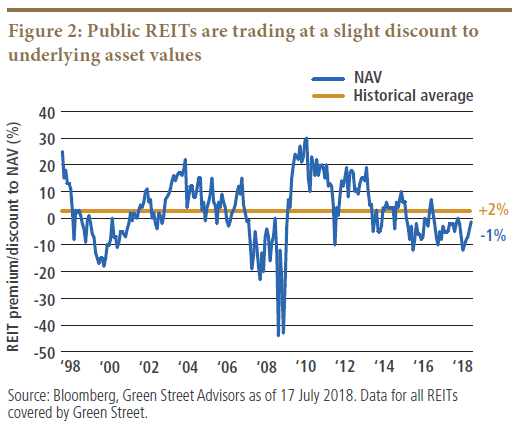
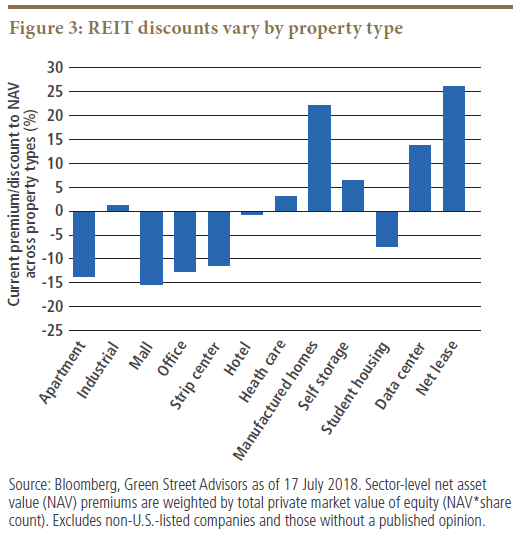
These benefits can become especially notable when many sectors of REITs are trading at large discounts to asset value, as they are today across most property sectors (see Figures 2 and 3). Specifically, based on consensus net asset value (NAV) estimates, an investor buying a REIT today is essentially buying the underlying physical real estate assets at a slight discount, depending on the property type. And because REITs are much more liquid than private real estate, they can be sold relatively efficiently under normal market conditions if they become expensive relative to their underlying assets.
A recent study titled “The Rate of Return on Everything” 2 – which looked at returns on all major asset classes across 16 advanced economies for the past 150 years – was particularly supportive of the long-term benefits of real estate investments. The conclusion states, “Arguably the most surprising result of our study is that long run returns on housing and equity look remarkably similar. Yet while returns are comparable, residential real estate is less volatile on a national level, opening up new and interesting risk premium puzzles.” For some investors it might be possible to build and manage a diversified portfolio of physical real estate assets, but for many this is neither workable nor desirable – and REITs may provide an attractive alternative for many investors. While REITs do tend to experience short-term volatility and can look like equities in the very short run, over time REIT values tend to track those of the underlying real estate they hold (see Figure 4).
The long view on REITs
Given our broader macro expectations of low to moderate returns across most investable asset classes over our secular horizon, we view REITs as relatively attractive within our multi-asset framework for long-term investors. Specifically, we believe REITs offer the following key benefits to investors:
- Solid forward return potential, with less volatility historically over the long term than traditional corporate equities
- Well-covered and growing dividends, providing a 4% dividend yield on average currently (based on the Dow Jones U.S. Select REIT Index)
- Generally healthy company fundamentals, including efficient property management platforms that result in high levels of occupancy and steady rent growth
- Generally low leverage and well-laddered debt maturity schedules
- Competitive tax efficiency relative to physical real estate and traditional equities
Investing in REITs is not without risks, including those that may arise from sharp increases in interest rate expectations, excessive new supply, or the impact of disruptive technology, as well as shifts in macroeconomic or investor sentiment or in a particular REIT’s financial condition or property management. Nonetheless, we believe REITs may offer compelling long-term risk-adjusted returns in today’s market.
1 According to NAREIT data from 1995 to 2018.
2 Jordà, Òscar, Katharina Knoll, Dmitry Kuvshinov, Moritz Schularick, Alan M. Taylor. 2017. “The Rate of Return on Everything, 1870–2015” Federal Reserve Bank of San Francisco Working Paper 2017-25.
DISCLOSURES
Past performance is not a guarantee or a reliable indicator of future results.
REITs are subject to risk, such as poor performance by the manager, adverse changes to tax laws or failure to qualify for tax-free pass-through of income. All investments contain risk and may lose value.
There is no guarantee that these investment strategies will work under all market conditions or are suitable for all investors and each investor should evaluate their ability to invest long-term, especially during periods of downturn in the market. Investors should consult their investment professional prior to making an investment decision.
PIMCO does not provide legal or tax advice. Please consult your tax and/or legal counsel for specific tax or legal questions and concerns. The discussion herein is general in nature and is provided for informational purposes only. There is no guarantee as to its accuracy or completeness. Any tax statements contained herein are not intended or written to be used, and cannot be relied upon or used for the purpose of avoiding penalties imposed by the Internal Revenue Service or state and local tax authorities. Individuals should consult their own legal and tax counsel as to matters discussed herein and before entering into any estate planning, trust, investment, retirement, or insurance arrangement.
The Dow Jones U.S. Select Real Estate Investment Trust (REIT) Index is an unmanaged index subset of the Dow Jones Americas U.S. Select Real Estate Securities (RESI) Index. This index is a market capitalization weighted index of publicly traded Real Estate Investment Trusts (REITs) and only includes only REITs and REIT-like securities. Green Street Commercial Property Price Index is a time series of unleveraged U.S. commercial property values that captures the prices at which commercial real estate transactions are currently being negotiated and contracted. Features that differentiate this index are its timeliness, its emphasis on high-quality properties, and its ability to capture changes in the aggregate value of the commercial property sector. The S&P 500 Index is an unmanaged market index generally considered representative of the stock market as a whole. The index focuses on the Large-Cap segment of the U.S. equities market. It is not possible to invest directly in an unmanaged index.
This material contains the opinions of the manager and such opinions are subject to change without notice. This material has been distributed for informational purposes only and should not be considered as investment advice or a recommendation of any particular security, strategy or investment product. Information contained herein has been obtained from sources believed to be reliable, but not guaranteed. No part of this material may be reproduced in any form, or referred to in any other publication, without express written permission. PIMCO is a trademark of Allianz Asset Management of America L.P. in the United States and throughout the world.
©2018, PIMCO.
CMR2018-0629-341480
© PIMCO
Read more commentaries by PIMCO