SUMMARY
- We believe the tax-exempt municipal market may offer attractive benefits to U.S. investors late in this economic expansion.
- Municipal bonds have tended to outperform taxable fixed income asset classes when rates are rising and offer lower correlations with equities. Limited muni supply will also likely remain a tailwind to performance.
- Credit quality will likely be a key performance driver when the economic cycle turns, making strong research and active selection critical.
It’s often said that the only certainties in life are death and taxes, but for investors, it could be argued that the two key certainties are taxes and recessions. The current economic expansion is now the second-longest in the postwar era, at 110 months; only the expansion ended in 2001 outlasted it, and by a mere 12 months. And while predicting the end of a business cycle is notoriously difficult, we view a recession as likely over the secular (three- to five-year) horizon.
We think investors should be readying their portfolios for this eventuality – and the tax-exempt municipal market has displayed a number of characteristics historically that could make it attractive for U.S. taxpayers late in this expansion.
Municipal bonds have outperformed when rates are rising
Municipal bonds have tended to outperform taxable fixed income asset classes as rates rise, and Federal Reserve rate hikes are a fixture of late-cycle markets. The Fed has hiked the overnight rate by 125 basis points (bps) since the beginning of 2017, and PIMCO expects further hikes this year and next. On a pretax basis, munis have outperformed taxable investment grade corporate bonds in three of the last four Fed tightening cycles (as proxied by the Bloomberg Barclays Municipal Bond Index and Bloomberg Barclays Investment Grade Corporate Bond Index). On an after-tax basis, the benefit has been more pronounced: Munis have outperformed investment grade credit, U.S. Treasuries and mortgages (as proxied by the Bloomberg Barclays U.S. Agency Fixed Rate MBS Index) in all four tightening cycles since 1987.
Munis offer greater diversification from stocks
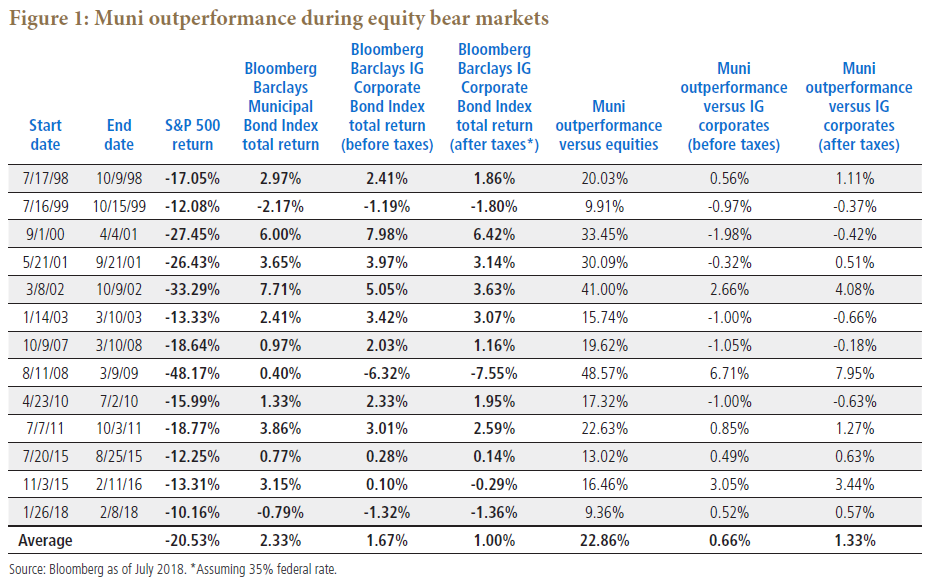
Munis also have lower correlations to risk assets than many taxable fixed income alternatives. Over the past decade, both investment grade and high yield munis have shown about one-third the correlation to equities compared with their taxable counterparts. Over the past 20 years, during periods when the S&P 500 declined at least 10%, munis outperformed equities by an average of 23% and investment grade corporate bonds by an average of 1.33% after accounting for federal income taxes (see Figure 1).

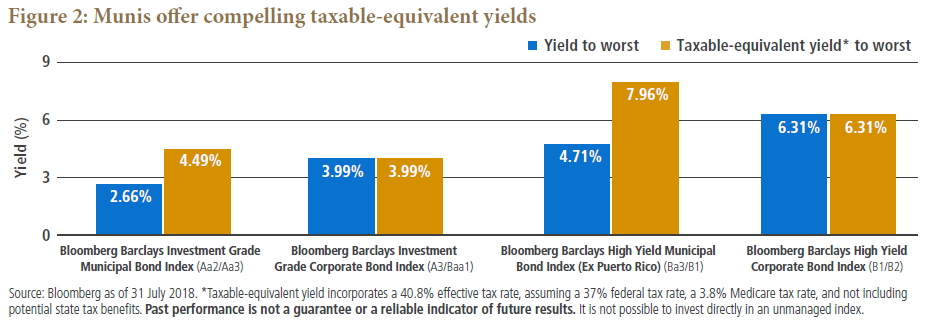
Tax-free carry helps reduce the “cost” of waiting for a potential shift in the cycle, without taking on additional credit risk. Investment grade and high yield munis currently offer approximately 50 bps and 165 bps of potential after-tax pickup for U.S. taxpayers, respectively (see Figure 2), with default rates that remain low relative to other asset classes.
Limited growth of municipal debt outstanding offers a performance tailwind
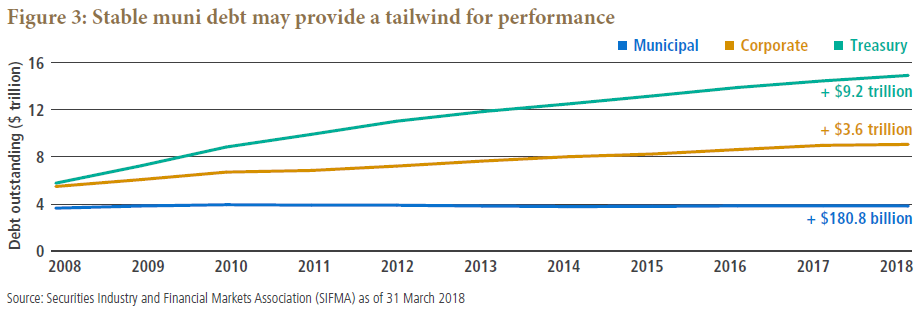
The size of the municipal bond market has remained broadly stable since the financial crisis (see Figure 3). While total U.S. bond market debt outstanding (reflecting municipal, Treasury and corporate debt) has increased by more than $10 trillion since 2008, munis contributed very little to that growth. Given the limited supply paired with the rising number of U.S. retirees who pay federal income taxes and may have a need for high quality income, we believe supply/demand dynamics will likely remain a tailwind to performance.
Credit quality will be a key performance driver when the cycle turns
While the late-cycle performance of municipals has been strong historically, it’s important to consider what might be different this time around. A key shift from past cycles is the sharp reduction in bond insurance on new muni issuance, from over 50% before the crisis to about 5% today. This has, in many ways, transformed the municipal market into a credit market. We expect underlying credit fundamentals to play a larger role in performance at the turn of this cycle, making strong research and active selection critical.
We see several potential areas of credit concern when the cycle turns:
State and local governments. While the amount of bonded debt has not increased substantially since the financial crisis, overall leverage – including pension liabilities – is up significantly: The Federal Reserve estimates that state and local government unfunded pension liabilities grew by roughly $1.5 trillion between 2007 and 2015. Moreover, changes in Governmental Accounting Standards Board (GASB) 67 and 68 accounting rules for pensions since the last cycle are requiring greater disclosure of pension liabilities and related asset volatility. State and local governments that failed to either increase pension funding or enact substantive reform measures could see greater balance sheet volatility at the turn of the next cycle. Furthermore, while we view the prospect of widespread defaults as remote, bankruptcy seems to be less of a dirty word than it was prior to Detroit’s Chapter 9 filing. Several municipalities have recently threatened bankruptcy filings in an effort to extract concessions from creditors or additional state funding.
Not-for-profit (NFP) health care. Rising labor costs are denting margins in the NFP health care sector, and we expect lower reimbursement to limit top-line revenue growth. Rising health care costs are spurring greater price awareness among consumers, employers and lawmakers. This will require NFP health systems to make sizable investments to redesign their care delivery systems to provide lower-cost, higher-quality patient care.
Not-for-profit higher education. Traditionally viewed as a “safer” part of the market, the private NFP higher education sector faces mounting stress, especially among smaller schools. According to Inside Higher Ed’s annual survey for 2018, 25% of chief financial officers at private universities have had “serious discussions” about a merger in the past year, up from just 5% in 2016, and 50% expect their colleges to become “financially unstable” within the next 10 years.
Project finance and new construction. Rising input costs may pressure bonds reliant on cash flows from timely and on-budget construction projects. Mounting costs related to trade disputes and labor shortages also pose a risk to this segment of the market.
Some segments will likely be more resilient during the next recession
While we expect greater credit challenges when the cycle turns, and credit selection will be key, we believe certain muni segments will prove resilient and offer compelling opportunities for investors:
Essential-service revenue bonds in favorable service areas. This segment benefits from clearer security features compared with general obligation bonds, relatively low revenue volatility and manageable leverage.
Select government obligation (GO) bonds. While we expect pension shortfalls and related downgrades to dominate the headlines, exposure to state and local governments with well-funded pensions, diverse local economies and favorable budgeting and reserve practices is still attractive.
NFP sectors with balance sheet cushion. The balance sheet strength of higher-quality NFP hospitals, universities, and other 501©3 entities should prevent material credit deterioration if demand stumbles. Some entities rated in the high A and AA categories have negative net debt.
Tax-secured revenue bonds with strong security provisions. The municipal market continues to debate the strength of certain tax-secured revenue bond structures, given their limited legal precedent and lack of conformity. We agree that there is wide disparity within this segment of the market, but believe there are bonds with structures that are more legally defensible and will likely perform well in a recession.
Recent Supreme Court rulings should bolster municipal credit
The Supreme Court has been busy this summer, ruling on several cases that have direct implications for municipal credit. We expect the rulings, on balance, could lead to increased tax revenue and offer modest cyclical (six- to 12-month) and secular (three- to five-year) tailwinds to state credit profiles. However, the timing and magnitude of these potential benefits will vary by municipality.
Murphy v. National Collegiate Athletic Association
The May ruling in Murphy v. National Collegiate Athletic Association struck down the Professional and Amateur Sports Protection Act, the federal prohibition of state-level legalization of sports gambling. States may now enforce their own laws to allow for sports betting. We expect the overall impact to municipal credit to be limited. A study by Oxford Economics estimates that states and local governments may now collect up to $3.4 billion in additional tax revenues as a result of sports betting, or 0.3% of total tax collections. Moreover, implementation and adoption rates will vary by state. While sports gambling tax revenues may provide modest support to address near-term budget items for select municipalities, sports gambling can be perceived as a regressive initiative that could have some serious negative effects, including addiction and poverty, that would ultimately require additional public spending and present a headwind to the sector.
Impact: Modestly positive for adopting states over the two-year horizon; longer-term outlook is less certain
South Dakota v. Wayfair
The June Supreme Court ruling in favor of South Dakota allows states to enforce their own tax laws and to require retailers to collect sales taxes on online transactions within state boundaries, regardless of the physical location of the retailer. We view the ruling as a modest positive for state and local credit due to the additional sales tax revenues that states and localities may now collect from online transactions. According to various estimates, the broader taxing power will allow for states and local governments to collect an incremental $8 billion–$23 billion annually (less than 2% of total tax collections). The timing and overall impact of the ruling will vary by tax jurisdiction, as states will now need to implement their own laws to collect sales taxes on out-of-state transactions.
Impact: Modestly positive over one- to three-year horizon
Janus v. American Federation of State, County, and Municipal Employees, Council 31 (AFSCME)
The June Supreme Court ruling on Janus v. AFSCMEoverturned the 1977 Abood v. the Detroit Board of Education case, which had allowed unions to charge public workers “agency fees” even if a worker elected not to affiliate with the union. We interpret the prospect of weaker political influence of public unions (and the greater likelihood of pension reform) as a positive development for municipal credit, particularly among municipalities with outsize unfunded pension burdens. However, we expect the impact to be recognized over the longer-term secular horizon, and the ruling does not affect states with constitutions that explicitly prohibit the impairment of pension benefits. Several Democratic-leaning states have also introduced legislation making it more costly to part from unions in an effort to blunt the potential impact of the ruling.
Impact: Positive over the long term, particularly among municipalities that are able to renegotiate retiree benefits
Bottom line? Munis may offer compelling late-cycle advantages
At this late stage of the economic cycle, municipal bonds may offer investors some key benefits. Munis have tended to outperform taxable fixed income asset classes when rates are rising and offer greater diversification from stocks, and limited supply remains a tailwind for performance. While credit challenges when the cycle turns will likely make active credit selection critical, we believe key muni segments will prove resilient and offer attractive opportunities for investors.
DISCLOSURES
Past performance is not a guarantee or a reliable indicator of future results. Investing in the bond market is subject to risks, including market, interest rate, issuer, credit, inflation risk, and liquidity risk. The value of most bonds and bond strategies are impacted by changes in interest rates. Bonds and bond strategies with longer durations tend to be more sensitive and volatile than those with shorter durations; bond prices generally fall as interest rates rise, and the current low interest rate environment increases this risk. Current reductions in bond counterparty capacity may contribute to decreased market liquidity and increased price volatility. Bond investments may be worth more or less than the original cost when redeemed. Income from municipal bonds may be subject to state and local taxes and at times the alternative minimum tax; concentrating in a single or limited number of states or sectors is subject to greater risk of adverse economic conditions and regulatory changes. The credit quality of a particular security or group of securities does not ensure the stability or safety of an overall portfolio. High yield, lower-rated securities involve greater risk than higher-rated securities; portfolios that invest in them may be subject to greater levels of credit and liquidity risk than portfolios that do not. Certain U.S. government securities are backed by the full faith of the government. Obligations of U.S. government agencies and authorities are supported by varying degrees but are generally not backed by the full faith of the U.S. government. Portfolios that invest in such securities are not guaranteed and will fluctuate in value. Diversification does not ensure against loss. Management risk is the risk that the investment techniques and risk analyses applied by the investment manager will not produce the desired results, and that certain policies or developments may affect the investment techniques available in connection with managing the strategy.
There is no guarantee that these investment strategies will work under all market conditions or are suitable for all investors and each investor should evaluate their ability to invest long-term, especially during periods of downturn in the market. No representation is being made that any account, product, or strategy will or is likely to achieve profits, losses, or results similar to those shown. The correlation of various indexes or securities against one another or against inflation is based upon data over a certain time period. These correlations may vary substantially in the future or over different time periods that can result in greater volatility. Defaults are measured by the sum of the cost value of defaulted issues divided by the respective market value of the municipal bonds in the month in which the default occurred.
Statements concerning financial market trends are based on current market conditions, which will fluctuate. References to specific securities and their issuers are not intended and should not be interpreted as recommendations to purchase, sell or hold such securities. PIMCO products and strategies may or may not include the securities referenced and, if such securities are included, no representation is being made that such securities will continue to be included.
This material contains the opinions of the manager and such opinions are subject to change without notice. This material has been distributed for informational purposes only and should not be considered as investment advice or a recommendation of any particular security, strategy or investment product. Information contained herein has been obtained from sources believed to be reliable, but not guaranteed. No part of this material may be reproduced in any form, or referred to in any other publication, without express written permission. PIMCO is a trademark of Allianz Asset Management of America L.P. in the United States and throughout the world.
©2018, PIMCO.
© PIMCO
Read more commentaries by PIMCO