Global trade tensions appeared to lose some bite with a thawing of U.S.-European trade relations, though some conflicts continued. A meeting between President Donald Trump and European Commission President Jean-Claude Juncker led to an apparent détente between the U.S. and the European Union (EU). The two agreed to work toward “zero tariffs,” easing concerns over Trump’s earlier threat to impose levies on European autos. However, tensions between the U.S. and China continued as U.S. tariffs on $34 billion of Chinese imports took effect at the start of the month alongside China’s retaliation in kind, with threats of further escalation from both sides. In contrast to the friction elsewhere, Europe turned to Japan to ink the largest free-trade deal for both regions. Outside of trade, the status quo appeared upended when President Trump criticized NATO allies over their defense-spending contributions and then attended a summit with Russian President Vladimir Putin in Helsinki. In Britain, Prime Minister Theresa May’s leadership was on shaky ground yet again after her proposed “Chequers Plan,” which advocated for a softer divorce from the EU, led to resignations from Foreign Secretary Boris Johnson and Brexit Secretary David Davis.
Strong fundamentals in the U.S. suggested continued policy normalization by the Federal Reserve, while rumors about Bank of Japan’s accommodative policy sparked increases in interest rates. U.S. GDP grew an impressive 4.1% annualized in the second quarter, the highest rate since 2014. This quickened pace was led by consumer spending, business investment and net exports (see chart), with an added boost from fiscal stimulus in the form of tax cuts and government spending. Housing markets in the U.S. showed some signs of softening, though, as residential investment contracted and home sales slowed on the back of rising mortgage rates and changes in tax incentives. On the monetary policy front, Fed Chairman Jerome Powell affirmed the plan for continued rate increases after giving an upbeat outlook for the economy, which sparked public criticism from President Trump – unusual for a sitting U.S. president – who asserted that raising rates “hurts all that we have done.” Elsewhere, rumors of a shift in the Bank of Japan’s (BoJ) policy caused the yen to strengthen and sent Japanese government bond yields higher. In the end, BoJ policymakers voiced their commitment to accommodative policy for an extended period, but tweaked their yield curve control policy to allow 10-year yields to move in a wider range around 0% depending on developments in economic activity.
Investors’ risk appetite returned despite trouble with the FANG trade. Global equity bourses moved higher, led by stocks in the U.S., where corporate earnings were upbeat and growth measures were solid. Companies were on track to report a 24% increase in profits compared to the same period in 2017, though the “FANG” group (Facebook, Amazon, Netflix and Google) appeared to lose some steam; Facebook and Netflix, along with Twitter, slumped on slowing growth prospects, with Facebook experiencing the largest one-day decline in market capitalization for a U.S.-listed company. Even so, risk markets were buoyed by hopes for improving trade relations after the Trump-Juncker meeting. Emerging market assets also saw some reprieve after falling for much of the year, with the exception of Turkey’s lira. The currency came under renewed pressure after President Recep Tayyip Erdogan expanded his power over the central bank, which subsequently kept policy rates unchanged at 17.75% despite high inflation. President Trump’s criticism of the Fed’s tightening path contributed to some depreciation in the U.S. dollar, while U.S. bond yields moved higher amid persistent yield curve flattening. In commodity markets, crude oil prices declined the most since July 2016 after Libya resumed export operations at four major ports that were previously under force majeure.
Stimulus Kicks In The U.S. economy grew 4.1% in the second quarter of 2018, its quickest pace in nearly four years. While the headline figure fell short of expectations, the composition of growth suggested underlying strength in the economy. Consumption growth, the key driver of GDP, rebounded to a 4% rate, up from just 0.5% in the first quarter. However, less sustainable factors likely contributed to the extent of the surge in GDP: Business investment advanced 7.3% and contributed just under one percentage point to growth, in part fueled by recent tax cuts and a rebound in oil prices. More notable, though, was the boost from net exports, driven by an 80% rise in food, feed and beverage shipments as soybean and corn exports increased sharply ahead of scheduled retaliatory tariffs from China.
Market snapshot
EQUITIES
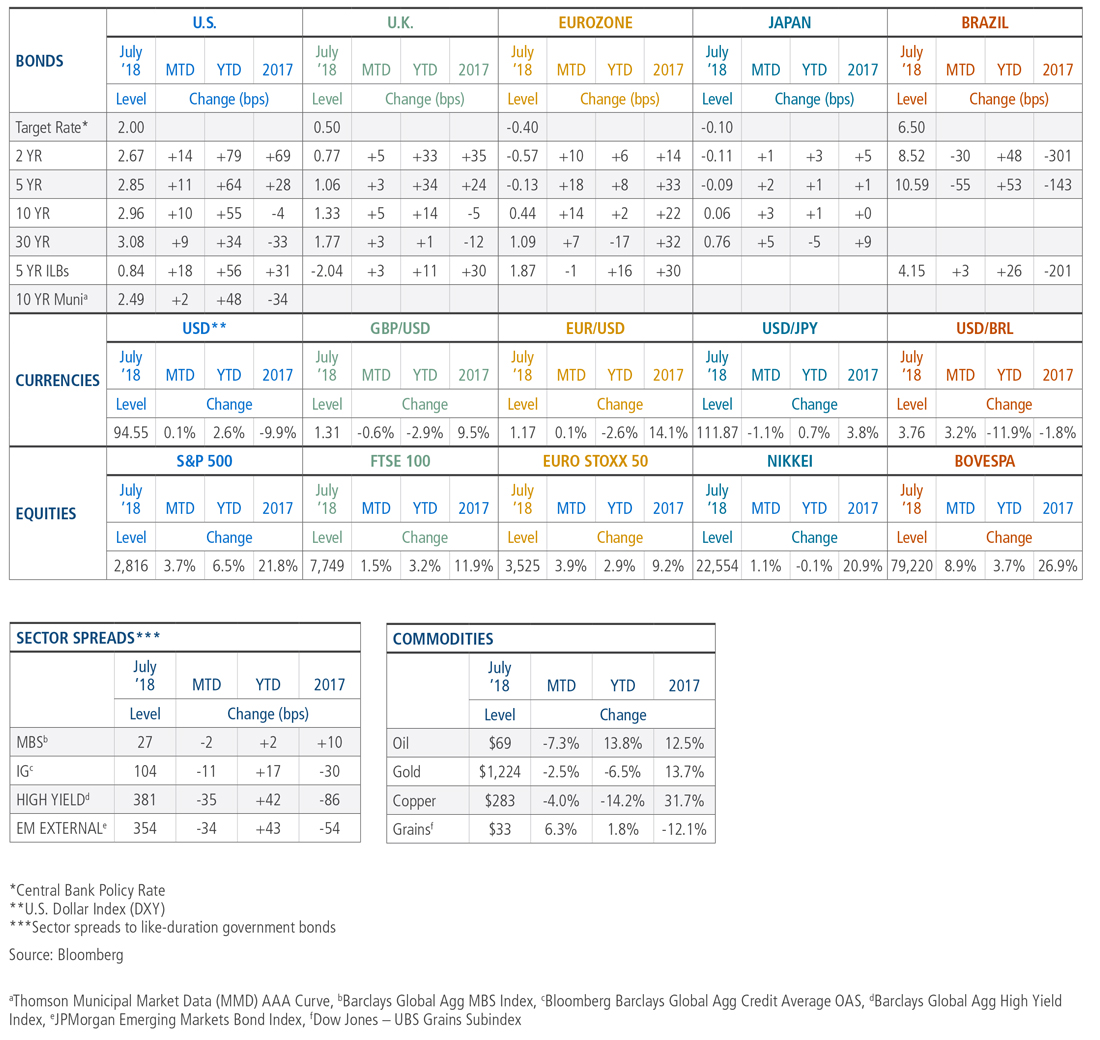
Continued strength in fundamentals helped improve investors’ appetite for risk and drove developed market stocks1 3.1% higher, despite ongoing geopolitical tensions. Stocks in the U.S.2 rallied 3.7%, supported by a strong start to Q2 earnings and solid economic data. In Japan, equities3 increased 1.1%, and European equities4 rose 3.1%, as the outlook for U.S.-related trade in both regions improved.
Overall, emerging market5 (EM) stocks gained 2.2% in July, led by a recovery in LatAm equities and in most currencies. In Brazil,6 stocks surged 8.9% due to an improvement in the local political outlook, strong earnings and appreciation in the Brazilian real. Although Chinese7 equities gained 2.0%, they underperformed the broader EM complex: The impact of a new fiscal and monetary easing package from the State Council was dampened by additional U.S. tariffs and a continued depreciation of the Chinese yuan. Benefiting from the pullback in energy prices, Indian8 stocks rose 6.4%, led by energy and financial companies, while economic data remained mixed overall. In Russia9, stocks rose 3.6% despite the fall in oil prices, as the ruble strengthened over the month.
DEVELOPED MARKET DEBT
Developed market debt yields shifted higher as solid growth and some reprieve in trade tensions helped support investors’ risk sentiment. The market’s expectation of a tweak to Bank of Japan (BoJ) monetary policy briefly contributed to relatively large moves in Japanese yields: The 10-year Japanese Government Bond (JGB) rate rose to 0.11%, its highest level since 2016, before falling to 0.06% after the BoJ introduced forward guidance, committing to keep interest rates “very low” for an “extended period of time.” The bank also added guidance on its 0% 10-year yield target that suggested it may allow long-term yields to fluctuate more depending on economic developments. In the U.S., the 10-year Treasury yield moved 10 basis points (bps) higher, and the yield curve flattened modestly following Federal Reserve Chairman Jerome Powell’s testimony to Congress, which justified continued rate increases amid strong economic activity. Elsewhere, yields rose in anticipation of the BoJ announcement and signs of some easing in global trade tensions, as seen in a 14-bp increase in German 10-year yields.
INFLATION-LINKED DEBT
Global inflation-linked bond (ILB) markets were generally down for the month of July amid rising developed market interest rates. However, they outperformed comparable nominal sovereign bonds across most countries. U.S. Treasury Inflation-Protected Securities (TIPS) returned ‒0.48%, as represented by the Bloomberg Barclays U.S. TIPS Index. The U.S. real yield curve flattened further, with a pronounced move higher in front-end rates as Federal Reserve Chairman Jerome Powell underscored the strong economic footing of the U.S. and reiterated the plan for gradual rate hikes during two appearances before Congress. The U.S. BEI curve steepened, with shorter-term expectations moving lower on sliding oil futures and weaker CPI for June. Eurozone breakeven rates also fell on the sell-off in oil markets and a tepid core inflation reading. In Brazil, real yields fell and BEI dipped as the government revised its growth expectation downward following the nationwide strike in May.
CREDIT
Global investment grade (IG) credit10 spreads tightened 9 bps in July, and the sector returned 0.53%, outperforming like-duration global government bonds by 0.92%. Spreads tightened steadily over the month thanks to lower-than-expected new issue supply, encouraging corporate earnings, strong GDP growth, and signs of some de-escalation in trade tensions.
For similar reasons, global high yield bonds11 provided their strongest monthly performance since February 2017, gaining 1.2%; net new issuance fell to its lowest level since April 2009. With five- and 10-year government yields higher over the month and speculative grade yields down 20 bps, global high yield spreads declined by 26 bps.
EMERGING MARKET DEBT
Emerging market (EM) debt overall posted positive returns in July, as did all of its subsectors. Tightening spreads drove external debt higher despite a move higher in underlying U.S. Treasury yields. On the local side, lower index yields and a softening of U.S. dollar momentum drove the positive performance. Turkey was a notable underperformer in both local and external debt: Unorthodox cabinet appointments and the lack of tightening by the central bank despite continued high inflation disappointed the markets and contributed to further weakening of the lira. China also meaningfully underperformed the local debt index, as its currency weakened on escalating trade tensions with the U.S. and the People’s Bank of China eased monetary policy.
MORTGAGE-BACKED SECURITIES
Agency MBS12 returned ‒0.11% and outperformed like-duration Treasuries by 20 bps during the month. Spreads tightened as volatility declined, rates inched higher and credit improved. The 4.0% and 4.5% coupons underperformed the 3.0% and 3.5% coupons; Ginnie Mae MBS outperformed conventional MBS as benign prepayments supported the sector; and 15-year MBS underperformed their 30-year counterparts amid flattening in the yield curve. Gross MBS issuance and prepayment speeds were unchanged versus June. Non-agency residential MBS outperformed like-duration Treasuries during July, while non-agency commercial MBS13 returned 0.06%, outperforming like-duration Treasuries by 37 bps.
MUNICIPAL BONDS
The Bloomberg Barclays Municipal Bond Index posted a positive return of 0.24% in July, bringing year-to-date returns to ‒0.01%. Munis overall outperformed Treasuries over the month, particularly at the front end of the yield curve, and lower credit quality munis returned 0.35%, bringing year-to-date returns to 4.03%. Supply in July was down 11% at $29 billion versus the previous month but up 15% year over year. On the policy front, the Supreme Court had a busy summer, ruling on several cases with direct implications for municipal credit. Notably, in South Dakota vs. Wayfair, the Supreme Court ruled that states can enforce their own tax laws and require retailers to collect sales taxes on online transactions within state boundaries, regardless of the physical location of the retailer. The ruling could be viewed as a modest positive for state and local credit.
CURRENCIES
The momentum of the U.S. dollar seemed to slow in July, weighed down by President Donald Trump’s criticism of the Federal Reserve’s rate hikes – and despite trade tensions that would typically be supportive of the dollar and strong U.S. growth data that affirmed the Fed’s tightening path. The euro made only insubstantial gains due to mixed economic data, a possible breakthrough with the U.S. on tariffs and the European Central Bank’s announcement that it will keep its policy rate unchanged through the summer of 2019. The British pound fell 0.6% as several high-profile Brexit supporters resigned from the UK government, which overrode the impact of a hawkish remark from the Bank of England. The Japanese yen fell 0.9% when an expected change to monetary policy ultimately turned out to be minor. Among EM currencies, the Chinese yuan weakened 2.9%, while trade tensions with the U.S. escalated and the central bank moved toward monetary easing.
COMMODITIES
Commodities delivered negative returns in July. In energy, crude oil prices declined amid concerns that simmering trade tensions between the U.S. and China could reduce economic activity. Oil came under further pressure from rising OPEC production; Libya’s National Oil Corporation resumed export operations at four major ports. Natural gas prices fell on cooler weather forecasts. In agriculture, dry conditions across Europe, the Black Sea region and Australia were expected to curb wheat production and drove strong performance. After falling to a 10-year low, soybeans recovered to end the month in positive territory. Prices of lean hogs tumbled on an outlook for rising U.S. production and retaliatory tariffs from Mexico and China. Base metals markets also traded lower, driven by concerns that a U.S.-China trade war would dampen demand. Copper prices fell below $6000/ton for the first time in a year, while worries of oversupply weighed on zinc. Gold underperformed on rising real yields, and platinum fell to a 10-year low.
Outlook
Based on PIMCO’s cyclical outlook from March 2018.
PIMCO expects world GDP growth to remain above-trend at 3.0%‒3.5% in 2018, with low but gently rising inflation. Still-favorable fiscal support suggests that solid growth will continue for the rest of 2018. Compared with our December forecast, we see marginally higher 2018 GDP growth in the U.S., eurozone, U.K. and China, while we lowered our estimates for Mexico and India. The causes of the stronger expansion are more uncertain and could affect its durability beyond 2018. Our inflation forecasts for 2018 have also risen slightly since our December forecast in response to a higher oil price trajectory.
In the U.S., we look for above-consensus growth of 2.25%–2.75% in 2018. Household and corporate tax cuts should boost growth by 0.3 percentage point in 2018, with another 0.3 percentage point coming from higher federal government spending resulting from the two-year budget deal. With unemployment dropping below 4%, we expect some upward pressure on wages and consumer prices, and core inflation to be above 2% over the course of 2018. Under new leadership, the Federal Reserve is expected to continue tightening gradually; we expect three rate hikes this year, with a fourth likely if economic and financial conditions are favorable.
For the eurozone, we expect growth will be in a range of 2.25%‒2.75% this year, about the same pace as 2017. The expansion has been broad-based across the region, but political challenges highlight some fragility. Core inflation, though, is expected to remain very low, creeping only marginally above 1%this year due to low wage pressures and the appreciation of the euro in 2017. We expect the European Central Bank to end its bond purchase program this year, though maturing bonds will be reinvested for some time. We do not foresee the first rate increase until mid-2019.
In the U.K., we expect above-consensus growth in the range of 1.5%–2.0% in 2018. Our base case is for a relatively smooth separation from the European Union, which would contribute to business confidence and investment picking up. After seven years of austerity, we also see some scope for stronger government spending. Inflation should fall back toward the 2% target by year-end, with the effect of sterling’s depreciation in 2017 fading. The Bank of England will likely follow a very gradual path higher.
Japan’s GDP growth is expected to remain firm at 1.0%–1.5% in 2018. Fiscal policy should remain supportive ahead of the planned value-added tax hike in 2019. With unemployment below 3% and job growth accelerating, wage growth should pick up further, helping core inflation rise over the year to slightly below 1%. With the appreciating yen providing disinflationary headwinds and the newly appointed deputy governors tilting the Bank of Japan leadership somewhat more dovish, the BOJ may not tweak its yield curve control policy until 2019.
In China, we expect a controlled deceleration in growth to 6.0%–7.0% this year, from 6.8% in 2017. The authorities’ focus is likely to be on controlling financial excesses, particularly in the shadow banking system, and on some fiscal consolidation, chiefly by local governments. We expect inflation to accelerate to 2.5% on stronger core inflation and higher oil prices. We are broadly neutral on the yuan and generally expect the authorities to control capital flows tightly to keep exchange rate volatility low.
In Brazil, Russia, India and Mexico, we expect growth to collectively rise to 4% in 2018, slightly above consensus, with modest upside risk from the growth rebound in India. Emerging markets are catching up to the recovery in developed markets, with improving fundamentals and greater differentiation among countries. This recovery is likely to be shallower and slower than others, however, and a deteriorating external backdrop could weigh on the asset class; EM potential growth has fallen, and key political events are likely to keep investors cautious. We expect inflation to stabilize around 4.1%, also above consensus, as most of the decline in EM inflation thus far appears cyclical rather than structural.