All Asset All Access, August 2018
Membership required
Membership is now required to use this feature. To learn more:
View Membership BenefitsSUMMARY
- Despite delivering nearly a 100% total return from the lows of early 2016, emerging market (EM) equities remain comparatively cheap when measured by various price ratios, and we do not believe the largest EM equity markets are at risk of a funding crisis.
- Our EM allocations amounted to 37% in All Asset and 41% in All Asset All Authority as of 30 June 2018, the majority in PIMCO RAE funds. These systematic active equity strategies currently exhibit a deep value tilt, and we believe our active positioning across countries and stocks provides attractive return potential when balanced against the risks.
- The All Asset strategies seek to set human emotion aside in order to contra-trade out of the most beloved, expensive assets and into bargains priced with attractive forward risk premiums. In this way, we seek to ratchet up sustainable real spending power for our clients with an aim to help them build true wealth.
Chris Brightman, Research Affiliates’ chief investment officer, discusses his views on positioning in emerging markets (EM) given the correction in many EM equity markets, while Rob Arnott, founding chairman and head of Research Affiliates, offers insight into why investors should look beyond a portfolio’s dollar value to consider levels of sustainable real spending. As always, their insights are in the context of the PIMCO All Asset and All Asset All Authority funds.
Q: Given the trade conflict with China and the currency crisis in Turkey, along with the corresponding correction in emerging market (EM) stock prices, have you changed your outlook and positioning for EM asset classes?
Brightman: In May, Turkey raised interest rates by 300 basis points (bps) as the lira fell to fresh lows. In June, Argentina raised short-term interest rates to 40% before its $50 billion bailout by the International Monetary Fund. July’s headlines proclaimed a “trade war” underway between the U.S. and China. Many pundits are now predicting panic in emerging markets.1 In response to this negative news, EM stock prices tanked, losing 10.4% in second-quarter 2018 (as proxied by the MSCI Emerging Markets Index).
We understand the fear. As of 30 June 2018, we have allocations to EM asset classes of 37% in the All Asset strategy and 41% in the All Asset All Authority strategy. How should we respond?
When deciding if we ought to alter our EM positions, we evaluate risks relative to estimated returns using our frontal cortex – the seat of rational decision-making – rather than our emotionally driven limbic system. Is EM risk underpriced, priced about right, or are these markets cheap (as we define it)? How much of today’s risk is not reflected in the market? How much is fully priced in to valuations? Should we reduce our EM positions in reaction to today’s bad news, or increase positions at now lower prices?
Let’s begin with our interpretation of the trade tensions with China. It’s bad policy, in our view. As Rob explained in the May edition of All Asset All Access, we recognize that the U.S. is often treated “unfairly” when it comes to trade. Yet we don’t see protectionism as the solution. If China prices a product unfairly low, then we’re getting a bargain. We don’t need protection from these bargains. Protectionist policies may hurt the country imposing those policies more than its trading partners. With the Chinese stock market in bear territory and the U.S. stock market remaining near all-time highs, we perceive an overreaction to these policies in China and an underreaction in the U.S.
More broadly, we think the media has a tendency to report attention-grabbing bad news while ignoring the slow accumulation of good news. The global economy, as indicated by almost all measures, has been steadily improving over the decades, and much of this improvement flows from EM growth. Since 2000, real GDP per capita in purchasing power parity (PPP) terms has grown by 60% in China, 41% in India, 24% in South Korea and 22% in Taiwan. In contrast, real GDP per capita in Germany, Japan, the U.K. and the U.S. has expanded by about 7%–8%.
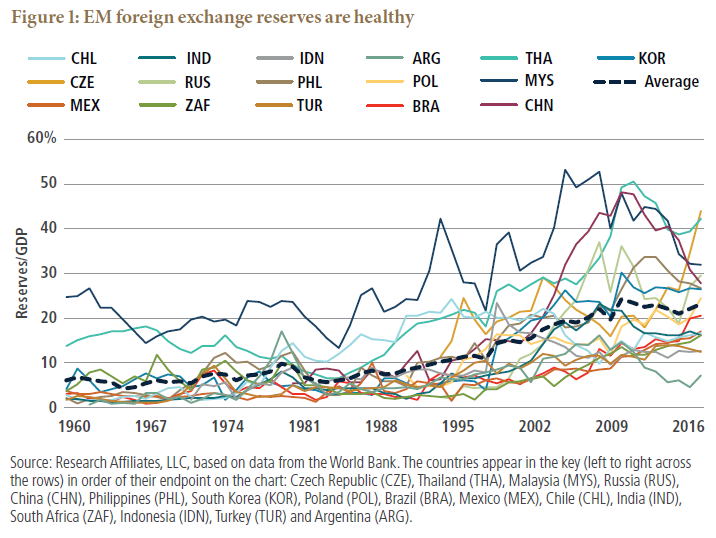
Contrary to pundits’ predictions, the largest EM equity markets are not at risk of a funding crisis, in our view. China, South Korea, Taiwan, India and Russia all present political or economic risks – that’s what makes them emerging markets. According to our analysis, however, none presents any measurable risk of a funding crisis. All have low external-debt-to-GDP ratios and ample foreign exchange (FX) reserves (see Figure 1), and most run current account surpluses (India runs an immaterial current account deficit). Brazil, Mexico and South Africa run current account deficits but also have low external-debt-to-GDP paired with healthy FX reserves. Only a few countries in our view, including Turkey and Indonesia, seem at material risk, with high external debt, low FX reserves and significant current account deficits. However, these at-risk markets are only a small fraction of the total EM equity market: As of 30 June 2018, Turkey and Indonesia represented just 0.8% and 1.9%, respectively, of the MSCI Emerging Markets Index.
To assess whether today’s widely reported risks are fairly priced, let’s take a look at valuations. Remarkably, even after EM stocks (as proxied by the MSCI Emerging Markets Index) have delivered nearly a 100% total return from the lows of early 2016, they remain comparatively cheap when measured by the cyclically adjusted price-to-earnings (CAPE) ratio, price-to-book ratio, price-to-sales ratio, market-cap-to-GDP ratio and other metrics. EM stocks are priced at less than half of the U.S. CAPE. With a CAPE over 30x, the U.S. equity market (as proxied by the S&P 500) seems a riskier bet, in our opinion, when comparing risk to forward-looking estimated returns.
We estimate returns of all asset classes using the fundamental building blocks of real returns. For the EM equity asset class, we begin with today’s dividend yield of 2.7%, add a real growth forecast of 3.5% (1.5% trend real growth in dividends and 2% real currency appreciation from productivity growth), and make a modest upward adjustment for valuation changes to arrive at an estimated annualized real return of nearly 7% over the next decade. In comparison, our analysis finds no other publicly traded asset class that we currently forecast will provide real returns greater than 5%.
Finally, we note that the majority of our EM equity investments are in PIMCO RAE funds, which are systematic active equity strategies that currently exhibit a deep value tilt. We believe that our active positioning within these RAE strategies, both across countries and among the stocks within each market, provides even higher long-term return potential balanced against the risks.
In our view, the frightening headlines and accompanying correction in EM asset prices are good news for the long-term investor. We are willing to accept short-term pain for improved long-term potential – an exchange that, while uncomfortable, has generally benefited many contrarian investors for generations.
Q: The All Asset and All Asset All Authority strategies seek real returns. How does that differ from seeking nominal returns, and why should that difference matter to your investors?
Arnott: Our industry tends to focus on nominal returns and to rely on current market levels to identify higher rates of return, at the expense of other potentially better gauges of investments’ long-term true value. The conventional view is that U.S. Treasury bills are among the lowest-risk strategies and that developed market stocks (U.S. and international) provide a large risk premium. But is that necessarily the case? This all-too-common presumption can be a costly mistake, because it provides an incomplete lens from which to base investment decisions.
Most people measure wealth in terms of a portfolio’s dollar value. But what if, instead of relying solely on asset values, investors also considered levels of real spending power (i.e., net of inflation) in their portfolios? In 2004, I wrote a piece for the Financial Analysts Journal's “Editor’s Corner,” pointing out that wealth should not be measured in dollars, but in real purchasing power.2 A million dollars in 2018 buys vastly less than the same sum in 1918.
Going a step further, I pointed out that wealth should really be measured not by our purchasing power for immediate spending, but by the real spending, net of inflation, that our assets can sustain over a horizon long enough to matter. I referred to this as “sustainable real spending” (Jim Garland coined the expression “portfolio fecundity” around that same time, for the same concept). It’s a framework that’s similar to the asset-liability matching approach used by corporate defined benefit pensions seeking to immunize their longer-term pension obligations (also referred to as liability-driven investing, or LDI). For individuals, our long-term liabilities are our future spending needs, which of course grow with inflation. Therefore, a million dollars invested in long-term, nominal (i.e., fixed-rate) European government bonds yielding near-zero actually present increased risks when viewed through a real-return lens because they have limited ability to sustain future purchasing power, net of inflation. Conversely, a like sum invested in a strategy with a higher yield, greater growth potential and positive correlation with inflation may be meaningfully less risky when viewed through the same real-return lens, even though the absolute risk of the two approaches may be comparable.
We believe that aiming for a steady increase in sustainable real spending far better aligns our investments with the long-term obligations they are intended to serve. There are a variety of metrics to measure how effective a portfolio’s real spending return is likely to be. For instance, because dividends generally rise with inflation, the dividend yield is a simple measure of the sustainable real spending of stocks (plus about 1.5 percentage points of real growth on average over the last century). The same applies to the real yields on bonds.
The key here is spending power over a relevant time horizon. For instance, we might measure an investment’s value against the changing cost of a 20-year inflation-indexed annuity3 – an approach that can be applied apples-to-apples across a wide roster of asset classes.
Consider figures 2 and 3. Figure 2 displays the long-term return and risk of asset classes from the vantage point of a nominal return investor: the x-axis is the volatility (standard deviation) of the annualized nominal returns of assets shown in the y-axis. Figure 3 reframes the same scatter graph for a real-return-oriented investor by displaying the volatility of a real income annuity (x-axis) that can be purchased with the same assets (the annualized returns in the y-axis are the same for both graphs).
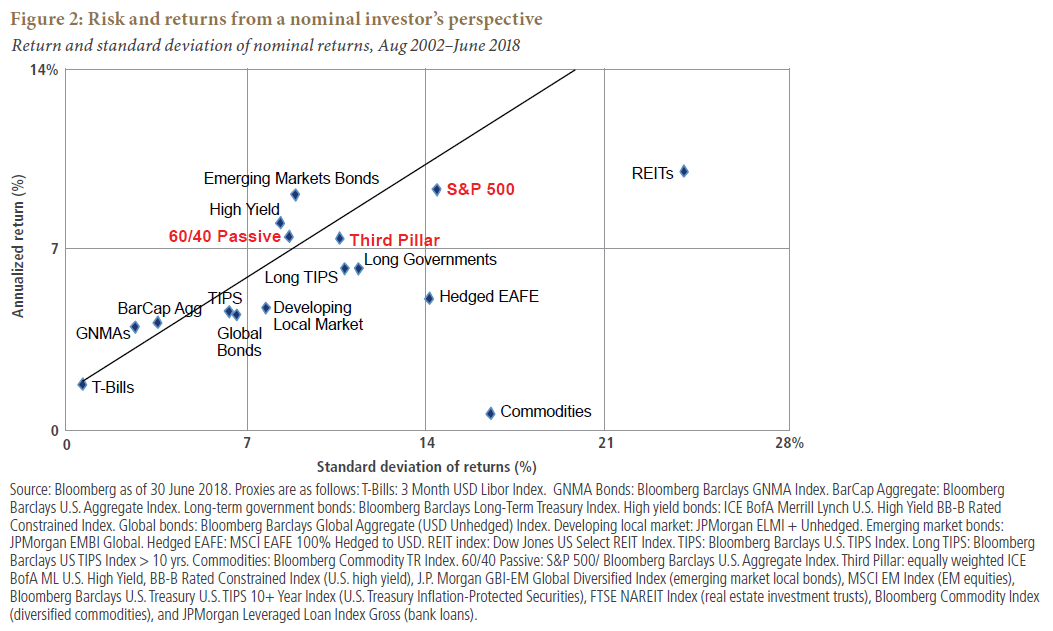
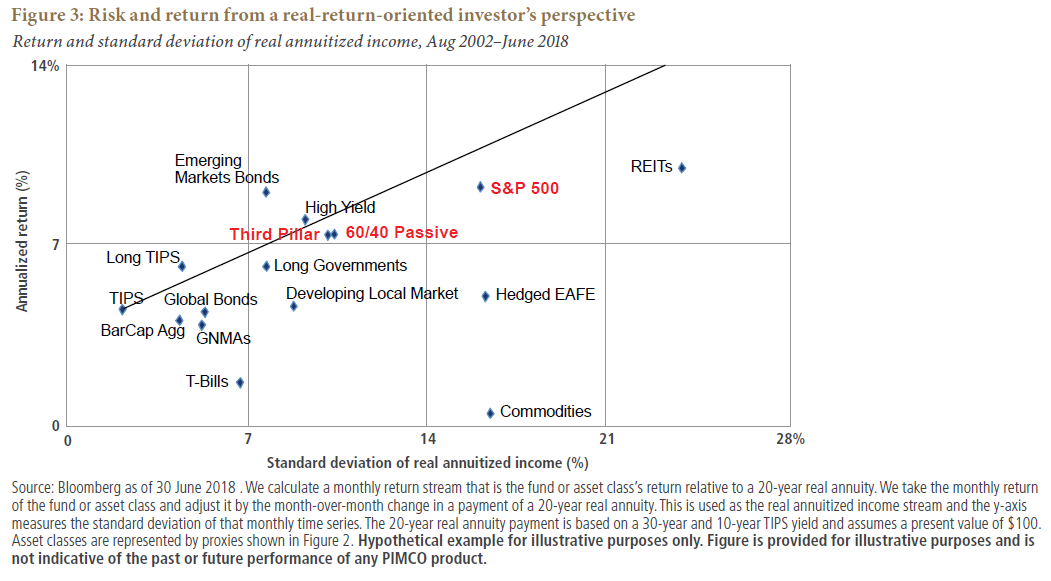
A comparison of the two exhibits suggests that Treasury Inflation-Protected Securities (TIPS) have been the most risk-minimizing strategy for real return investors, while Treasury bills have been the most risk-minimizing for nominal return investors. From a sustainable, long-term real spending perspective, government bonds have been less risky than they may intuitively seem, and long TIPS even less so. In contrast, stocks (U.S. and international) delivered even more volatility in real sustainable spending than in portfolio valuations, while EM bonds delivered a bit less.
This brings us to an interesting and often underappreciated nuance. Even though most of the markets in which we invest may seem riskier than a conventional U.S. 60/40 portfolio (proxied by 60% S&P 500 Index and 40% Bloomberg Barclays U.S. Aggregate Bond Index), the All Asset strategy may actually be risk-reducing from the perspective of an investor seeking to build real spending power, given its focus on “Third Pillar” assets (including real assets, emerging markets and high yield bonds). As measured by the volatility of our nominal portfolio value, the risk (or volatility) for Third Pillar assets since the All Asset Fund’s inception is greater (at 10.5%) than that of a U.S. 60/40 portfolio (at 8.6%), over the same time frame (see Figure 2). However, when measured in terms of real sustainable spending, Third Pillar risk goes down, while the risk for a conventional 60/40 portfolio goes up, to 10.1% and 10.4%, respectively (see Figure 3).
These results do not surprise us, because they are in line with the mission and design of our strategies. Sixteen years ago, we launched the real-return-oriented All Asset strategies with an aim to invest for a steady increase in sustainable spending, while providing a simple way for investors to complement their holdings in mainstream stocks and bonds with a strategy that we believe provides true diversification.
Is maintaining a focus on real sustainable spending power easy? Hardly! After all, it requires investors to go against human instinct: to sell what has given us great joy and profit, while buying what has inflicted pain and losses. One of the beauties of our strategies is that they seek to set human emotion aside, contra-trading out of the most beloved, expensive assets and into bargains that are priced with attractive forward risk premiums for the patient long-term investor.
This is the engine that seeks to ratchet up sustainable real spending with an aim to build true wealth for our clients.
The All Asset strategies represent a joint effort between PIMCO and Research Affiliates. PIMCO provides the broad range of underlying strategies – spanning global stocks, global bonds, commodities, real estate and liquid alternative strategies – each actively managed to maximize potential alpha. Research Affiliates, an investment advisory firm founded in 2002 by Rob Arnott and a global leader in asset allocation, serves as the sub-advisor responsible for the asset allocation decisions. Research Affiliates uses their deep research focus to develop a series of value-oriented, contrarian models that determine the appropriate mix of underlying PIMCO strategies in seeking All Asset’s return and risk goals.
1 Interested readers can learn more in Research Affiliates’ June 2018 publication, “Pundits Predicting Panic in Emerging Markets,” by Chris Brightman, Michele Mazzoleni and Jonathan Treussard.
2 Please see “Sustainable Spending in a Lower-Return World,” the “Editor’s Corner” piece in the September/October 2004 issue of the Financial Analysts Journal.
3 To calculate the historical cost of an inflation-indexed annuity, we can use the TIPS yield curve to estimate how much it would cost to be in a TIPS portfolio that would pay, for example, $100 a month indexed to inflation for the next 20 years.
DISCLOSURES
Investors should consider the investment objectives, risks, charges and expenses of the funds carefully before investing. This and other information are contained in the fund’s prospectus and summary prospectus, if available, which may be obtained by contacting your investment professional or PIMCO representative or by visiting www.pimco.com. Please read them carefully before you invest or send money.
The terms “cheap” and “rich” as used herein generally refer to a security or asset class that is deemed to be substantially under- or overpriced compared to both its historical average as well as to the investment manager’s future expectations. There is no guarantee of future results or that a security’s valuation will ensure a profit or protect against a loss.
Past performance is not a guarantee or a reliable indicator of future results.
A word about risk:
The fund invests in other PIMCO funds and performance is subject to underlying investment weightings which will vary. Investing in the bond marketis subject to risks, including market, interest rate, issuer, credit, inflation risk, and liquidity risk. The value of most bonds and bond strategies are impacted by changes in interest rates. Bonds and bond strategies with longer durations tend to be more sensitive and volatile than those with shorter durations; bond prices generally fall as interest rates rise, and the current low interest rate environment increases this risk. Current reductions in bond counterparty capacity may contribute to decreased market liquidity and increased price volatility. Bond investments may be worth more or less than the original cost when redeemed. Investing in foreign denominated and/or domiciled securities may involve heightened risk due to currency fluctuations, and economic and political risks, which may be enhanced in emerging markets. Commodities contain heightened risk including market, political, regulatory, and natural conditions, and may not be suitable for all investors. Mortgage and asset-backed securities may be sensitive to changes in interest rates, subject to early repayment risk, and their value may fluctuate in response to the market’s perception of issuer creditworthiness; while generally supported by some form of government or private guarantee there is no assurance that private guarantors will meet their obligations. High-yield, lower-rated, securities involve greater risk than higher-rated securities; portfolios that invest in them may be subject to greater levels of credit and liquidity risk than portfolios that do not. Investing in securities of smaller companies tends to be more volatile and less liquid than securities of larger companies. Inflation-linked bonds (ILBs) issued by a government are fixed-income securities whose principal value is periodically adjusted according to the rate of inflation; ILBs decline in value when real interest rates rise. Equities may decline in value due to both real and perceived general market, economic, and industry conditions. Entering into short sales includes the potential for loss of more money than the actual cost of the investment, and the risk that the third party to the short sale may fail to honor its contract terms, causing a loss to the portfolio. The use of leverage may cause a portfolio to liquidate positions when it may not be advantageous to do so to satisfy its obligations or to meet segregation requirements. Leverage, including borrowing, may cause a portfolio to be more volatile than if the portfolio had not been leveraged. Derivatives and commodity-linked derivatives may involve certain costs and risks such as liquidity, interest rate, market, credit, management and the risk that a position could not be closed when most advantageous. Commodity-linked derivative instruments may involve additional costs and risks such as changes in commodity index volatility or factors affecting a particular industry or commodity, such as drought, floods, weather, livestock disease, embargoes, tariffs and international economic, political and regulatory developments. Investing in derivatives could lose more than the amount invested. The cost of investing in the Fund will generally be higher than the cost of investing in a fund that invests directly in individual stocks and bonds. Diversification does not ensure against loss.
There is no guarantee that these investment strategies will work under all market conditions or are suitable for all investors and each investor should evaluate their ability to invest long-term, especially during periods of downturn in the market. Investors should consult their investment professional prior to making an investment decision.
PIMCO does not offer insurance guaranteed products or products that offer investments containing both securities and insurance features.
The 3-Month LIBOR (London Interbank Offered Rate) Index is an average interest rate, determined by the ICE Benchmark Administration, that banks charge one another for the use of short-term money (3 months) in England’s Eurodollar market. The Bloomberg Barclays Global Aggregate (USD Unhedged) Index provides a broad-based measure of the global investment-grade fixed income markets. The three major components of this index are the U.S. Aggregate, the Pan-European Aggregate, and the Asian-Pacific Aggregate Indices. The index also includes Eurodollar and Euro-Yen corporate bonds, Canadian Government securities, and USD investment grade 144A securities. The Bloomberg Barclays Global Aggregate ex-USD (USD Unhedged) Index provides a broad-based measure of the global investment-grade fixed income markets, excluding USD. The two major components of this index are the Pan-European Aggregate and the Asian-Pacific Aggregate Indices. The index also includes Euro-Yen corporate bonds and Canadian Government securities. The Bloomberg Barclays GNMA Index is an unmanaged index covering mortgage-backed pass-through securities of the Government National Mortgage Association (GNMA). Bloomberg Barclays Long-Term Treasury Index consists of U.S. Treasury issues with maturities of 10 or more years. Bloomberg Barclays U.S. Aggregate Index represents securities that are SEC-registered, taxable, and dollar denominated. The index covers the U.S. investment grade fixed rate bond market, with index components for government and corporate securities, mortgage pass-through securities, and asset-backed securities. These major sectors are subdivided into more specific indices that are calculated and reported on a regular basis. Bloomberg Barclays U.S. TIPS Index is an unmanaged market index comprised of all U.S. Treasury Inflation Protected Securities rated investment grade (Baa3 or better), have at least one year to final maturity, and at least $250 million par amount outstanding. Performance data for this index prior to 10/97 represents returns of the Barclays Inflation Notes Index. Bloomberg Barclays U.S. Treasury Inflation Notes: 10+ Year is an unmanaged index market comprised of U.S. Treasury Inflation Protected securities with maturities of over 10 years. The Bloomberg Commodity Total Return Index is an unmanaged index composed of futures contracts on 22 physical commodities. The index is designed to be a highly liquid and diversified benchmark for commodities as an asset class. The Dow Jones U.S. Select Real Estate Investment Trust (REIT) Index is an unmanaged index subset of the Dow Jones Americas U.S. Select Real Estate Securities (RESI) IndexSM. This index is a market capitalization weighted index of publicly traded Real Estate Investment Trusts (REITs) and only includes only REITs and REIT-like securities. The ICE BofA Merrill Lynch 1-3 Year Treasury Index is an unmanaged index that tracks the performance of the direct sovereign debt of the U.S. Government having a maturity of at least one year and less than three years. ICE BofA Merrill Lynch U.S. High Yield, BB-B Rated, Constrained Index tracks the performance of BB-B Rated US Dollar-denominated corporate bonds publicly issued in the US domestic market. Qualifying bonds are capitalization-weighted provided the total allocation to an individual issuer (defined by Bloomberg tickers) does not exceed 2%. Issuers that exceed the limit are reduced to 2% and the face value of each of their bonds is adjusted on a pro-rata basis. Similarly, the face value of bonds of all other issuers that fall below the 2% cap are increased on a pro-rata basis. JPMorgan Emerging Local Markets Index Plus (Unhedged) tracks total returns for local currency-denominated money market instruments in 23 emerging markets countries with at least U.S. $10 billion of external trade. The JPMorgan Emerging Markets Bond Index Global is an unmanaged index which tracks the total return of U.S.-dollar-denominated debt instruments issued by emerging market sovereign and quasi-sovereign entities: Brady Bonds, loans, Eurobonds, and local market instruments. JPMorgan Government Bond Index-Emerging Markets Global Diversified Index (Unhedged) is a comprehensive global local emerging markets index, and consists of regularly traded, liquid fixed-rate, domestic currency government bonds to which international investors can gain exposure. The J.P. Morgan Leveraged Loan Index is designed to mirror the investable universe of U.S. dollar institutional leveraged loans, including U.S. and international borrowers. The J.P. Morgan U.S. Liquid Index is a market-weighted index that measures the performance of the most liquid issues in the investment grade, dollar-denominated corporate bond market. The MSCI EAFE Index is an equity index which captures large and mid cap representation across Developed Markets countries* around the world, excluding the US and Canada. With 928 constituents, the index covers approximately 85% of the free float-adjusted market capitalization in each country. The MSCI Emerging Markets Indexis a free float-adjusted market capitalization index that is designed to measure equity market performance of emerging markets. The MSCI Emerging Markets Index consists of the following 21 emerging market country indices: Brazil, Chile, China, Colombia, Czech Republic, Egypt, Hungary, India, Indonesia, Korea, Malaysia, Mexico, Morocco, Peru, Philippines, Poland, Russia, South Africa, Taiwan, Thailand, and Turkey. The National Association of Real Estate Investment Trusts (NAREIT) Equity Index is an unmanaged market weighted index of tax qualified REITs listed on the New York Stock Exchange, American Stock Exchange and the NASDAQ National Market System, including dividends. The S&P 500 Index is an unmanaged market index generally considered representative of the stock market as a whole. The index focuses on the Large-Cap segment of the U.S. equities market. It is not possible to invest directly in an unmanaged index.
This material contains the opinions of the manager and such opinions are subject to change without notice. This material has been distributed for informational purposes only and should not be considered as investment advice or a recommendation of any particular security, strategy or investment product. Information contained herein has been obtained from sources believed to be reliable, but not guaranteed. No part of this material may be reproduced in any form, or referred to in any other publication, without express written permission. PIMCO is a trademark of Allianz Asset Management of America L.P. in the United States and throughout the world.
PIMCO Investments LLC, distributor, 1633 Broadway, New York, NY, 10019 is a company of PIMCO.
CMR2018-0719-345255
© PIMCO
Membership required
Membership is now required to use this feature. To learn more:
View Membership BenefitsSponsored Content
Upcoming Virtual Events View All












