All Asset All Access, July 2018
Membership required
Membership is now required to use this feature. To learn more:
View Membership BenefitsSUMMARY
- Research Affiliates believes Fed Chairman Jerome Powell will likely be sensitive to the impact of Fed policy on business and the financial system, but his potential response to an inflation shock is untested.
- Putting real return diversifiers in place to counteract mainstream investments’ vulnerability to a potential inflation surprise seems compelling and may be prudent.
- Research Affiliates and PIMCO have collaborated for over 15 years to create products that address key investor challenges, including vulnerability to renewed inflation prospects and inadequate diversification relative to U.S equity risk.
- The strategies we jointly launch often benefit from multiple sources of potential return within a single fund, including the return of the asset class, the excess return of the collateral, PIMCO’s active management expertise and the benefits of Research Affiliates’ empirically tested systematic equity market insights.
Rob Arnott, founding chairman and head of Research Affiliates, discusses his optimism about Federal Reserve Chairman Jerome Powell and why putting inflation-fighting diversifiers in place now may be prudent, while Jonathan Treussard, Research Affiliates’ head of product management, offers insight into how PIMCO and Research Affiliates collaborate to create innovative solutions that aim to meet the needs of investors. As always, their insights are in the context of the PIMCO All Asset and All Asset All Authority funds.
Q: What are your thoughts on Federal Reserve Chairman Jerome Powell, and how does this inform your positioning for a potential inflation overshoot?
Arnott: I’m heartened by Chairman Jay Powell’s private-sector background. He’s the first Fed chairman since Paul Volcker who has run a business and had to meet a payroll. This likely means less reliance on academic models, less temptation to run multi-trillion-dollar experiments and more reliance on common sense. Powell will likely be sensitive to the impact of Fed policy on business and the financial system, and – at the same time – less tempted to offer a “Powell Put.” He has mentioned simplifying areas that affect banks, such as the stress test and other rules impacting smaller banks. Might this lead to an increase in lending activity? Possibly.
Long before his confirmation as chairman in February, he earned a reputation as a bipartisan consensus builder. Notably, he has never dissented in a monetary policy vote since joining the board in May 2012 as Fed governor. Accordingly, it’s unlikely that Chairman Powell will change course from the policy normalization put in place by the Fed under Janet Yellen. For this year, Fed guidance calls for a gradual rise in rates and a concurrent, even more gradual, reduction in the balance sheet.
Several questions bear mention as we look forward over a longer horizon. How and when will Powell end the process of policy normalization after the current round of rate hikes is done? If inflation strikes swiftly and with a vengeance, would Powell aggressively tighten rates to avert the threat, even at the risk of triggering a bear market? I fear this scenario less with Powell than I would have with Yellen, and already he has emphasized the symmetrical nature of the Fed’s inflation target, but he’s untested. It’s worth noting that by the time Volcker took extreme action to rein in inflation in the 1980s, the populace was so traumatized by inflation that they were willing to accept bitter medicine to address the problem. Today the populace is by no means ready for bitter medicine, in our view – not even close.
As we mull the inflation scenario posed by that last question, let’s consider Figure 1. It’s evident that unanticipated moves in inflation have historically hurt both stocks and bonds. While past is not prologue, you’ll also observe that during all periods of positive inflation shocks over the last 45 years, risk-adjusted returns as measured by Sharpe ratios are substantially higher for a basket of inflation-fighting diversifiers (i.e., “Third Pillar” assets) relative to mainstream assets. In this exhibit, we define inflation shocks based on the difference between actual inflation at the end of the quarter and expectations for inflation at the start of the quarter. An “inflation shock” is a quarter that falls in the top third of all historical inflation surprises, with inflation at least 0.6 percentage points above expectations, from June 1973 through March 2018.
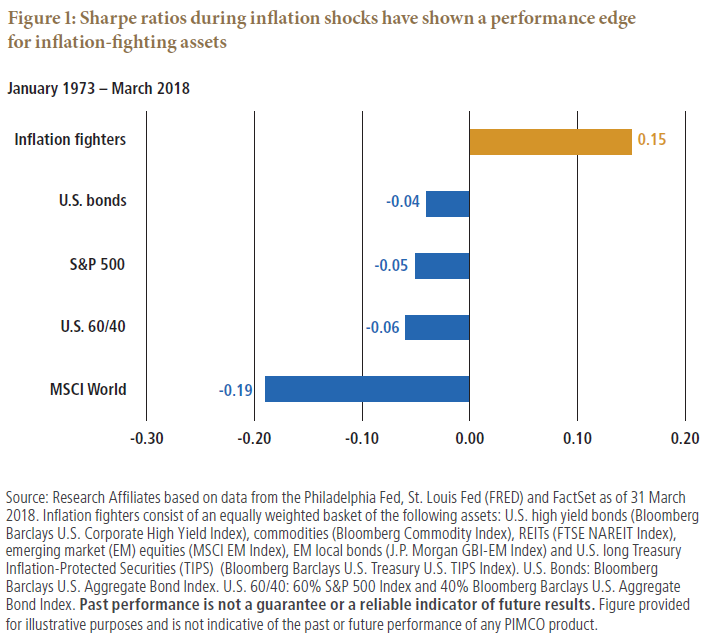
Keep in mind our finding, discussed in the June 2017 edition, that All Asset and All Authority generally beat a conventional 60/40 balanced portfolio during bear markets (stocks down, year over year) and during periods of high volatility (VIX over 20%). The conventional portfolio generally won during low-volatility bull markets.1 The chart above shows a third scenario, renewed inflation, in which these inflation fighters have tended to win.
If an investor is highly confident that – for years to come – we’ll see low inflation and rising markets with low volatility, then diversifying strategies may not be as crucial. If an investor is highly confident that he or she will “hear the bell ring” before we see renewed inflation (or economic or market turbulence), then they may choose to hold off and rotate to diversifying strategies just in the nick of time. But, if an investor fears that, at some point in the coming two to four years, we’ll see renewed inflation (above Fed targets), or renewed bouts of volatility, or a recession, or a bear market – and that the markets won’t warn us just before these shocks hit – then it may be better to seek diversification now, so that it’s in place when it’s needed.
The markets and the economy will inevitably test Powell and the Fed’s tightening resolve. Putting real return diversifiers in place to counteract the vulnerabilities of mainstream investments seems both compelling and may be prudent.
Q: How do Research Affiliates and PIMCO collaborate to develop and launch new investor solutions, several of which are included in the All Asset suite’s opportunity set?
Treussard: For over 15 years, the teams at Research Affiliates and PIMCO have collaborated on new investment products, driven by our common tradition of innovation in the service of investors. We believe that our combined product design capabilities, along with PIMCO’s investment management and client service expertise, can help us deliver on our shared mission of serving investors seeking innovative, robust and market-tested investment strategies.
In the early 2000s, we came together to create a new strategy to address three investor challenges: low prospective returns from mainstream asset classes, inadequate diversification relative to U.S equity risk, and vulnerability to renewed inflation prospects. The All Asset suite was launched shortly after. Spanning a broad array of asset classes, the All Asset strategies initially centered on 12 underlying PIMCO funds within its opportunity set; today, over 60 funds are available to the All Asset suite in its continued pursuit to address the same three challenges for investors.
Since the launch of the All Asset suite, PIMCO has introduced a wide array of additional active solutions across global markets that offer potential to add value within our allocation framework and deepen our opportunity set in a distinct manner. These include systematic quantitative equity strategies that our firms have introduced together over the years.
Just three months after the publication of “Fundamental Indexation” in the Financial Analysts Journal in March 2005 (coauthored by Rob Arnott, Jason Hsu and Philip Moore of Research Affiliates), PIMCO was among the first investment management companies to launch an equity strategy predicated on the concept of fundamental weighting. The introduction of PIMCO RAE Fundamental PLUS Fund (and subsequent launches) is a testament to the joint commitment of Research Affiliates and PIMCO to innovate for the benefit of investors.
As we push our research agenda forward and derive new insights to incorporate into systematic equity strategies that aren’t tethered to market-capitalization weights, we’ve expanded our range of strategies within the PIMCO Research Affiliates Equity (RAE) suite of funds. In addition to the RAE PLUS and RAE equity strategies, the suite also includes Low Volatility PLUS funds, which allow investors, including the All Asset strategies, to seek to capture lower-risk equity exposure. Finally, the Fundamental Advantage and Worldwide Long/Short PLUS funds seek to be equity market neutral and low beta, respectively. An important part of the All Asset suite’s toolkit, these absolute-return-oriented strategies can be attractive alternatives to seek to de-risk the portfolio, offering the potential for positive expected returns while aiming to lower the portfolio’s equity market correlation.
Our two firms continue to forge ahead with innovative investment strategies that seek to meet important investor needs. The most recent launches in September 2017 featured three PIMCO RAFI Dynamic Multi-Factor equity ETFs, which further expand All Asset’s opportunity set. These smart beta index strategies are designed to offer diversified exposure to multiple equity factors, including value, quality, low volatility, momentum and size, thereby providing multiple potential long-term excess return drivers in a manner that aims to limit the prospect of prolonged underperformance tied to a single equity investment factor. Consistent with our tradition of allocating on the basis of forward-looking attractiveness, the RAFI Dynamic Multi-Factor strategies adjust factor allocations over time, carefully tilting toward exposures that may benefit from long-term return reversal and short-term momentum. As always, these strategies are designed with an eye toward reducing transaction costs and improving implementation characteristics so that investors can capture as much of the prospective excess returns as possible.
With every expansion in the opportunity set made possible by the launch of innovative PIMCO funds, the All Asset strategies can tactically access new and targeted exposures that align with our long-standing aim of delivering improved real returns and diversification to investors. The strategies we jointly launch are designed to add value in a structural way and to deliver institutional-level execution, and often benefit from multiple sources of potential return within a single fund. These include but are not limited to the return of the asset class, the excess return of the collateral, PIMCO’s active management expertise and the benefits of Research Affiliate’s empirically tested systematic equity market insights.
The All Asset strategies represent a joint effort between PIMCO and Research Affiliates. PIMCO provides the broad range of underlying strategies – spanning global stocks, global bonds, commodities, real estate and liquid alternative strategies – each actively managed to maximize potential alpha. Research Affiliates, an investment advisory firm founded in 2002 by Rob Arnott and a global leader in asset allocation, serves as the sub-advisor responsible for the asset allocation decisions. Research Affiliates uses their deep research focus to develop a series of value-oriented, contrarian models that determine the appropriate mix of underlying PIMCO strategies in seeking All Asset’s return and risk goals.
1 The trends noted for a “bear market” and a “high volatility” market in Figure 1 of the June 2017 edition have persisted; as of May 2018, the rolling 12-month return of the S&P 500 has been positive and the average 12-month volatility has been below 20.
DISCLOSURES
Investors should consider the investment objectives, risks, charges and expenses of the funds carefully before investing. This and other information are contained in the fund’s prospectus and summary prospectus, if available, which may be obtained by contacting your investment professional or PIMCO representative or by visiting www.pimco.com. Please read them carefully before you invest or send money.
Past performance is not a guarantee or a reliable indicator of future results. The performance figures presented reflect the total return performance and reflect changes in share price and reinvestment of dividend and capital gain distributions. All periods longer than one year are annualized. The minimum initial investment for Institutional class shares is $1 million; however, it may be modified for certain financial intermediaries who submit trades on behalf of eligible investors.
Investments made by a Fund and the results achieved by a Fund are not expected to be the same as those made by any other PIMCO-advised Fund, including those with a similar name, investment objective or policies. A new or smaller Fund’s performance may not represent how the Fund is expected to or may perform in the long-term. New Funds have limited operating histories for investors to evaluate and new and smaller Funds may not attract sufficient assets to achieve investment and trading efficiencies. A Fund may be forced to sell a comparatively large portion of its portfolio to meet significant shareholder redemptions for cash, or hold a comparatively large portion of its portfolio in cash due to significant share purchases for cash, in each case when the Fund otherwise would not seek to do so, which may adversely affect performance.
Differences in the Fund’s performance versus the index and related attribution information with respect to particular categories of securities or individual positions may be attributable, in part, to differences in the pricing methodologies used by the Fund and the index.
There is no assurance that any fund, including any fund that has experienced high or unusual performance for one or more periods, will experience similar levels of performance in the future. High performance is defined as a significant increase in either 1) a fund’s total return in excess of that of the fund’s benchmark between reporting periods or 2) a fund’s total return in excess of the fund’s historical returns between reporting periods. Unusual performance is defined as a significant change in a fund’s performance as compared to one or more previous reporting periods.
A word about risk:
The fund invests in other PIMCO funds and performance is subject to underlying investment weightings which will vary. Investing in the bond market is subject to risks, including market, interest rate, issuer, credit, inflation risk, and liquidity risk. The value of most bonds and bond strategies are impacted by changes in interest rates. Bonds and bond strategies with longer durations tend to be more sensitive and volatile than those with shorter durations; bond prices generally fall as interest rates rise, and the current low interest rate environment increases this risk. Current reductions in bond counterparty capacity may contribute to decreased market liquidity and increased price volatility. Bond investments may be worth more or less than the original cost when redeemed. Investing in foreign denominated and/or domiciled securities may involve heightened risk due to currency fluctuations, and economic and political risks, which may be enhanced in emerging markets. Commodities contain heightened risk including market, political, regulatory, and natural conditions, and may not be suitable for all investors. Mortgage and asset-backed securities may be sensitive to changes in interest rates, subject to early repayment risk, and their value may fluctuate in response to the market’s perception of issuer creditworthiness; while generally supported by some form of government or private guarantee there is no assurance that private guarantors will meet their obligations. High-yield, lower-rated, securities involve greater risk than higher-rated securities; portfolios that invest in them may be subject to greater levels of credit and liquidity risk than portfolios that do not. Investing in securities of smaller companies tends to be more volatile and less liquid than securities of larger companies. Inflation-linked bonds (ILBs) issued by a government are fixed-income securities whose principal value is periodically adjusted according to the rate of inflation; ILBs decline in value when real interest rates rise. Equities may decline in value due to both real and perceived general market, economic, and industry conditions. Entering into short sales includes the potential for loss of more money than the actual cost of the investment, and the risk that the third party to the short sale may fail to honor its contract terms, causing a loss to the portfolio. The use of leverage may cause a portfolio to liquidate positions when it may not be advantageous to do so to satisfy its obligations or to meet segregation requirements. Leverage, including borrowing, may cause a portfolio to be more volatile than if the portfolio had not been leveraged. Derivatives and commodity-linked derivatives may involve certain costs and risks such as liquidity, interest rate, market, credit, management and the risk that a position could not be closed when most advantageous. Commodity-linked derivative instruments may involve additional costs and risks such as changes in commodity index volatility or factors affecting a particular industry or commodity, such as drought, floods, weather, livestock disease, embargoes, tariffs and international economic, political and regulatory developments. Investing in derivatives could lose more than the amount invested. The cost of investing in the Fund will generally be higher than the cost of investing in a fund that invests directly in individual stocks and bonds. Diversification does not ensure against loss.
There is no guarantee that these investment strategies will work under all market conditions or are suitable for all investors and each investor should evaluate their ability to invest long-term, especially during periods of downturn in the market. Investors should consult their investment professional prior to making an investment decision.
PIMCO may or may not continue to own the securities referenced herein and, if such securities are owned, no representation is being made that such securities will continue to be held. Holdings are subject to change.
Exchange Traded Funds (“ETF”) are afforded certain exemptions from the Investment Company Act. The exemptions allow, among other things, for individual shares to trade on the secondary market. Individual shares cannot be directly purchased from or redeemed by the ETF. Purchases and redemptions directly with ETFs are only accomplished through creation unit aggregations or “baskets” of shares. Shares of an ETF are bought and sold at market price (not NAV). Brokerage commissions will reduce returns. Investment policies, management fees and other information can be found in the individual ETF’s prospectus. Buying or selling ETF shares on an exchange may require the payment of brokerage commissions. Due to the costs inherent in buying or selling Fund shares, frequent trading may detract significantly from investment returns. Investment in Fund shares may not be advisable for investors who expect to engage in frequent trading. Different fund types (e.g. ETFs, open-ended investment companies) and fund share classes are subject to different fees and expenses (which may affect performance). They may also have different minimum investment requirements and be entitled to different services. The Funds mentioned herein use an indexing approachand may be affected by a general decline in market segments or asset classes relating to its Underlying Index. The Fund invests in securities and instruments included in, or representative of, its Underlying Index regardless of the investment merits of the Underlying Index. Smart beta refers to a benchmark designed to deliver a better risk and return trade-off than conventional market cap weighted indices. Current holdings are subject to risk. Holdings are subject to change at any time. An investment in an ETF involves risk, including the loss of principal. Investment return, price, yield and Net Asset Value (NAV) will fluctuate with changes in market conditions. Investments may be worth more or less than the original cost when redeemed. ETF shares may be bought or sold throughout the day at their market price on the exchange on which they are listed. However, there can be no guarantee that an active trading market for PIMCO ETF shares will develop or be maintained, or that their listing will continue or remain unchanged.
Bloomberg Barclays U.S. Aggregate Index represents securities that are SEC-registered, taxable, and dollar denominated. The index covers the U.S. investment grade fixed rate bond market, with index components for government and corporate securities, mortgage pass-through securities, and asset-backed securities. These major sectors are subdivided into more specific indices that are calculated and reported on a regular basis. The Bloomberg Barclays U.S. Corporate High-Yield Index the covers the USD-denominated, non-investment grade, fixed-rate, taxable corporate bond market. Securities are classified as high-yield if the middle rating of Moody’s, Fitch, and S&P is Ba1/BB+/BB+ or below. The index excludes Emerging Markets debt. Bloomberg Barclays U.S. TIPS Index is an unmanaged market index comprised of all U.S. Treasury Inflation Protected Securities rated investment grade (Baa3 or better), have at least one year to final maturity, and at least $250 million par amount outstanding. Performance data for this index prior to 10/97 represents returns of the Barclays Inflation Notes Index. The Bloomberg Commodity Total Return Index is an unmanaged index composed of futures contracts on 22 physical commodities. The index is designed to be a highly liquid and diversified benchmark for commodities as an asset class. The FTSE National Association of Real Estate Investment Trusts (NAREIT) Equity Index is an unmanaged market weighted index of tax qualified REITs listed on the New York Stock Exchange, American Stock Exchange and the NASDAQ National Market System, including dividends. The S&P 500 Index is an unmanaged market index generally considered representative of the stock market as a whole. The index focuses on the Large-Cap segment of the U.S. equities market. It is not possible to invest directly in an unmanaged index.
This material contains the opinions of the manager and such opinions are subject to change without notice. This material has been distributed for informational purposes only and should not be considered as investment advice or a recommendation of any particular security, strategy or investment product. Information contained herein has been obtained from sources believed to be reliable, but not guaranteed. No part of this material may be reproduced in any form, or referred to in any other publication, without express written permission. PIMCO is a trademark of Allianz Asset Management of America L.P. in the United States and throughout the world.
PIMCO Investments LLC, distributor, 1633 Broadway, New York, NY, 10019 is a company of PIMCO.
CMR2018-0619-338821
© PIMCO
Membership required
Membership is now required to use this feature. To learn more:
View Membership Benefits