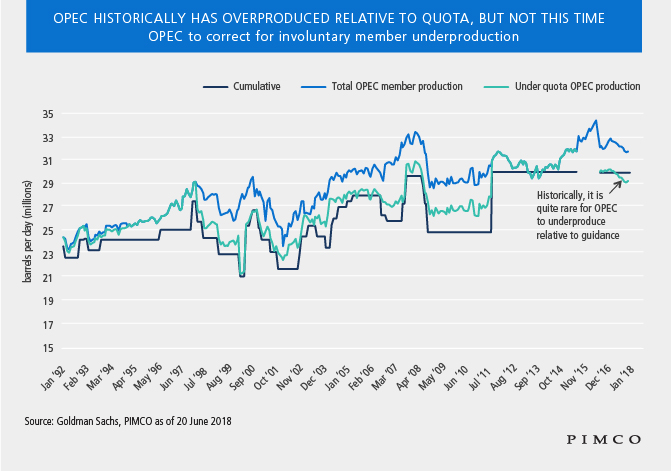
The recent OPEC meetings and press conference have given oil investors greater clarity about the cartel’s intentions and reaction function: OPEC, along with Russia and other partners, agreed to boost aggregate output by 700,000–1 million barrels per day. Individual countries that are able to increase production, such as Saudi Arabia and Russia, will be free to do so under the new agreement (putting those that can’t at a clear disadvantage). Production declines in certain countries had caused OPEC to produce below its quota, a rare event historically (see chart).
In the weeks leading up to the meetings, oil prices fell nearly 10% from three-year highs reached in May as traders anticipated an agreement to raise output – a reasonable response, in our view. However, while OPEC has agreed to boost output, its stated goal is to stabilize inventories, which would be consistent with sustained backwardation of the oil price curve and positive roll yield, in our view. Longer term, we think OPEC may need to increase output further into 2019 if buyers of Iranian oil curb imports in response to U.S. pressure – a development that could test global spare capacity.
The oil output increase in perspective
Although OPEC did not offer full clarity on how it plans to allocate the production increase, a net boost in supply of up to 1 million barrels per day appears likely. While this is not a trivial amount, we note that Angolan and Venezuelan output has dropped by roughly half that amount over the past nine months, pushing OPEC’s overall compliance with output cuts to historical highs. Given this, we think the increase was very much needed to slow the pace of inventory drawdowns.

Will checks on Iranian imports test capacity?
While the recent output agreement is important, a reduction in Iranian exports resulting from the implementation of U.S. sanctions would likely have a significantly larger impact on prices. Given some limitations to ramping up U.S. production over the next year, any drop in Iranian exports would lead to additional calls to key OPEC members to boost production – most notably Saudi Arabia, which will likely be close to previous oil production highs after the output increase. Said another way, the oil market could very well be testing how much spare capacity is left in the system over the next 18 months, until material additional pipeline capacity becomes available.
Investor takeaways
We believe the current environment of backwardation and positive roll yield will likely drive positive returns. The futures curve is pricing in a $4 decline in oil prices over the next year, and we view an outright decline as unlikely absent a material economic slowdown. In the details of its communication, OPEC appears to be mapping out a rough level at which it views the price of oil as fair and where certain countries would start to seek market share as opposed to price gains. Additionally, recent data suggest a slowdown in oil demand growth as prices accelerated to $80 per barrel. This is particularly true for refined petroleum products, which originate from crude oil processed in a refinery, as opposed to liquefied petroleum gases, most of which are not sourced from refining crude.
What will ultimately matter most is how much oil OPEC delivers relative to its guidance, and data on this is a few months away. Any signs of a notable slowdown in diesel or gasoline demand are worth monitoring. But with the global economy performing reasonably well and OPEC having demonstrated its ability to deliver on its production quota, our base case is that oil balances remain tight and that prices realized exceed what the futures market is indicating.
For more of our views on oil and other commodities, see related content on the PIMCO BLOG.
Greg Sharenow and Nicholas Johnson are PIMCO portfolio managers focusing on commodities and are regular contributors to the PIMCO Blog.
© PIMCO
© PIMCO
Read more commentaries by PIMCO