As many traditional credit sectors begin to approach full valuations, credit investors may want to look in new directions for attractive returns with manageable downside risk. In diversified credit portfolios today, de-risking and building liquidity are important, but we also see attractive relative value opportunities in a couple of (sometimes overlooked) sectors.
-
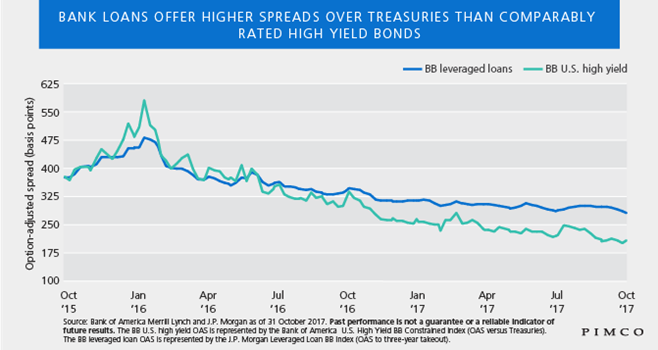
High quality bank loans: While spreads have tightened in absolute terms across credit markets, many high quality bank loans currently offer a similar spread to high yield bonds, but with lower volatility. Compared with high yield bonds (a frequent allocation in a diversified credit portfolio), bank loans sit higher in a company’s capital structure and offer floating-rate coupons as well as structural protections. In a large capital structure, where bank loans are senior secured, recovery rates in the event of a bankruptcy are usually materially higher than for high yield bonds – a feature that historically has contributed to lower volatility for bank loans relative to high yield bonds. With prices wrapped around par, bank loans now offer limited price appreciation as they are generally callable without penalty. However, bank loans may provide diversification in a rising rate environment and attractive yield for broader credit portfolios. Based on current spread levels, BB rated bank loans look attractive versus high yield bonds with the same rating, and in many cases offer a wider spread (see chart).
-
Senior securitized credit: Non-agency residential mortgage-backed securities (RMBS) remain one of PIMCO’s highest conviction trades within global fixed income, as these instruments offer a relatively stable yield profile across a variety of housing market scenarios and a way for investors to diversify their existing corporate credit risk. In our base case scenario, non-agencies offer high-yield-like return potential with less exposure to downside risk, and they may also benefit from higher inflation as the collateral appreciates. In addition to non-agency MBS, senior commercial MBS (CMBS) and collateralized loan obligations (CLOs) represent high quality, defensive assets that historically have traded at wider spreads than investment grade corporates due to their lower liquidity and higher structural complexity.
It’s important to remember that across all credit sectors – investment grade, high yield, MBS, municipals, leveraged loans – rigorous bottom-up credit research can help unearth attractive risk/reward opportunities.
Key takeaways
In today’s environment, as traditional credit market betas become less attractive, investors should consider tactical allocations to non-core sectors such as bank loans and higher-quality securitized credit. These instruments can allow investors to target attractive income levels while maintaining a diversified, resilient and relatively high quality portfolio.
For more on multi-sector credit investing, please read our Q&A, “Seeking Opportunities Across the Credit Spectrum Amid Rallying Markets.”
Eve Tournier is head of pan-European credit portfolio management and the lead portfolio manager for the firm’s global multi-sector credit strategies.
Sonali Pier is a portfolio manager focusing on high yield and multi-sector credit opportunities.
Investing in the bond market is subject to risks, including market, interest rate, issuer, credit, inflation risk, and liquidity risk. The value of most bonds and bond strategies are impacted by changes in interest rates. Bonds and bond strategies with longer durations tend to be more sensitive and volatile than those with shorter durations; bond prices generally fall as interest rates rise, and the current low interest rate environment increases this risk. Current reductions in bond counterparty capacity may contribute to decreased market liquidity and increased price volatility. Bond investments may be worth more or less than the original cost when redeemed. Bank loans are often less liquid than other types of debt instruments and general market and financial conditions may affect the prepayment of bank loans, as such the prepayments cannot be predicted with accuracy. There is no assurance that the liquidation of any collateral from a secured bank loan would satisfy the borrower’s obligation, or that such collateral could be liquidated. Mortgage- and asset-backed securities may be sensitive to changes in interest rates, subject to early repayment risk, and while generally supported by a government, government-agency or private guarantor, there is no assurance that the guarantor will meet its obligation. Collateralized Loan Obligations (CLOs) may involve a high degree of risk and are intended for sale to qualified investors only. Investors may lose some or all of the investment and there may be periods where no cash flow distributions are received. CLOs are exposed to risks such as credit, default, liquidity, management, volatility, interest rate and credit risk. The credit quality of a particular security or group of securities does not ensure the stability or safety of the overall portfolio. There is no guarantee that these investment strategies will work under all market conditions or are suitable for all investors and each investor should evaluate their ability to invest long-term, especially during periods of downturn in the market. Investors should consult their investment professional prior to making an investment decision.
© PIMCO
© PIMCO
Read more commentaries by PIMCO