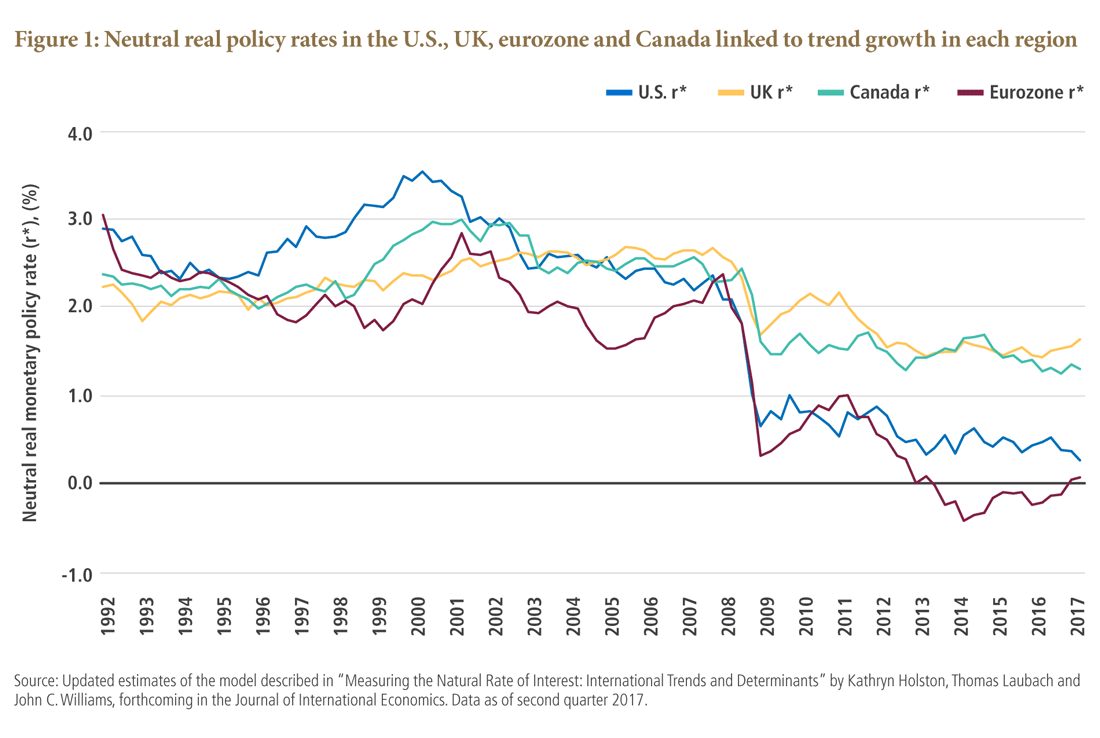
If countries are adjusting monetary policy in response to common, global neutral real rate shocks, there may well be a positive correlation in policy – even in the absence of policy cooperation or coordination.
In the face of a country-specific decline in the neutral rate, exchange rate depreciation may not in and of itself signal a “beggar-thy-neighbor” policy. By contrast, no exchange rate adjustment may be required for global (rather than country-specific) neutral rate shocks.
The global factor present in neutral (r*) policy rates around the world may inform and influence monetary policy decisions and prompt useful coordination – but likely not binding cooperation.
The concept of the neutral fed funds rate – often referred to as r* by Federal Reserve researchers and others – has become central to understanding how the Fed thinks about and communicates its plans for policy normalization at the same time that it begins the process of shrinking its balance sheet.
We’ve been writing about this New Neutral for monetary policy in a global context since 2014, and over the intervening years, both Fed thinking and market pricing have converged to the view that r* – the Fed policy rate consistent with 2% inflation and full employment in the U.S. economy – is much closer to 2% than to the pre-crisis estimates of 4% or greater.
What is perhaps less appreciated is the global component that drives neutral policy rates in different countries. Understanding that there is a significant global factor in neutral policy rates is crucial to understanding why central bank policies tend to be correlated across countries and how exchange rates and markets are likely to react to changes in policy.
Each country’s neutral rate may reflect the state of the global business cycle
At the annual Bank for International Settlements (BIS) research conference in June, I presented a paper on “The Global Factor in Neutral Policy Rates.”1 The focus, summarized here, is the practical implications for monetary policy and foreign exchange rates in a world of correlated r* shocks.
How does this model work?
In the original Taylor Rule, r* is assumed to be constant so that only a country’s inflation rate and output gap influence changes in the policy rate. However, the original Taylor rule can be easily modified to allow for a time-varying r*and for this time-varying r* to depend in part on the state of the global economy.
For example, Holston, Laubach and Williams (see Figure 1) show empirically that the neutral real policy rate in the U.S., UK, eurozone and Canada is a function of expected trend growth in each country. So if there is a common factor across countries in productivity growth, there will be a common factor in neutral policy rates. In the BIS paper, I show that in the sort of macro models that many central banks use to conduct policy simulations, r* in each country will also be a function of the state of the global business cycle. As a result, even when home and foreign fundamentals are statistically independent, if countries are adjusting policy in response to common, global neutral real rate shocks, there may well be a positive correlation in policy – even in the absence of policy cooperation or coordination. (I discuss central bank correlation, coordination and cooperation below and also in a prior edition of Global Central Bank Focus.)
Currency effects
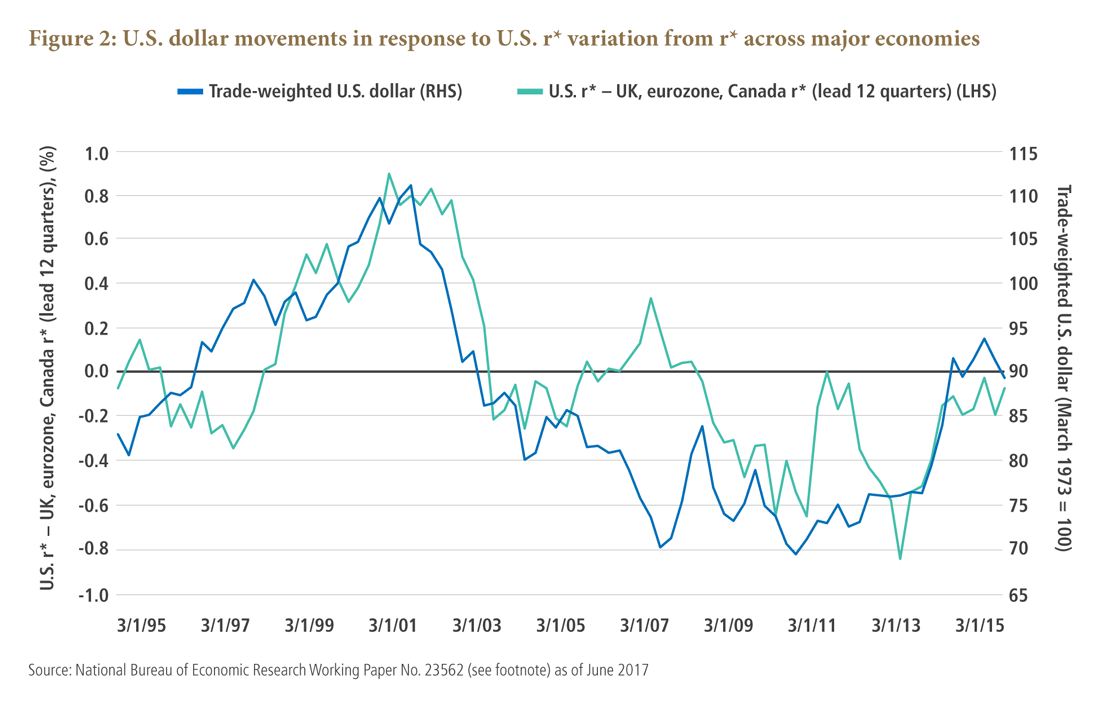
In a world of r* shocks, exchange rates will tend to respond not to the global factor in r* but instead to a country’s deviations in its r* from the global average (see Figure 2, in which the movement in the trade-weighted value of the U.S. dollar responds to the U.S. neutral policy rate’s variation relative to that of the eurozone, UK and Canada, following a lag). In that case, exchange rate depreciation in the face of a country-specific decline in r* shocks may not in and of itself signal a “beggar-thy-neighbor” policy. By contrast, no exchange rate adjustment may be required for global (rather than country-specific) r* shocks. In response to a global shock, a common global decline in real policy rates can do all the work to attain macroeconomic adjustment. This may look like, but is not necessarily evidence of a global “currency war” with a “race to the bottom” in policy rates as countries seek to avoid rate differentials and home currency appreciation as other countries cut interest rates.
Coordinated efforts
What about the potential gains from monetary policy coordination among different countries? To the extent a foreign central bank has some comparative advantage in “nowcasting” or forecasting productivity growth, its business cycle or its policy reaction function and r*, sharing this information with other central banks could improve the effectiveness of each bank’s policy in meeting its domestic objectives. In practice, since r* is not observable, coordination in such efforts could be very valuable at creating better estimates.
The ties that bind
While this model works in theory, what are the practical problems with taking global monetary policy one step further by engaging in cooperation? In practice, the cost to a regime of policy cooperation – in the sense of cooperative game theory – could be larger than the theoretical benefits. The problems include the threat to the credibility of the central bank, the challenges to central bank communication, and the resulting potential loss of public support for policymakers’ sound, rules-based decisions when the policy choices required by binding cooperation react not only to home inflation but also to deviations of foreign inflation from target. For example, if home inflation is above target but foreign inflation is below target, the optimal policy rule under cooperation calls for the home (real) policy rate to be lower – more accommodative – than it would be in the absence of cooperation. The divergence between economic conditions in the home country and the policy rate set under a cooperative policy would be politically untenable. In light of these inherent challenges to formal global monetary policy cooperation, its absence from the world stage is not a surprise, and very likely a good thing.
The global factor present in r* policy rates around the world may inform and influence policy decisions and prompt useful coordination – but likely not binding cooperation – that ultimately could benefit the global economy.
DISCLOSURES
This material contains the opinions of the manager and such opinions are subject to change without notice. This material has been distributed for informational purposes only and should not be considered as investment advice or a recommendation of any particular security, strategy or investment product. Information contained herein has been obtained from sources believed to be reliable, but not guaranteed. No part of this material may be reproduced in any form, or referred to in any other publication, without express written permission. PIMCO is a trademark of Allianz Asset Management of America L.P. in the United States and throughout the world. THE NEW NEUTRAL is a trademark of Pacific Investment Management Company LLC in the United States and throughout the world.