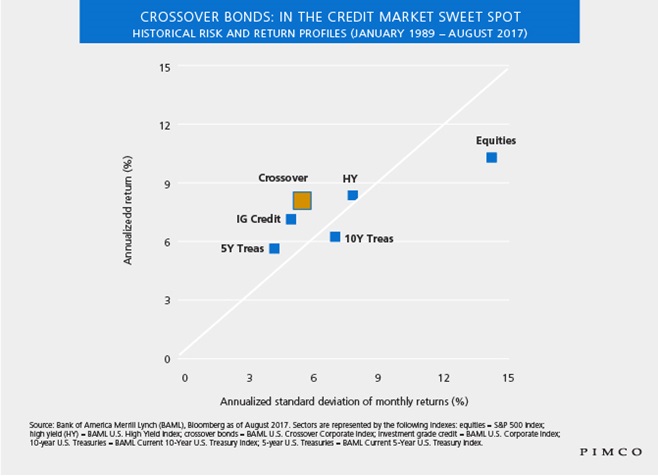
Tighter spreads and fuller valuations across the credit spectrum have many investors looking to corporate crossover bonds, often dubbed the “sweet spot” of the corporate bond market. As the name implies, crossover bonds “cross” or straddle the theoretical line between investment grade and high yield corporate bonds. They comprise the lowest level of investment grade (BBB+/Baa1 through BBB-/Baa3) and the highest level of high yield (BB+/Ba1 through BB-/Ba3).
The unique attributes of corporate crossover bonds may offer solutions for investors assessing a range of objectives and risks:
-
Investors may be reluctant to take on high levels of credit risk despite generally low yields on offer across much of the fixed income marketplace. They could be concerned the aging economic expansion is nearing an end, or worried about the market impact of the Federal Reserve’s interest rate hikes, or discouraged by tighter spreads across credit markets this year. Crossover bonds could help these investors target attractive yields within a more defensive overall position. (For PIMCO’s views on credit spreads and other investment implications for 2018, please read our latest Cyclical Outlook.)
-
Investors seeking a resilient credit allocation for the long term may find crossover bonds attractive; the sector offers a structural opportunity across market cycles. In any environment, active management may help pinpoint crossover bonds with a complementary balance of yield potential and relatively low default risk.
Attractive risk-adjusted return profile relative to both investment grade and high yield
Since the inception of the XOVR index of crossover bonds in January 1989, crossover bonds have outperformed investment grade bonds both on a risk-adjusted and an absolute basis (see chart). And relative to riskier asset classes such as high yield, crossover bonds have provided a comparable return with about two-thirds of the volatility.

Lower correlation to Treasuries versus pure investment grade
Today, a top-of-mind concern for many investors, especially investment grade credit investors, is the potential for rising rates to erode their fixed income returns. While the crossover sector has a similar risk/return profile as investment grade corporates, it has less than half the correlation to Treasuries: 34% versus 71% for pure investment grade corporate bonds. Crossover bonds can help diversify a bond portfolio amid rising rates.
Meaningfully lower credit risk versus broad high yield market
When investing in corporate bonds, one of the dominating risks is credit risk, or the risk of default when an issuer fails to pay back principal or interest. The risk of default is minimal at the investment grade level but grows at the margin from the lowest-rated investment grade bonds to the highest-rated high yield bonds (BBB to BB). Then it increases almost exponentially as one moves to the lowest quality ratings, which constitute the vast majority of the underlying defaults within the broader high yield market. While the yields at these lower levels of the credit market may be meaningfully higher, they are not always realized; thus, investors are not always compensated for this higher level of credit risk.
In summary, investors seeking higher yields than can be found in the pure investment grade corporate market but who can’t or won’t tolerate a significant pickup in credit risk may find an attractive solution in corporate crossover bonds.
Rigorous credit research and analysis is vital to uncovering attractive opportunities across the spectrum and around the world. Learn more about PIMCO’s credit research process.
Hozef Arif is a portfolio manager focused on global high yield and crossover bond portfolios. Michael Brownell is a strategist on the credit team.
DISCLOSURES
Past performance is not a guarantee or a reliable indicator of future results.
All investments contain risk and may lose value. Investing in the bond market is subject to risks, including market, interest rate, issuer, credit, inflation risk, and liquidity risk. The value of most bonds and bond strategies are impacted by changes in interest rates. Bonds and bond strategies with longer durations tend to be more sensitive and volatile than those with shorter durations; bond prices generally fall as interest rates rise, and the current low interest rate environment increases this risk. Current reductions in bond counterparty capacity may contribute to decreased market liquidity and increased price volatility. Bond investments may be worth more or less than the original cost when redeemed. Corporate debt securities are subject to the risk of the issuer’s inability to meet principal and interest payments on the obligation and may also be subject to price volatility due to factors such as interest rate sensitivity, market perception of the creditworthiness of the issuer and general market liquidity. The credit quality of a particular security or group of securities does not ensure the stability or safety of the overall portfolio. High yield, lower-rated securities involve greater risk than higher-rated securities; portfolios that invest in them may be subject to greater levels of credit and liquidity risk than portfolios that do not. Management risk is the risk that the investment techniques and risk analyses applied by the investment manager will not produce the desired results, and that certain policies or developments may affect the investment techniques available to the manager in connection with managing the strategy. There is no guarantee that these investment strategies will work under all market conditions or are suitable for all investors and each investor should evaluate their ability to invest long-term, especially during periods of downturn in the market. Investors should consult their investment professional prior to making an investment decision.
© PIMCO
© PIMCO
Read more commentaries by PIMCO