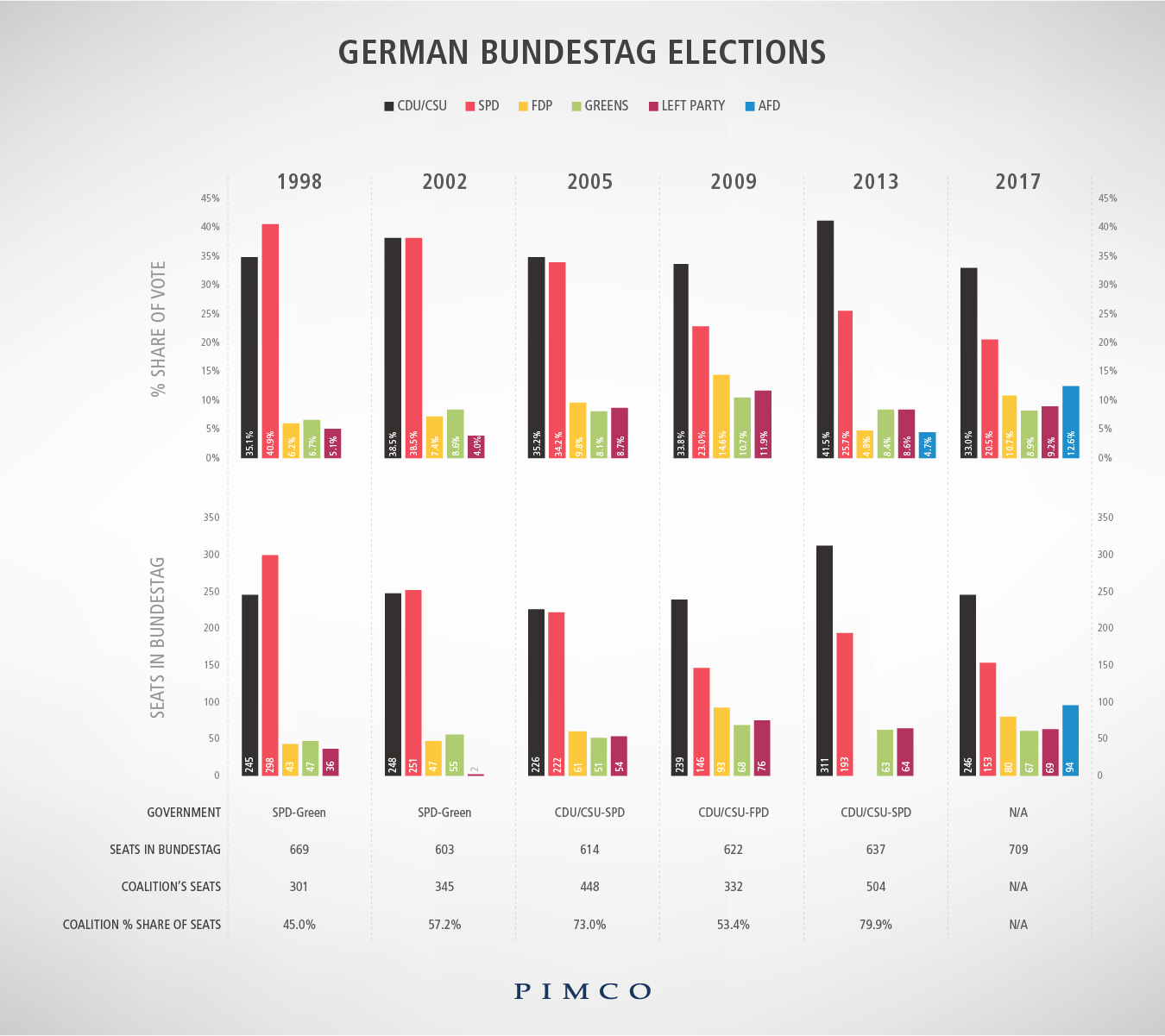
Broad-based support for Europe among Germany’s key political parties vying for seats in the Bundestag’s 19th legislative period meant Sunday’s election was unlikely to be disruptive for financial markets. And the muted reaction in financial markets Monday morning confirmed this was the case. Voters nonetheless sent shockwaves through Germany’s political establishment, especially in southern and eastern states, abandoning mainstream parties in hitherto unseen proportions in favour of the liberals and ultra-right and in so doing unravelling traditional coalition alliances.
Preliminary official results as of 25 September show the Christian Democratic Union (CDU) and its Bavarian sister party, the Christian Social Union (CSU), emerging as the strongest political force with 33% of the party-list vote, elevating Angela Merkel’s conservatives to the role of forming the next government. Five other parties surpassed the five percent threshold to enter the Bundestag: the Social Democrats (SPD) with 20.5% of the vote, Alternative for Germany (AfD) with 12.6%, Free Democrats (FDP) with 10.7%, Left Party with 9.2% and the Green Party with 8.9%.
While the CDU/CSU and SPD clung on to first and second places respectively, their losses were unprecedented in the Federal Republic’s electoral history. CDU/CSU lost 8.5 percentage points relative to their 2013 election result, the conservative’s largest loss from one election to the next and their lowest share of the vote since 1949. With exit polls suggesting more than a million former CDU/CSU voters switched to AfD, CSU leader Horst Seehofer dryly noted “We left our right flank exposed.” SPD fared no better, losing nearly half a million voters to AfD and recording its lowest share of the vote ever.

Coalition math: look to Schleswig Holstein
With SPD leader Martin Schulz stating his party will “lead the opposition,” thereby ruling out a grand coalition, and Merkel ruling out coalitions with both far-left and right, mathematically, a so-called Jamaica coalition among CDU/CSU-FDP-Greens (after the colours of the Caribbean state’s flag) constitutes the most likely viable government alternative. Expect markets to now focus on how Merkel might bring together diverse views of conservatives, liberals and greens under one government.
While a black-yellow-green coalition is untested at central government level, it has been in place in the state of Schleswig Holstein since May this year and in Saarland from 2009 to 2012. And coalitions between the CDU and the Greens also govern in Hessen and Baden-Wurttemberg. If it works at state level, Merkel’s skill at compromising will likely make it work at central government level too.
Policy matters: Christian, Wolfgang and the back-bench
Regardless which coalition emerges, fiscal policy under the new government will see small income tax cuts worth 0.5% to 1% of GDP in 2018, with further reductions worth another 0.5% of GDP scheduled for 2020 when the solidarity surcharge expires, based on pre-election manifestos.
European policy is where opinions differ. Some commentators depict the FDP, led by Christian Lindner, as anti-European. We disagree. Lindner’s eurozone views are very similar to those of Wolfgang Schäuble, Merkel’s finance minister, which foresee a confederation of fiscally independent member states. Lindner supports evolving the European Stability Mechanism into a fund with greater responsibility for the eurozone’s fiscal oversight and formalising the leadership role of the Eurogroup – the informal group of eurozone finance ministers – a role that Schäuble may aspire to if the FDP insists on leading the finance ministry. Linder’s red line is fiscal transfers within the eurozone over and above the current European Union (EU) budget, a view that finds support in much of the CDU/CSU.
Many of the FDP’s euro policies are unfeasible without changing the European Treaty or creating a pan-eurozone risk-free asset. Risk-weighting government bonds, creating a sovereign debt restructuring mechanism, and enabling member states to exit the euro without leaving the EU might hold swing among the liberals but will hardly find a majority in the German government let alone the European Council. And where the FDP might push back on the next potential government’s European policies, expect the Greens to pull forward, enabling Chancellor Merkel’s middle-ground to prevail. Although French President Macron’s vision for a federal eurozone governance structure is not shared by the FDP, from a volatility perspective, markets ought not to worry about a Jamaica coalition.
While matching neither the scale of populist votes cast by Britons to leave the EU nor Americans casting their ballot for Donald Trump, AfD will change the tone spoken from the Bundestag’s back-benches. Not since the 1950s have the far-right entered parliament. We would expect AfD’s indirect influence on the new coalition to materialise mostly in immigration and internal security, however; not in European policy. Expect CSU to push harder for a cap on immigrants and border security controls within the visa-free Schengen area to persist.
We view AfD’s success as a protest vote against the outgoing grand coalition, particularly concerning how Merkel dealt with the refugee crisis. Beyond immigration, however, AfD is deeply divided. Although directly elected to the Bundestag, AfD co-chair Frauke Petry split from her party Monday morning in reaction to fundamental opposition against its right-wing tendencies. Some AfD followers may yearn for the Deutschmark, but the vast majority of Germans see their country’s future in the euro. Modern Germany is not the Weimar Republic. Should periphery spreads widen in the weeks ahead owing to concerns about Germany’s commitment to the European project, we would view that as noise and an opportunity to fade.
Andrew Bosomworth is PIMCO’s head of portfolio management in Germany and a regular contributor to the PIMCO Blog.
All investments contain risk and may lose value. This material is intended for informational purposes only. Forecasts, estimates and certain information contained herein are based upon proprietary research and should not be considered as investment advice or a recommendation of any particular security, strategy or investment product. No part of this material may be reproduced in any form, or referred to in any other publication, without express written permission. PIMCO is a trademark of Allianz Asset Management of America L.P. in the United States and throughout the world. THE NEW NEUTRAL is a trademark of Pacific Investment Management Company LCC in the United States and throughout the world.
©2017, PIMCO
© PIMCO
Read more commentaries by PIMCO