Money market reform has arrived. The SEC’s sweeping changes, along with technical and macroeconomic factors, will likely make money market funds (MMFs) safer – if far less attractive – to defined contribution (DC) plan participants. In our view, if plan sponsors want a capital preservation option that has the potential to deliver returns above inflation, it’s time to consider a change, perhaps to stable value, short-duration bonds or even to white label solutions.
The SEC reforms, set to take effect on 14 October 2016, transform key elements that have made MMFs popular since their introduction in the U.S. in 1971. The new rules impose potential liquidity fees and gates on many MMFs and require institutional prime funds to move from fixed to variable net asset values (NAVs). These changes are a response to the events of September 2008, when the bankruptcy of Lehman Brothers forced the Reserve Primary Fund, the oldest money market fund, to “break the buck” by pricing its shares at 97 cents.
DC consultants have recognized that the reforms mark a sea change in an asset class that has been a staple of DC plans. In PIMCO’s 10th Annual 2016 DC Consulting Support and Trends Survey, which captures opinions from 66 U.S. consulting firms that serve over 11,000 clients with DC assets in excess of $4.2 trillion, 95% of consultants said they were somewhat likely, likely or very likely to recommend switching from a money market fund to stable value; 49% had similar views about switching to ultra-short bond funds.
The capital preservation space is not as simple as it once was and optimal solutions change. If a sponsor uses an MMF as a capital preservation option, PIMCO thinks the reforms are a good reason to consider alternatives. This is especially true given the increase in DC litigation in recent years.
Capital preservation and DC
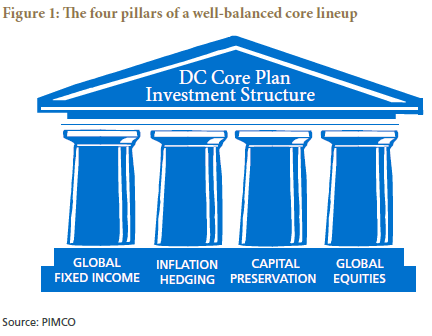
PIMCO believes that capital preservation strategies – along with global fixed income, inflation-hedging options and global equities – are one of four key pillars of a DC plan’s core investment lineup. Each contributes to ensuring a balanced selection of diversifying asset classes (see Figure 1). Capital preservation strategies seek to preserve invested principal, generate income, provide a liquid, low-risk investment during volatile markets or offset riskier investments in a portfolio.
In our view, a successful capital preservation option should meet these conditions:
- ΠLiquidity: A significant portion of invested principal can be easily sold or converted into cash under most market conditions without significantly changing the value of the investment.
- Low risk: The value of invested principal should be reasonably assured over an appropriate time horizon as determined by the sponsor – daily, monthly or quarterly.
- Real return: Investments should seek to generate real returns, or returns over inflation, to help participants maintain and potentially grow the purchasing power of their retirement assets.
However, market dynamics over the past decade – including compressed short-term bond yields, changing supply and demand dynamics and now the implementation of the SEC’s money market reforms – have eroded the ability of MMFs to deliver on all three of these critical aims.
Post-reform realignment
In anticipation of the new regulations, many MMF fund complexes have transitioned much of their prime MMF offerings to government MMFs in recognition of the market’s preference for a $1.00 NAV product without fees and gate complications.
Moreover, the SEC changes imposed significant changes to structural and operational aspects of MMFs, which created challenges for DC recordkeepers, custodians and trustees. Government MMFs have become DC trustees’ preferred MMF solution because these funds are managed to a fixed $1.00 NAV while remaining exempt from mandatory fees and gates, reducing their operational challenges. The result: Over the past 18 months, many plan sponsors that used prime MMFs received negative consent letters from their service providers; these gave notice that the plan’s capital preservation option had changed from a prime MMF to a government MMF.
In our view, the material SEC reforms and the dramatic realignment of the MMF industry is a prompt to DC sponsors to scrutinize their use of MMFs. This may be particularly urgent given the recent rise in DC-related litigation.












