Now’s the time when many of us are off enjoying a well-earned summer vacation. This week I was remembering one of my favorites that occurred a few years ago. It was great; we hosted a family reunion in a large, rented house on Big Bear Lake in Southern California with spectacular weather and scenery.
The lake is situated over 7,000 feet above sea level. To get there you come up the west slope of the mountain northbound on State Highway 18 (the “Rim of the World” Highway). The 45-minute road trip was everything you dream of (or fear) in a mountain road experience.
As for me, I love driving in the mountains. For a lifetime Midwesterner, leaving the flatlands behind and taking on the twists and turns of a mountain trail is a joy. I had just left the office a few hours beforehand and Flexible Plan was still fresh on my mind, so I, of course, related the climb up the mountain to our investment management.
Like the market, most of the time you’re climbing upward, but even when you’re trying to ascend 7,000 feet, you go through dips and flat spots as you work your way up the mountain. In investing and mountain climbing, it’s not just straight up.
The only way a road builder can assault a mountain is to engage in a series of switchbacks. You know, first you ascend toward the right, and then around the next turn you travel toward the left. Following this pattern, you crisscross back and forth up the mountain. A buy-and-hold, straight-line approach would sooner or later put you over the edge. You need to actively manage the experience to make it to the top.
State Highway 18 is well thought out. Like our various tactical strategies, it has many pullovers, so a driver pressured by the faster traffic behind can manage the risk and pull to the side to let the drivers more comfortable with the road move at the rate that suits them. At key spots, its makers erected guard rails. Like our many defensive tools, these provide one more safety measure to keep you on the road.
Finally, there is an element of faith that you must employ to reach your goal of the summit. Each time the mountain switches back, you come around a bend—with towering cliffs on one side, a sickening drop off on the other. The yellow road signs are showing a squiggle up ahead. The speed limit markers drop in value; proceed at 40, 20, then 10 mph, they warn.
You know caution is in order. Even though you cannot see what’s coming, you know that if you follow the guidelines marked on the road by the experts, take your foot off the accelerator and hover over the brakes, your momentum will carry you safely through the unknown and around the bend. As clients of an investment manager, I’m sure you know the feeling. It can be difficult at times, but it’s the best way to reach the top and achieve your investment goals.
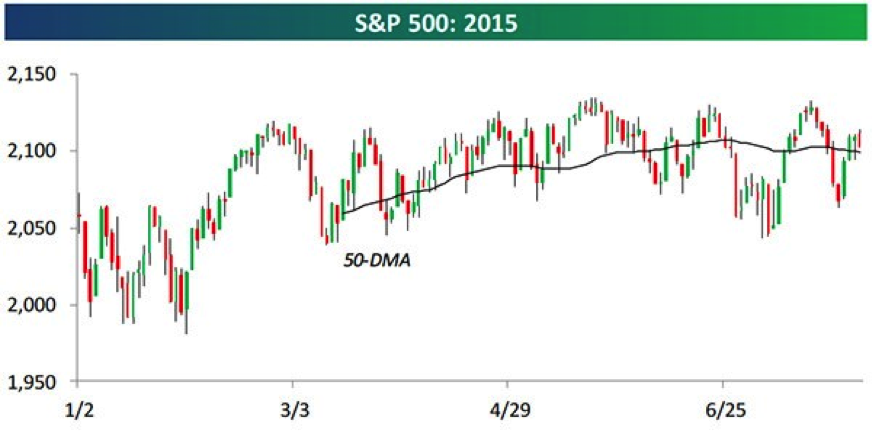
Speaking of switch backs, this year’s financial markets have been filled with nothing but. A glance at the chart of the S&P 500 below evidences this. Since February, the Index has been in a sideways dance that has seen us switch almost weekly from euphoria to depression.
Source: Bespoke Investment Group
Bonds, too, have seen almost weekly reversals. And as July came to an end, the average bond index was down for the year. At least some stock market indexes had managed to yield some gains.
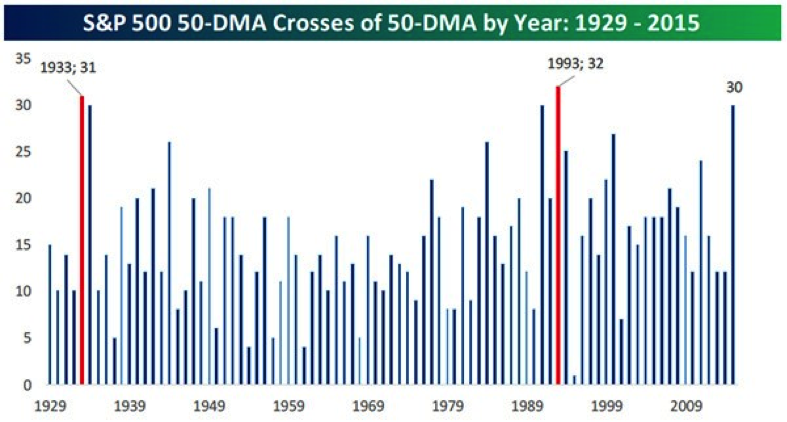
But even in stocks, it has been a bumpy road. The 50-day average of daily price closes of the S&P 500 Index is a closely watched indicator of the trend in the market. As I write this we are two closes away from tying the market history record for most yearly switchbacks above and below the 50-day average … and we still have five months of this year to travel through.
Source: Bespoke Investment Group
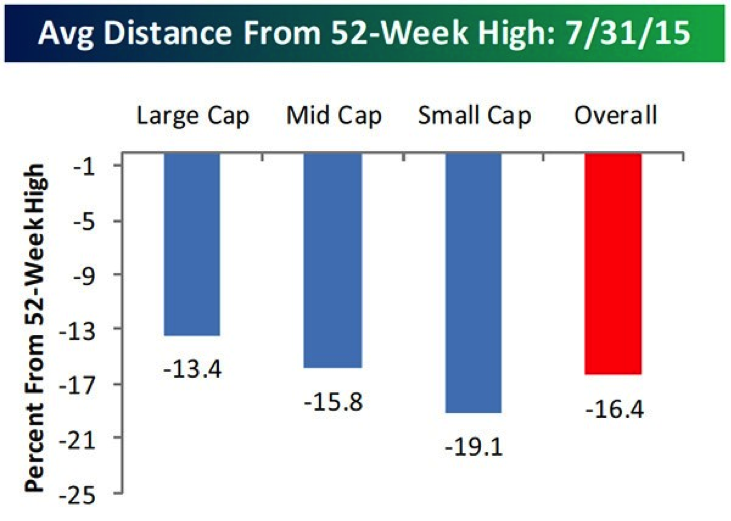
Making the ride even bumpier, it is obvious that this year the average stock price as evidenced by the Index has not been a good indicator of what the average investor has experienced. With the market averages (S&P 500 and NASDAQ) within 2% of their market highs, you would expect most stocks to be trading close to their recent highs as well. However, as the chart below illustrates, most stocks are substantially below their former heights.
Source: Bespoke Investment Group
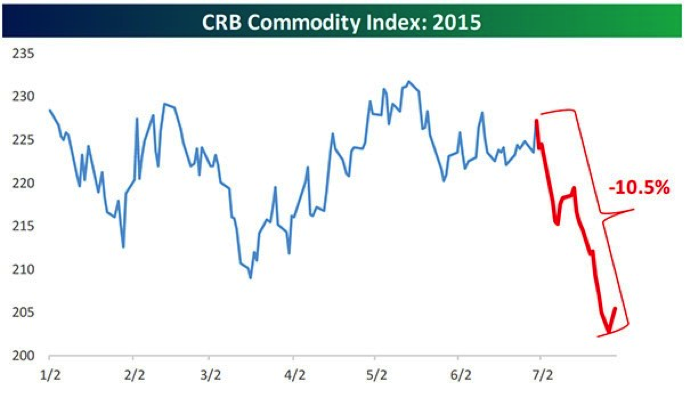
Finally, commodities have normally been a good alternative to bonds and stocks, but not this year. Led by energy, most commodities have seen declines in prices this year.
Source: Bespoke Investment Group
A discouraging review, I know, but our job is not to recreate the past or try to drive backwards down from the mountain top. We strive to keep moving forward and upward on the mountainous road that stretches through the financial wilderness.
Looking forward, the picture for the remainder of the year still appears to have the possibilities for ending up at new heights … at least where stocks are concerned. (Bonds, in contrast, seem likely to be in a downtrend for years to come.)
Economic indicators, while slightly on the weak side last week, have been improving. For the most part this year, economic readings have exceeded expert expectations and that tends to be supportive of higher stock prices ahead.
This is also the case for the earnings reports from the second quarter. These continue to beat earnings analyst expectations generally and specifically at a higher rate than last quarter. Revenue reports are similarly outperforming the first quarter.
Investors seem not to have caught on to these positives as yet, focused as they and the media have been on Greece and the Chinese market crash, which have little relevance to US investors. Just as consumer confidence readings last week were down sharply, investors, both individual investors and newsletter writers, have become more bearish and at near record lows in bullish sentiment. This is normally a contrary indicator and should be rated intermediate-term bullish.
While August is usually a volatile month (as is September), it is important to remember that this volatility can be on the upside when stocks reach this juncture in the year and are still registering gains. Over the last twenty years, when stocks were up YTD on July 31st, stocks (the S&P 500) went on to register gains 79.3% of the time!
Finally, when traveling a mountain road, one must always be aware of whether they are ascending or descending. Just as there can be dips when you are driving up the mountain, there can also be little hills to climb when you are traveling down a mountainside.
Our focus should not be these little hills or dips. What should concern us is the primary direction. At the moment, the intermediate market trend tells us that we are still ascending. Should we reach the top and start moving in another direction, our computerized strategies can alert us and start to judiciously apply the brakes should that prove necessary to keep us on the road to our ultimate destination.
All the best,
Jerry
http://www.flexibleplan.com/market-hotline/disclosures












