No matter what profession or stage of your career you may be in, everyone is ultimately “selling something.” Whether a teacher, a lawyer, a physician, a plumber, or a high school student applying to colleges, we are all salespeople in one way or the other.
For close to 30 years, I had the opportunity to consult with corporations in all types of industries. We worked with clients to formulate marketing plans, communications objectives, and the execution of marketing tools to meet those objectives, whether they be advertising, direct marketing, public relations, sales promotion, events, or all of the above. Our goals could vary tremendously, but in the final analysis, it all came down to selling more product.
The founder of our agency, Bill Bernbach, was generally credited as being one of the two or three legendary giants of the advertising “creative revolution” of the 1950s through the 1970s. Bernbach was one of the leaders in moving away from the mindless and repetitive jingles and product demonstrations of the day to creative approaches that had more lasting meaning, emotional appeal, and brand-building impact. (If you are of a certain age, you probably remember the mind-numbing Anacin “hammer” and what seemed like dozens of cigarette jingles all over the airwaves.)
Bernbach’s agency, Doyle Dane Bernbach, took on what had to have been one of the greatest marketing challenges of all-time: trying to sell a German-manufactured automobile in the United States a little more than a decade after World War II. On an initially very limited budget, Bernbach’s team created memorable and heart-warming black-and-white print ads and TV commercials that often were higher-rated than the magazines or TV shows in which they appeared. The rest is history, as the Beetle, the Volkswagen brand, and VW’s campaigns became an incredible success story in the advertising and automotive industries.
I was thinking about Bernbach’s philosophy on selling when we were selecting keynote speakers for the inaugural Proactive Advisor National Conference, to be held September 15-16 in Detroit. Bernbach put forward many quotable lines, but the essence of just about all of them was, “You have to reach people in the heart as well as the mind. Make them think, but also make them want to laugh or even cry.”
One of our keynote speakers, Harry Beckwith, is the author of a seminal book on marketing and sales practices, “Selling the Invisible.” First published in 1997, “Selling the Invisible” is considered a marketing classic for any service business where the ultimate goal is not to sell a physical object, but to sell an “invisible” intangible solution. It has been called “one of the most influential marketing books of all-time,” and Mr. Beckwith is well-known for delivering its tenets in a dynamic speaking style.
What does any of this have to do with investments, managed accounts, and the relationships of advisors with their clients? One of Beckwith’s key premises is that while the “service economy” dominates US GDP, the selling of largely “invisible” services is far different from selling hard goods that you can “see, touch, and feel.” Services, he says, “often come down to the promise of someone doing something,” and that trust and emotion play a huge role in their buying and selling.
The challenge when considering what “invisible services” to buy from the consumer’s perspective—whether it’s the services of a home remodeler or an accountant or a financial planner—is that it’s especially difficult to evaluate expertise and quality since you often won’t really know whether someone was truly an expert until after the fact. From a financial advisor’s perspective, it’s equally challenging to “sell the invisible” (long-term planning and investment advice) when consumers often just default back to the inertia of doing nothing. In “Selling the Invisible,” Mr. Beckwith conveys numerous concepts around marketing, selling, and positioning that focus on areas that most people don’t necessarily think about, but are extremely relevant for any profession. They are equally important for anyone who is sitting on the “buying” side of the table.
Bill Bernbach would certainly approve of many of Mr. Beckwith’s messages, but perhaps none more than the bold ending statement of one of the early chapters in “Selling the Invisible”: Appeal only to a prospect’s reason and you may have no prospect at all.
All the best,
Jerry
P.S. Equity markets closed Monday, July 20th, with slight gains, although the S&P 500 Index briefly traded above its prior all-time closing high. Speaking of “selling,” the ongoing Greece situation certainly has had its share of sales moments, with pitches having to be made to the Greek people, to the Greece Parliament, and a variety of internal political parties, and then to a seemingly unending stream of European agencies and government entities. While the outcome is still uncertain over a longer time frame, it appears markets have largely put the Greek concern away for now, especially with US Q2 earnings season in play.
According to Bespoke Investment Group, with 100 of S&P 500 companies reporting through the end of last week, results so far have been “mediocre at best.” Of those companies reporting, 58.4% have beat analyst estimates on EPS, while just over half (51.5%) have beat on revenues. However, as Bespoke notes, the overall NASDAQ Index, and especially the Internet sector, continue on a market-leading pace, with several tech companies delivering results that far outperformed expectations. As of the close on Friday, the NASDAQ 100 was up just over 10% for the year(!), compared to 3.4% for the SPX and 1.5% for the DJIA. That is an impressive performance amid all of the market uncertainty and up-and-down action for much of 2015.
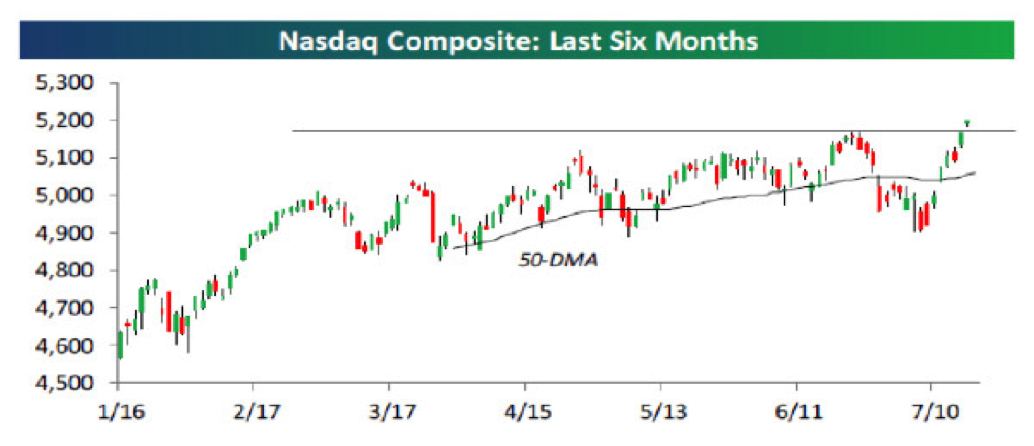
Source: Bespoke Investment Group
http://www.flexibleplan.com/market-hotline/disclosures












