Whenever I’m in the car nowadays I’m always listening to satellite radio. I, like probably you, vowed I’d never pay for radio … but the constant barrage of commercials on free radio, plus the fact that Sirius comes free the first year I own my car, helped to overcome my resistance.
Even with all of the satellite radio options, I don’t change the station of choice much. In fact, other than when my son joins me in the car for our trip to the ball park and quickly switches the station to his favorite, it rarely changes at all. For some time, the Blend (channel 16 on Sirius) has been my favorite. Its adult contemporary rock format that regularly throws out a decade or two to keep the play list within the last 20 to 25 years—playing both the old and the new within that period—is just right for me.
The Blend also suits me from an investment perspective. For two decades Flexible Plan has been known for being the place where you can create portfolios that blend the performance of a number of diverse actively managed strategies into a single portfolio. This is in recognition of the fact that no strategy works all of the time and that a portfolio of such strategies can give you an edge in dealing with the uncertain markets that lie ahead – be they bull or bear.
It seems like every time I’ve jumped into the car lately, sooner rather than later the Blend is playing a song that has been a favorite of mine since it was released in 2012. Why they are returning with regularity to this song is known only to the programmers at the station.
I suppose the fact that it was voted number one in various polls and headed the hit list in most nations for quite some time might have had something to do with it. Four million digital downloads in the US alone might also have something to do with it.
The song I’m talking about is Passenger’s Let Her Go. British/American Michael Rosenberg’s lyrics, backed by a group of talented Australian musicians, get to me every time I hear them. Their melancholy message is that it is only with the perspective gained by the passage of time that we know what we really had.
The part that sparked the idea behind this week’s Hotline was when Michael sings:
Well you only need the light when it's burning low
Only miss the sun when it starts to snow
Only know you love her when you let her go
As investors, take a moment and try to think back to how you felt in 2008. The markets were plunging. It seemed like 300-point or greater down days were commonplace. Fear was in the air and many of those investors who were wise enough or lucky enough to have included dynamic, risk-management strategies (alternative strategies, if you will) in their portfolio were rewarded for their patience during the market exuberance that preceded the ‘07-‘08 bear market.
These fortunate investors did not know that they had made the right move until after stocks plummeted. I’m sure many were not sure of their decision during the markets’ heyday, but rather only were able to reach that conclusion when the market environment changed after considerable time in the rally phase.
Today the 2007-2008 crash that saw a $100,000 investment in a passive, blue–chip-laden S&P 500 mutual fund or ETF fall to less than $50,000 in value is a distant memory. And the equally devastating 2000-2002 sell-off is just plain lost in the mists of time for most investors.
Yet,
Only know you've been high when you're feeling low
Only hate the road when you’re missin' home
Only know you love her when you let her go
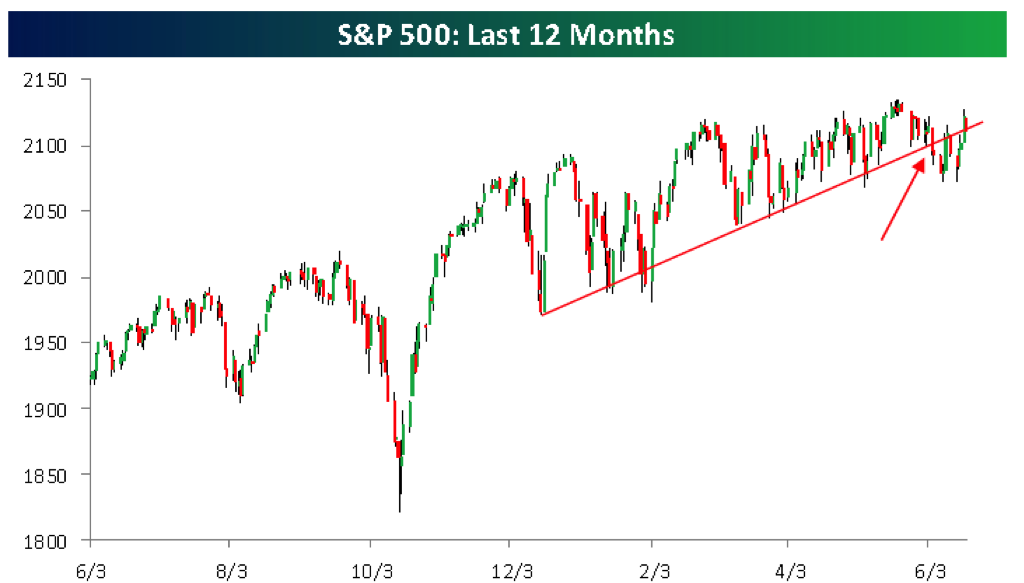
Today I fear that it is very difficult for most investors to get the proper perspective on their portfolio’s ability to deal with a market environment different from the present one. Today we see new highs being made each month in most of the popular indexes.
It has been six years since the tech-heavy NASDAQ composite reduced a $50,000 portfolio invested in it in 2007 to less than $15,000 in 2009. It is easier to celebrate that index finally getting back to breakeven last Thursday, and to forget the losses sustained and, instead, just go with the flow.
Yet investing is about the future, not the past. You can’t invest in the past market; you can only invest for the future. The past, however, does tell us what can happen in the future.
We know that valuations are now a bit above average. We know that it has now been over six years since the last bear market ended. And we know that these bear markets do occur with some regularity. While we don’t know precisely when they will occur, it usually is between five and seven years, measured from a bear market bottom to the beginning of the next one.
Source: Bespoke Investment Group
Regular readers of this column know that I am not a perma-bear, like so many of my fellow asset managers. We have been bullish on stocks for years now. Classic, our long running market-timing strategy, has never been stuck in a buy mode for so extended a time in its history.
And nothing has really changed on that … so far. Yet we know that even very successful market-timing strategies can miss a signal. If they are momentum based, one always has to wait for momentum to reverse. While that is happening, prices fall away from their high-water mark before you get a sell signal. At the same time, buy-and-hold investments reflect what the market is doing and when stocks are plunging; so do the portfolios of believers in the buy-and-hold approach.
For this reason we have two core beliefs: First, you should always have some portion of your portfolio invested in dynamic risk-managed strategies – they can be the best alternative investments. And second, you should diversify your portfolio of such strategies to deal with the uncertainty that is our financial future.
Even when the market is soaring, and even at the expense of short-term returns, you must keep one leg out the door, ready to bolt for safety. No one knows when the top will be put on in this market. It could be two years from now or it could be today. All we know for sure is that, based on history, it will happen.
Staring at the bottom of your glass
Hoping one day you'll make a dream last
But dreams come slow and they go so fast
Having diversified, dynamic, and risk-managed strategies in your portfolio is the only way I know to achieve true diversification to meet the uncertainties that with certainty lay ahead. If you invest following only a single strategy, especially if it is buy and hold … Let Her Go.












