Whyuse a multi-asset approach to hedge inflation?
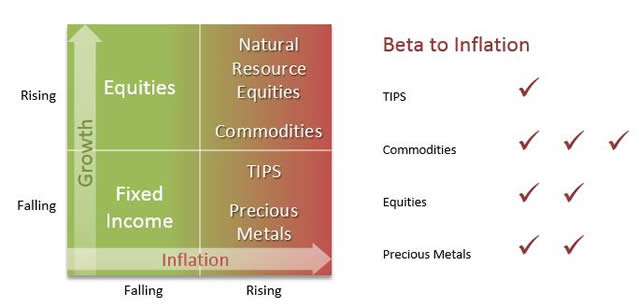
As can be seen in the schematic above, most portfolios are effectively a bet on a low inflation environment due to their heavy reliance on mainstream equitiesand fixed income securities.In order to protect a portfolio from the damage that inflation can inflict, asset classes that are sensitive to increasesininflation need to be incorporated into the asset mix.These include Inflation Linked Bonds (TIPS), Precious Metals, Global Natural Resource equities and Commodities.
TIPS and Gold do best in a high inflation / low growth environment while Natural Resource equities and Commodities tend to do best in high inflation / high growth environments.Also, although Commoditiestend to have the most sensitivity (i.e., highest beta) to inflation, their high volatility makes this asset class unattractive to rely upon exclusively to create an inflation hedge.
While manyinvestors usea single asset class, such as TIPS or Commodities,as their inflation hedge, we think this is a mistake. Predicting an inflationary spike is very difficultandtrying to forecast the type ofinflationary environment (stagflation/low growth, hyperinflation/high growth,etc.)is doubly hard.
Therefore, we believe that a multi-assetclass approachis the best way to hedge inflation risk.Not only does it help protect a portfolio regardless of the type of inflationary environment, it creates amore stable inflation hedgeby combining highly volatile Commodities with less volatile asset classes such as TIPS, Natural Resource equities and Precious Metals.
An added benefit of this multi-asset class approach to inflation hedging is that these inflation sensitive asset classes are not highly correlated with equities and fixed incomesecurities.Thiscan provide the investor with a portfolio that has better risk adjusted returnseven in the absence of inflation.
In conclusion, because we do not know when inflation will hit or how hard, or whether there will be a high growth or low growth economic environment when inflation does resurface,a strategic allocation of 10 – 20% toa multi-assetclass inflation hedge is prudent.
Mutual Funds involve risks including the possible loss of principal. There is no guarantee that any investment will achieve its objectives, generate positive returns or avoid losses.
Theuse of derivatives, commodities, futures, options, swaps, structured notes, and natural resource investments, exposes the Fund to additional risks including increased volatility, lack of liquidity, and possible losses greater than the Fund’s initial investment as well as increased transaction costs. The use of derivatives to increase the Fund’s combined long and short exposure creates leverage and can amplify the effects of market volatility and the potential for gain or loss. The Fund’s losses are potentially unlimited in a short position transaction. The Fund is classified as non-diversified and the performance of one or a small number of portfolio holdings can affect overall performance.
Thereis a risk that issuers and counterparties will not make payments on securities and other investments, resulting in losses to the Fund. Investments in debt securities rated below investment grade may be subject to significant loss of value in principal and interest and possible default. High-yield and lower rated investments generally are subject to greater price volatility and illiquidity than higher rated investments. Fixed income and inflation indexed securities could lose value due to interest rate changes or deflation, and are subject to price shifts, prepayment, credit risks and market expectations. Foreign fixed income issuers involve increase risk due to adverse issuer, political, regulatory, currency, market, or economic development and may become less liquid and difficult to value.
Investmentsin foreign securities and emerging markets involve risks not generally associated with investments in securities of U.S. companies including currency rate changes, political, social and economic conditions, accurate company information, foreign control on investment and market operations including banks and security depositories. These risks may be greater in emerging markets and less developed countries.
CertainFund investment strategies, including transactions in options, futures contracts, and commodities traded through its Subsidiary, may be subject to special tax rules, the effect of which may have adverse tax consequences for the Fund.
Regulatorychanges regarding commodity pool operators and wholly owned subsidiaries imposed by the CFTC and IRA tax code could result in the inability of the Fund and/or Subsidiary to operate as described in the prospectus and could negatively affect the Fund and its shareholders. Compliance with such requirements will likely increase the costs associate with an investment in the Fund.Investors should carefully consider the investment objectives, risks, charges and expenses of the Inflation Hedges Strategy Fund. This and other important information about the Fund is contained in the prospectus, which can be obtained at www.northpeakam.com or by calling 855-294-7538. The prospectus should be read carefully before investing.
TheInflation Hedges Strategy Fund is distributed by Northern Lights Distributors, LLC, member FINRA.
2041-NLD-8/20/2013
North Peak Asset Management, LLC., is not affiliated with Northern Lights Distributors, LLC.
© North Peak Asset Management
