Captain Ahab never caught Moby Dick, but Morgan Stanley shows how tracking billionaire tech whales like Elon Musk can eventually land a fortune. Not long ago, the bank appeared to have shot itself in the foot as lead lender on the disastrous $44 billion buyout of social media platform Twitter, now known as X. But by staying close to Musk until the mercurial entrepreneur’s rocket company SpaceX listed on Nasdaq, the bank has more than won back its earlier losses.
For investors, the second quarter proved the value in Morgan Stanley’s twin poles of investment banking and wealth management — and illustrated how they feed each other’s success in exuberant times. It is a business model built patiently after the bank’s near-death experience in the 2008 financial crisis and one that cross-town rival Goldman Sachs Group Inc. is deeply focused on replicating.
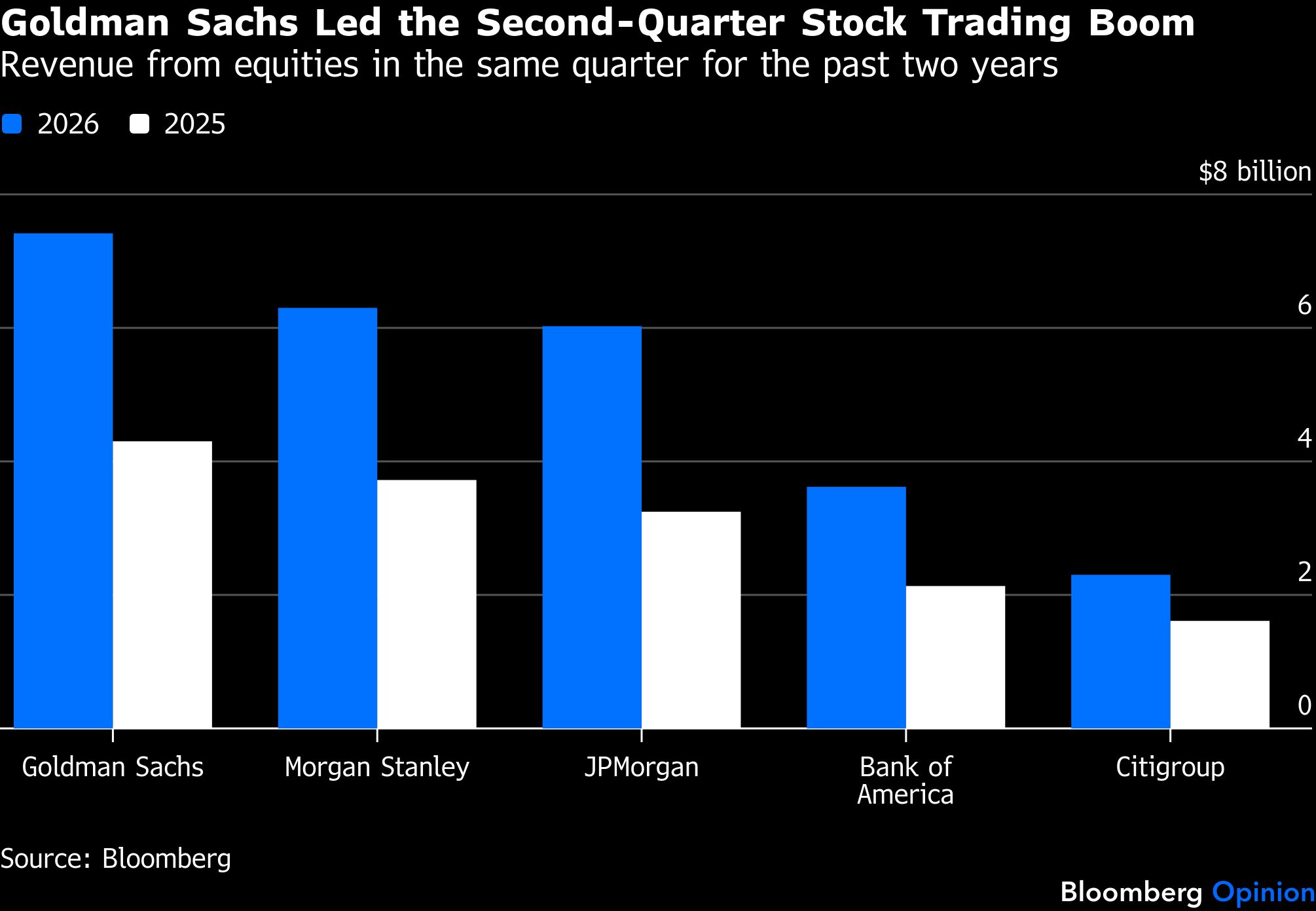
Morgan Stanley had a huge quarter in stock trading and investment banking fees, just like most of its rivals. Business has been buoyed by the huge spending of tech companies developing artificial intelligence and a healthy revival in initial public offerings and mergers and acquisitions. The bank’s $6.3 billion in equities trading revenue for the three months ended June 30 was just ahead of JPMorgan Chase & Co.’s $6 billion but some way behind Goldman’s $7.4 billion.

All three easily smashed Goldman’s previous record of $5.3 billion for this business set only last quarter, with stock values rallying and use of borrowed money by hedge funds and other investors expanding to turbocharge bets on the AI theme. I see this as a harbinger of potentially dangerous instability to come.
Morgan Stanley also reported its strongest quarter for IPO fees since 2021, helped by being one of the lead underwriters on the $75 billion SpaceX share sale and taking nearly 20% of the roughly $500 million fee pool along with Goldman, according to Bloomberg News and other reports. This helped lift its total investment banking fee income by nearly 60% compared with the period a year earlier, the strongest growth among the five leading US banks.
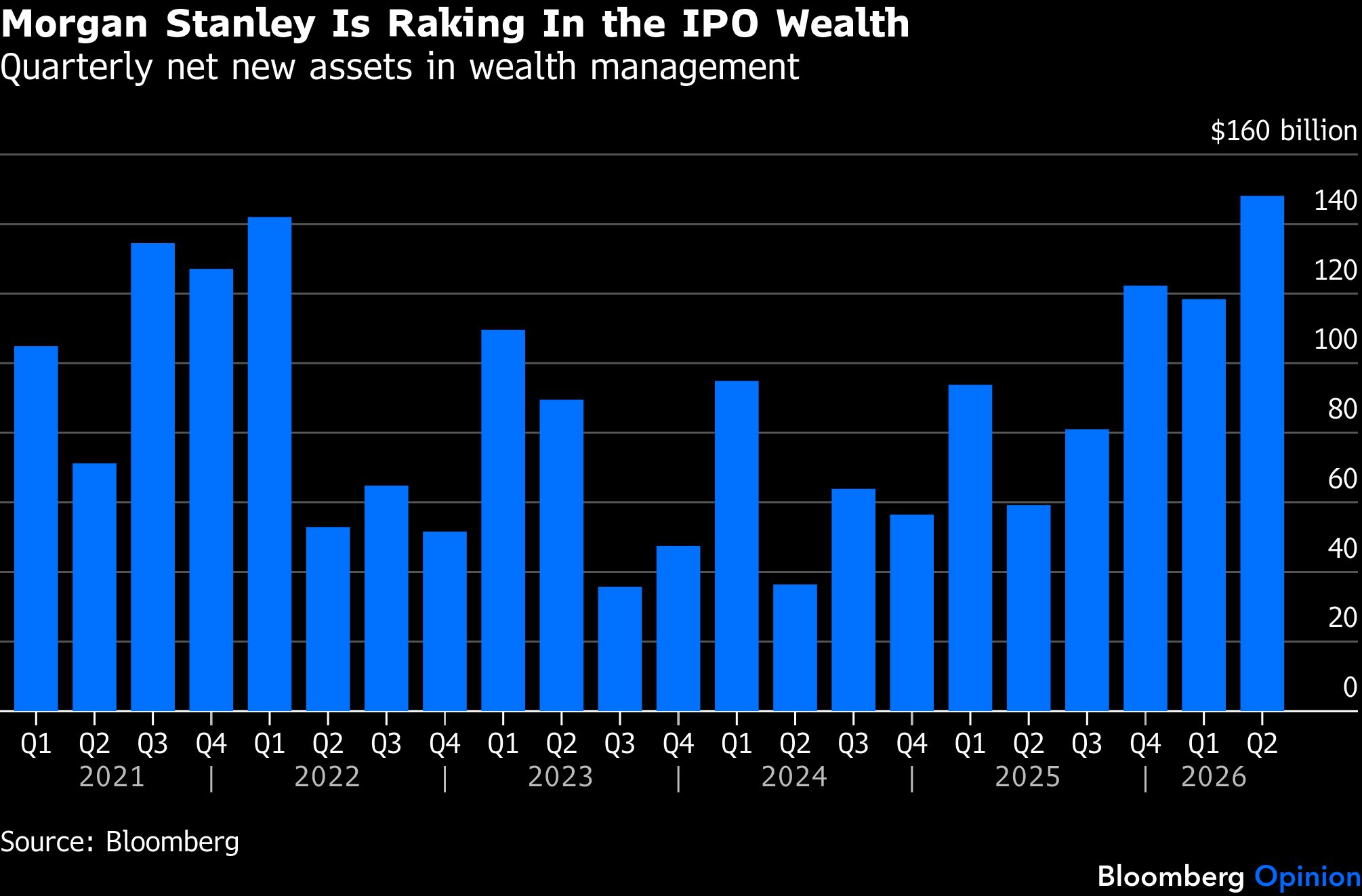
But Morgan Stanley tapped into this rich seam of activity in another way, too — one that Goldman and other rivals don’t have the same access to. Its wealth management business drew in a record $148 billion of net new assets in the quarter, slightly more than half of which came directly from the big IPOs of the quarter.
These assets, which likely included cash and newly public shares, came through the bank’s workplace business where it offers wealth management to employees of a company. Sharon Yeshaya, chief financial officer, said most of the inflows were from employees of large, late-stage private companies that listed in the quarter. While she didn’t name SpaceX, the record-breaking IPO, which ended up raising more than $85 billion, no doubt delivered a big slice of these flows.
There is plenty more to come in this vein as well. “We have about 70% of the top 100 unicorns by market cap in our workplace pipeline,” Yeshaya told investors on the earnings call on Wednesday.
This gives Morgan Stanley two bites of the same apple when it comes to listings like SpaceX — and two ways to make money out of highly demanding and sometimes controversial billionaire clients. More than that, the money accumulating in the wealth business generates management fees every month, making the income more reliable than trading and dealmaking fees.
Morgan Stanley makes nearly half its revenue each quarter from wealth and asset management versus almost one-quarter for Goldman. The high and sustainable profits from this business is why Morgan Stanley’s shares trade at a higher valuation than those of Goldman or JPMorgan.
To be sure, a significant downturn in financial markets would hit the wealth business hard: When clients’ portfolios are worth much less, a percentage management fee obviously brings in much less revenue. But at least those fees will still be flowing even if trading collapses, hedge funds slash their borrowing and dealmaking dries up. For now though, Morgan Stanley is raking it in from all sides.
A message from Advisor Perspectives and VettaFi: Discover something new! Click here to register for our upcoming webcasts.
Bloomberg News provided this article. For more articles like this please visit
bloomberg.com.
Read more articles by Paul Davies