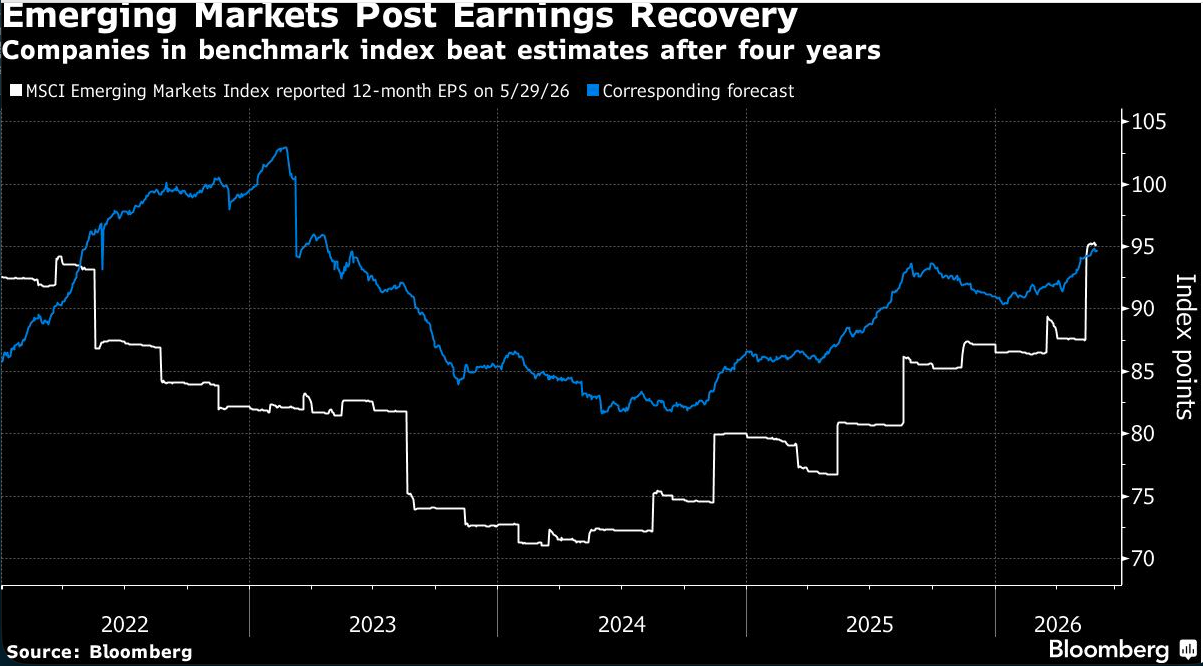
For the first time in four years, companies in emerging markets are beating profit estimates, giving investors a fresh reason to believe the bull market is just getting started.
Companies in the MSCI EM Index have reported average annual earnings above expectations set a year ago for the first time since April 2022, according to data compiled by Bloomberg. Asian tech firms are driving the results, but profits are also improving in other sectors of the market, like Indian oil refiners and Brazilian electricity companies.
With emerging-market stocks riding gains of nearly 30% this year, evidence of healthy profit growth is signaling to bulls that the rally is being built on solid fundamentals, rather than speculative froth. That’s prompting investors like Morgan Stanley and JPMorgan Chase & Co. to predict that gains will spread beyond artificial intelligence-related stocks.
“This is a genuine inflection point,” said Ninety One UK Ltd.’s Archie Hart. “The market is finally being validated by fundamentals rather than running ahead of them.”

The weighted average earnings-per-share reported by MSCI companies in the 12 months through May was 95.1 index points, rising above analysts’ blended-forward estimates of 94.6 made a year ago.
Stronger earnings may persuade more asset managers to shift money to EM stocks, helping drive the next stage of the rally. A 5% shift from US portfolio weightings would translate into roughly a 30% increase in EM allocations due to the relative sizes of the markets, according to Hart’s calculations.
He also highlighted that emerging-market technology companies still trade at a steep discount to their US peers while generating faster earnings growth as another reason to be bullish. An index of US semiconductor equipment makers trades at more than 46 times estimated 12-month forward earnings, compared with 12.3 times for the MSCI EM Information Technology Index.
The earnings surprises are part of a comeback in emerging markets that took hold in 2025. Profits started to improve last year on the back of more AI spending and China’s economic stimulus. Before that, EM profits fell by 25% between 2022 and 2024 as higher interest rates sapped growth.
Among AI-related juggernauts, South Korea’s SK Hynix reported first-quarter profit 43% above estimates, Samsung Electronics exceeded projections by 16%, and Taiwan Semiconductor Manufacturing Co. beat forecasts by 5.7%. Among other top performers, Indian Oil Corp. exceeded estimates by 33%, while Brazilian electricity producer Eneva SA posted a 44% beat.
“Performance across different regions will likely continue to vary, but the direction of travel across virtually all of them is now positive, which has not been true for most of the past decade,” said Morgan Stanley Investment Management’s Deputy Chief Investment Officer Jitania Kandhari.
Still, the dominance of the AI trade is raising concerns about concentration risk, she said. Asian companies are beating expectations by a wide margin, compared with the rest of the EM universe, where the surprises are more modest or negative.
Energy companies started beating earnings estimates this quarter, and financial companies crossed the threshold at the end of 2025. Commodity and industrial firms are reporting profits close to expectations. But missed estimates remain the rule in other parts of the market. Consumer staples and consumer discretionary companies are among the biggest laggards, while health care, real estate and utilities are also underperforming forecasts.
Despite the mixed profit performances of the subgroups, the MSCI EM index has surged above 1,800, reaching successive records.
“There is still narrowness under the hood,” said Ashish Chugh, a money manager at Loomis Sayles. “Much of the EPS growth will come from the tech sector.”
Broader Recovery
There are other factors to support the case for a wider earnings recovery. As China emerges from deflation, investors see scope for a broader industrial recovery. Equity issuance is also slowing and buybacks are increasing, boosting earnings per share.
Since 2010, the country’s stock market had been flooded with new share issuance, suppressing EPS growth by as much as six percentage points even when underlying businesses performed well, according to Hart, who says that trend is now reversing.
JPMorgan Asset Management predicts a revival across emerging markets that will underpin earnings growth. The environment should favor industrial, defense and commodity sectors as China’s economy recovers and inflation accelerates, according to Anuj Arora, chief investment officer for emerging-market equities at JPMAM.
“A softer dollar, ongoing deficit spending in major economies, and a multiyear AI and infrastructure capex cycle continue to create a constructive backdrop for emerging markets,” Arora said.
A message from Advisor Perspectives and VettaFi: Discover something new! Click here to register for our upcoming webcasts.
Bloomberg News provided this article. For more articles like this please visit
bloomberg.com.
More Closed End Funds Topics >