Quantum Computing: Hype or the Real Deal?
Membership required
Membership is now required to use this feature. To learn more:
View Membership Benefits Advisor Perspectives welcomes guest contributions. The views presented here do not necessarily represent those of Advisor Perspectives.
The word "quantum" is defined as "an amount," with its Latin root meaning "how much." In physics, a quantum is the smallest discrete unit of any physical property. The adjective form, as in quantum leap, describes a sudden, significant, and fundamental change. It is also a perfect adjective for coining the next potential technological innovation — quantum computing.
Quantum computing is being hailed as the next technology to revolutionize computing, following in AI's footsteps. The headlines below, though confusing for non-quantum experts, are quite impressive:
- Google Unveils 'Mind-Boggling' Willow Chip, Solving 10-Septillion-Year Problem in Minutes
- World's First 10,000-Qubit Processor Achieves 100x Leap in Qubit Count
- JUPITER Supercomputer Breaks World Record with 50-Qubit Quantum Simulation
- Caltech Physicists Build Massive 6,100-Qubit Neutral Atom Array
- A Photon Was Teleported Across 270 Meters in Stunning Quantum Breakthrough
But promising headlines loaded with industry jargon have a long history of appearing well ahead of reality. Accordingly, it’s important to better understand what quantum computing is, why it matters, and whether the hype is justified and worth investing in.
Classic Computing & Moore’s Law
To understand quantum computing, we need to first understand what bits are.
Every classical computer — from your smartphone and the laptop on your desk to El Capitan, the world's most powerful supercomputer — operates using bits.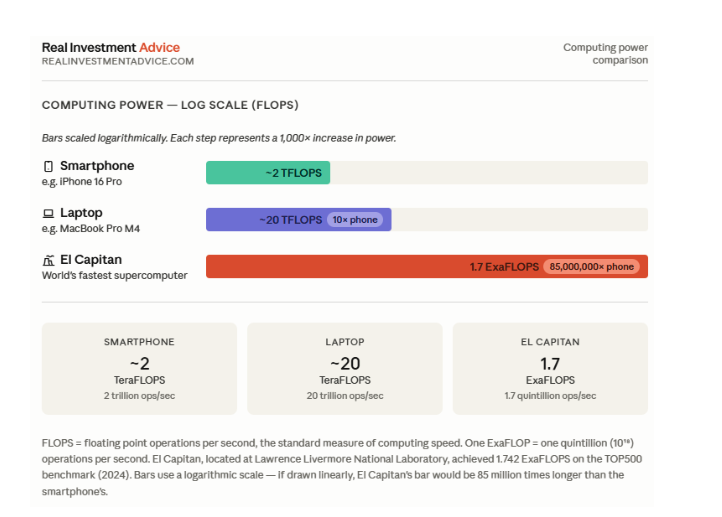
A bit is the fundamental unit of information: It is either a 0 or a 1. Every email you send, video you stream, and game you play is the result of billions of 0s and 1s switching on and off. Over the last 50+ years, innovations have continually optimized the performance of these binary operations. However, continuing down this path becomes increasingly harder.
Moore's Law describes computing innovation, while the law’s limits best describe the problem. Moore’s Law states, “The number of transistors on a microchip doubles roughly every two years, while the cost of computers is cut in half.”
As the graph below shows, Moore’s law has resulted in exponential growth in computing power at increasingly lower costs. Note that the y-axis is on a log scale, with each tick representing a 100 times improvement in computing power per dollar.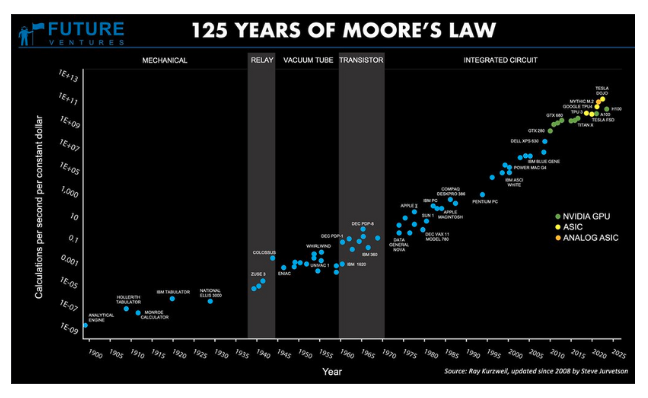
The problem with Moore’s law is that it is limited by physical barriers. Specifically, the ability of chip manufacturers to continually shrink transistors. While there have been many innovations that extend the lifespan of Moore’s Law, the limits dictated by physics are becoming harder and more expensive to overcome.
Quantum Bits
Quantum computing takes a fundamentally different approach than the binary bits used by classical computers. Instead of bits, it uses quantum bits, or qubits.
Unlike bits, which exist only as a 0 or a 1, a qubit can be a 0 and 1, but it can also exist in three additional properties as follows:
- Superposition: A qubit can exist as a 0 and a 1 simultaneously, allowing a quantum computer to explore multiple solutions at the same time.
- Entanglement: Two qubits can become linked such that the state of one instantly determines the state of the other, regardless of the distance between them.
- Interference: Quantum algorithms exploit wave-like behavior to amplify correct answers and cancel out incorrect ones, steering the computation toward the right result.
Confusing? Absolutely, but the critical takeaway is relatively simple. Quantum computing doesn't process information sequentially. Instead, it explores many possible solutions simultaneously.
To help better appreciate the difference, let's consider the task of solving a maze. A classical computer will try one path and, if it fails, try a second, third, fourth, and so on, until it stumbles upon the correct one. A quantum computer explores all possible paths at the same time, thus finding the correct path much more quickly.
For certain applications, such as cryptography, drug discovery, materials simulation, and financial optimization, where the number of potential “paths” is astronomical, quantum computing can significantly reduce computation time. To wit, consider the stunning quote from The New York Times below.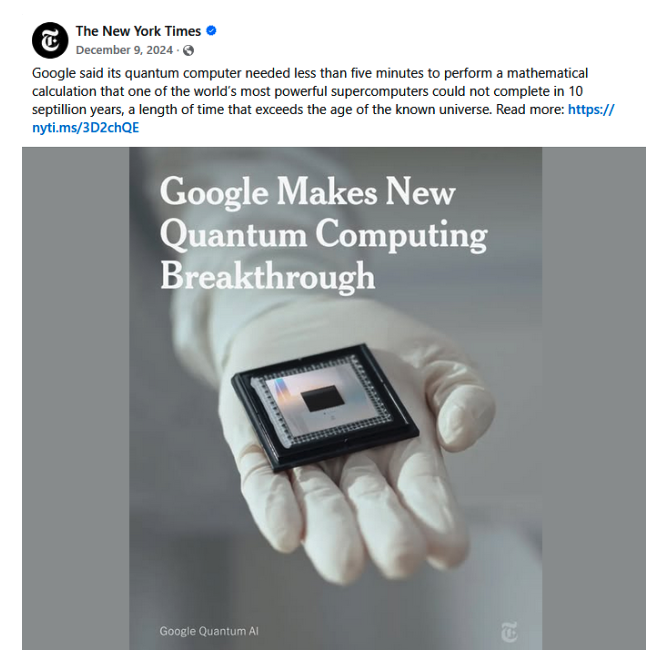
Excitement Versus Reality
Now we must quell the excitement and explain why patience is warranted.
Traditional bits, 0s and 1s, are robust. For instance, they operate efficiently regardless of room temperature or vibrations, like a Wi-Fi signal.
Conversely, qubits are fragile and need to be isolated from the outside world. Any contact with its environment, even something as subtle as a slight temperature change or a vibration, causes it to behave like a classical bit and lose its quantum characteristics.
Accordingly, quantum processors are cooled to temperatures near absolute zero, roughly -460 degrees Fahrenheit. For context, that is about 100 degrees Fahrenheit colder than Pluto’s typical temperature range.
To overcome these obstacles, they are housed in elaborate dilution refrigerators and shielded from interference. Even with these expensive controlled conditions, qubits can make errors at rates that would be unacceptable in classical computing.
Quantum Reliability
The quantum industry measures progress toward reliability using the ratio of logical qubits to raw physical qubits. A logical qubit is one that has been error-corrected to behave reliably, as opposed to a raw physical qubit, which is prone to mistakes. It currently takes somewhere between 1,000 and 10,000 physical qubits to produce a single reliable logical qubit. To put that in perspective, useful quantum computing requires thousands of logical qubits. Therefore, the total physical count of qubits needs to be in the tens of millions.
Increasing the number of logical qubits is a massive task that engineers are working to overcome. Many researchers think that fault-tolerant machines capable of solving real-world problems are still many years away.
The challenge in building qubits lies in two competing demands. They need to be isolated from the environment to maintain superposition and entanglement. But at the same time, they must be practical enough to build, control, and scale into the millions needed for a useful computer.
No one has figured out the best way to build a qubit; scientists are at various stages of developing numerous qubit types.
The graphic below, courtesy of Aliro, summarizes three approaches.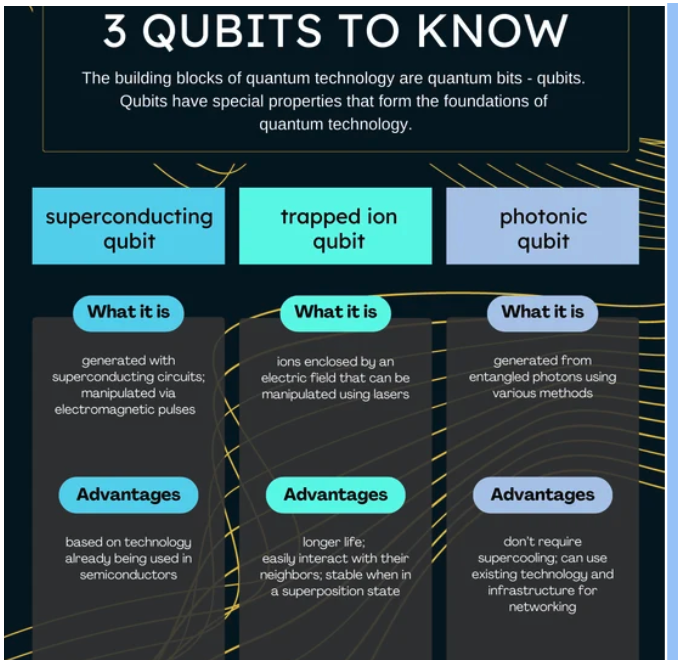
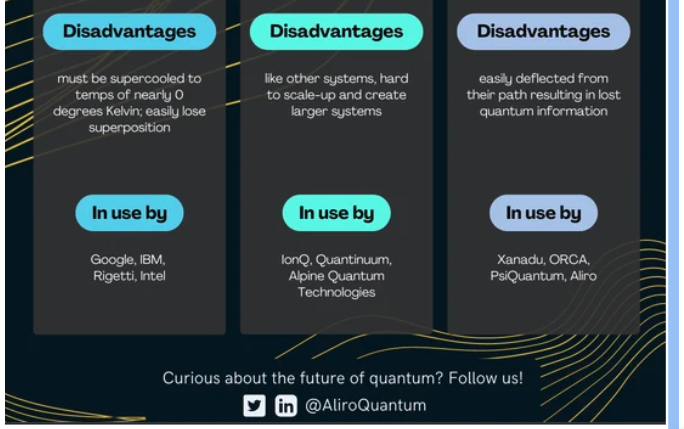
The answer may be that a hybrid approach or something not yet in development overcomes these challenges.
Investing in Quantum
Despite the potentially long timeline and technological hurdles, the industry is making substantial progress. Accordingly, the investment possibilities are slowly coming into focus. To help you get started with your research, we provide a snapshot of the publicly traded quantum computing companies.
Keep in mind that IBM, Alphabet, and Microsoft are large companies with numerous streams of substantial revenue. While those cash flows help fund quantum R&D, the ultimate impact of quantum computing on their bottom lines will be diluted by other business lines. IonQ, D-Wave, and Rigetti are quantum-centric companies. Any significant breakthroughs could be extremely valuable to shareholders. However, while they have some revenue to fund R&D, they will be much more dependent on debt and dilutive equity offerings.
IBM (IBM)
IBM is arguably the most experienced builder in the field. Its Quantum roadmap continues to evolve. The 2026 roadmap below, courtesy of IBM, shows the company is targeting fault-tolerant systems with thousands of logical qubits by 2033. IBM is not solely a quantum computing company. Cash flows from its mainframe and hybrid cloud businesses help fund quantum research and development.
IBM has actively researched quantum computing since the 1970s, and launched the IBM Quantum Platform, the first accessible quantum computer, on the cloud in 2016. Their long-term commitment and prior successes provide them with a knowledge and infrastructure advantage over their competitors.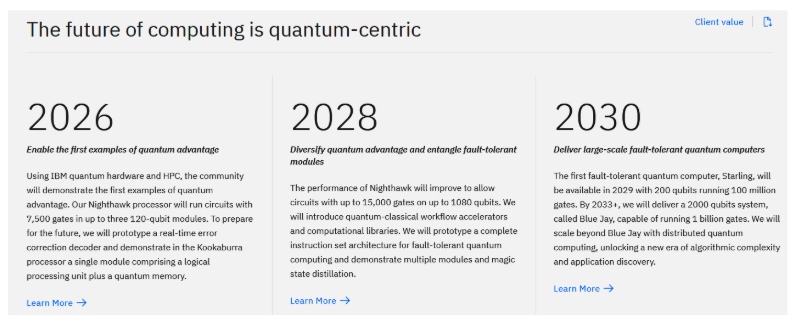
Hot off the presses: IBM and the U.S. Commerce Department announced the U.S.’s first purpose-built quantum foundry, supported by a proposed $1 billion chips grant. The funds are part of a $2 billion total going to nine quantum computing companies.
Google (GOOG)
Google achieved one of the field's most important milestones in December 2024 when its Willow chip surpassed a key threshold. The chip demonstrated what the company called below-threshold quantum error suppression, meaning that adding more qubits reduced error rates rather than compounding them, as was the case previously.
In October 2025, Google announced "verifiable quantum advantage," claiming its Willow chip completed a specific algorithm roughly 13,000 times faster than classical supercomputers. Google's deep integration with DeepMind and its classical AI capabilities gives it a unique hybrid research platform.
Microsoft (MSFT)
Microsoft has pursued a different technical path, betting on topological qubits. While these qubits are much more stable than those in other approaches, they are incredibly difficult to create and verify in a laboratory setting. Microsoft released its first topological qubit chip in early 2025. Azure Quantum, its cloud platform, has become an important interface layer, connecting users to multiple quantum hardware providers, including IonQ and Quantinuum.
IonQ (IONQ)
IonQ is the most prominent pure-play quantum company in the public markets. Rather than producing superconducting qubits, IBM and Alphabet's approach, IonQ uses trapped-ion technology, in which individual ytterbium ions serve as qubits. The approach runs more slowly but is generally more accurate. In 2025, IonQ became the first quantum company to exceed $100 million in GAAP revenue. It has also been aggressively acquisitive, purchasing Oxford Ionics for approximately $1.1 billion and adding quantum sensing and networking capabilities through several smaller deals.
D-Wave (QBTS)
D-Wave takes a narrow but commercially pragmatic approach. Rather than pursuing universal quantum computing, D-Wave specializes in quantum annealing, a technique to optimize problems in logistics, supply chains, and scheduling. Its products may appeal to a relatively small number of clients, but it is the one generating the most near-term commercial traction. D-Wave's Advantage systems are in active production use with real enterprise customers today, not just in a lab.
Rigetti Computing (RGTI)
Rigetti is a smaller pure-play competitor focused on superconducting systems. Its Ankaa-3 processor has shown improved interconnect performance. It has faced financial pressure, but it retains a dedicated engineering team and a growing cloud customer base.
Summary
The quantum computing story is real. The question is not whether we will see quantum computers widely used, but when. The underlying physics is sound, the engineering progress is documentable, and the potential applications are significant.
The investment case requires patience and a realistic view of the potentially long timeframe. By most industry estimates, fault-tolerant quantum computing capable of broadly outperforming classical computers on a commercially viable basis is at least a decade away. The companies best financially positioned to survive that long a wait are those with diversified revenue streams (IBM, Alphabet, and Microsoft) or near-term niche players like D-Wave.
Given the long development time horizon, the associated financial burden, and the uncertainty about which qubit types and companies will be the winners, we recommend a portfolio approach. A diversified approach ensures greater stability and improves the odds of success. Last, and maybe most important, patience is required, as quantum computing companies, especially the smaller ones, are likely to have fits and starts as they progress.
Read more by Michael Lebowitz:
- Timing Productivity Benefits: The AI Economy
- The AI Economy: A Look Beyond the Facade
- Gamma And Momentum: A Recipe for Moonshots & Tears
Michael Lebowitz is a portfolio manager with RIA Advisors and author for Real Investment Advice. For more information, contact him at [email protected] or 301.466.1204.
Join RIA Advisors and elevate your career within a deeply experienced team focused on innovation. Our collaborative environment is built on a foundation of advanced technology and effective investment models, designed to enhance your ability to serve clients and grow your practice. Benefit from a supportive culture that encourages professional development and fosters a forward-thinking approach. By joining our team, you’ll be part of a group dedicated to excellence and continuous improvement, empowering you to focus on building meaningful client relationships and pursuing your business ambitions. Discover the advantages of working with our accomplished advisory team by starting your conversation today.
A message from Advisor Perspectives and VettaFi: Discover something new! Click here to register for our upcoming webcasts.
Membership required
Membership is now required to use this feature. To learn more:
View Membership Benefits