I’ve lost count of the praise heaped on US hedge funds for their “historic performance” in April on artificial intelligence-related bets and alleged foresight of a ceasefire in the Iran war. The fact that one month’s performance was so celebrated, particularly when hedge funds as a group generated less than half the return of the broad US stock market last month, shows how little investors have come to expect of them.
It wasn’t always like this. It’s hard to imagine so much pomp over a single month when hedgies reigned supreme in the 2000s, much the way technology entrepreneurs do today, or star mutual fund managers did in the 1980s. Investors begged hedge funds to take their money two decades ago; even the industry’s brightest lights are on bended knee these day for investment.
Hedge funds are going the way of mutual funds, prey to increasingly competitive markets and an encroaching lineup of cheap, sophisticated investment products.
Bobby Jain, former co-chief investment officer at legendary multistrategy hedge fund Millennium Management, is the latest high-profile casualty of waning investor interest. After launching his namesake multistrategy fund Jain Global two years ago with more than $5 billion in commitments, Jain announced recently that he will return outside money to investors and rejoin Millennium. Multistrategy funds are highly capital intensive, and Jain Global presumably did not achieve the necessary scale.
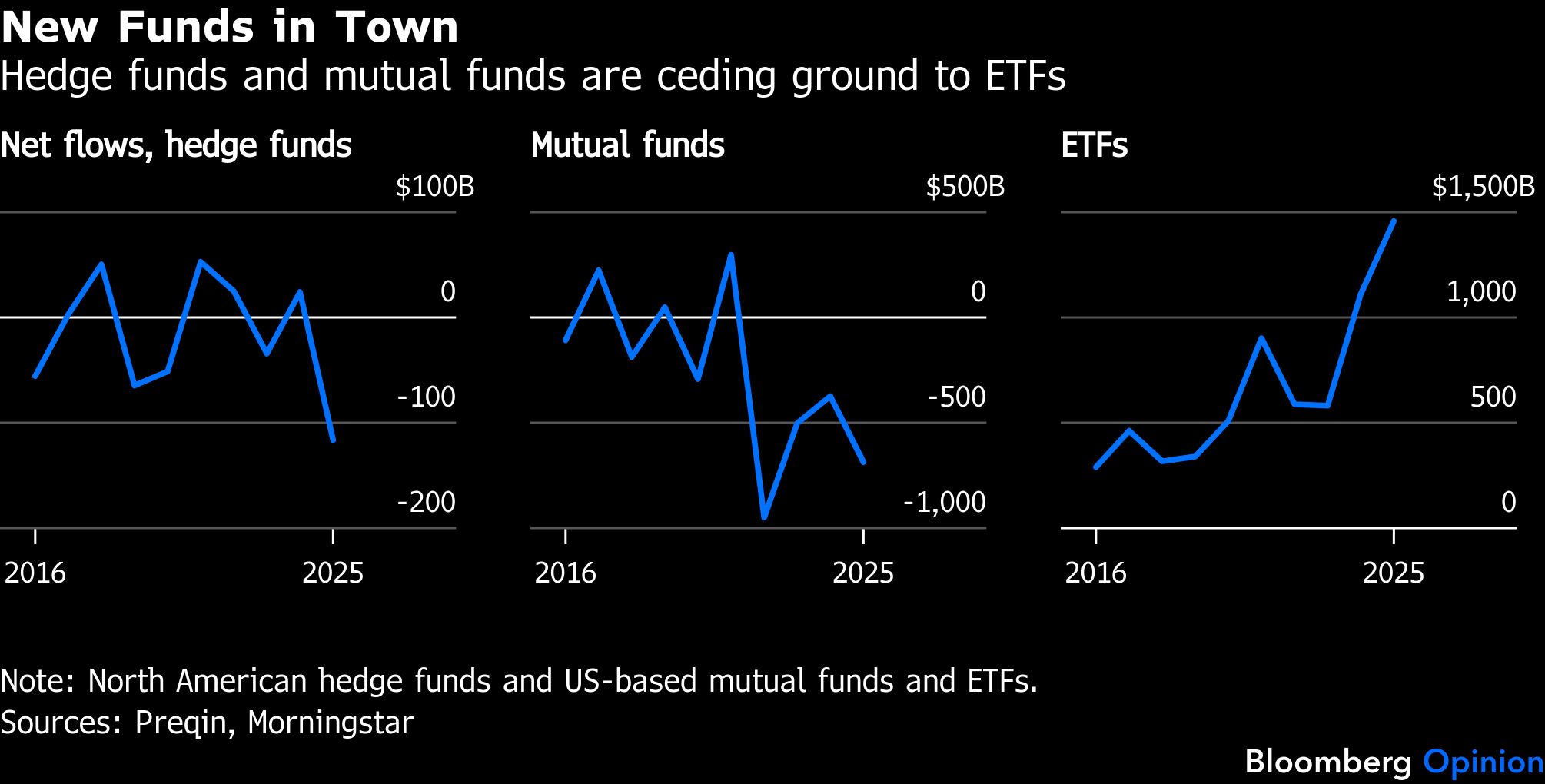
Jain isn’t the only one feeling a chill. Investors have pulled money from hedge funds for years, and the trend appears to be accelerating, at least in the US. They yanked a net $170 billion from funds in North America from 2016 to 2025, $116 billion of which exited last year, according to Preqin. Hedge funds elsewhere also recorded a collective net outflow over the same time.
Multistrategy funds were not spared, giving up $16 billion globally over the past decade. Unfortunately for Jain Global, it debuted at a particularly tough time: Investors pulled $11 billion from multistrategy funds in the months leading up to Jain’s launch in July 2024. Better timing would probably not have saved the fund given the longer-term trend of investor exits. Hedge funds that are not already at scale face long odds.
It’s not just hedge funds. Mutual funds are experiencing a similar exodus, only in larger numbers given their bigger size. Investors have pulled a net $2.7 trillion from open end US-based mutual funds since 2016, according to Morningstar Inc. That money appears to have migrated to exchange-traded funds, which have taken in more than $7 trillion in assets over the same time.

That’s not a knock on mutual fund and hedge fund managers. Better technology and more data have made portfolio managers smarter, better informed and more skilled than ever. But the more adept fund managers become, the more efficient markets become at pricing assets, making it harder for them to win.
That makes market-tracking index funds more attractive, which is where most of the money in ETFs resides. Even those who want a crack at beating markets are probably better off with ETFs because they replicate many mutual fund and hedge fund strategies more cheaply and tax efficiently.
You wouldn’t know investors are fleeing old-school funds judging by their assets. Mutual funds still manage $23 trillion and hedge funds $5.6 trillion, both all-time highs. Rising asset prices have more than offset outflows so far, in large part because investors who want out are strapped with sizable capital gains.
But two cliffs lie ahead. During the next big, sustained downturn, investors will have an opportunity to dump investments at depressed prices and thereby lower tax bills. There hasn’t been such an opening since the 2008 financial crisis, an unusually long time. Also, baby boomers wield much of the money in mutual funds and hedge funds and are expected to pass it down over the next two decades in a wealth transfer estimated in the tens of trillions of dollars. This is likely to result in sizeable liquidations and a massive haircut to the assets entrusted to mutual funds and hedge funds.
ETFs may well displace mutual funds, although hedge funds won’t disappear. Managers who can persuade investors to pay hefty fees for novel strategies and fancy tricks for beating markets will continue to prefer the exclusivity and relative privacy of running a hedge fund. But with US-based ETFs up to $15 trillion in assets and growing fast, the heyday of mutual funds and hedge funds is over, no matter how great April was.
A message from Advisor Perspectives and VettaFi: Discover something new! Click here to register for our upcoming webcasts.
Bloomberg News provided this article. For more articles like this please visit
bloomberg.com.
Read more articles by Nir Kaissar