When Walt Disney Co. announced in November 2022 that Bob Iger would return as chief executive officer, the market took it as an auspicious sign. The stock jumped more than 6% on the news, its biggest increase in nearly two years.
Instead, Wall Street should have taken it as a warning. Boomerang CEOs are almost universally greeted as heroes, but historically their track records are humbling. A 2019 study found their annual stock performance was 10% worse than their rookie counterparts. And a separate analysis from leadership advisory firm Spencer Stuart found that since 2010, 66% of boomerangs in the S&P 500 had lower total shareholder returns during their second go-arounds.
In Iger’s case, investors seemed to think that as one of corporate America’s most revered and accomplished CEOs, he could defy that pattern. But as he exits the job for a second time (his last day was Wednesday), the simple story is that he’s become just another example of an underachieving boomerang CEO, at least as far as the market is concerned. During Iger 2.0, Disney significantly underperformed the S&P 500 Index: Its shares rose about 9% compared with nearly 70% for the index. Compare that with Iger 1.0, from 2005 to 2020, when the stock climbed 438% compared with 155% for the S&P.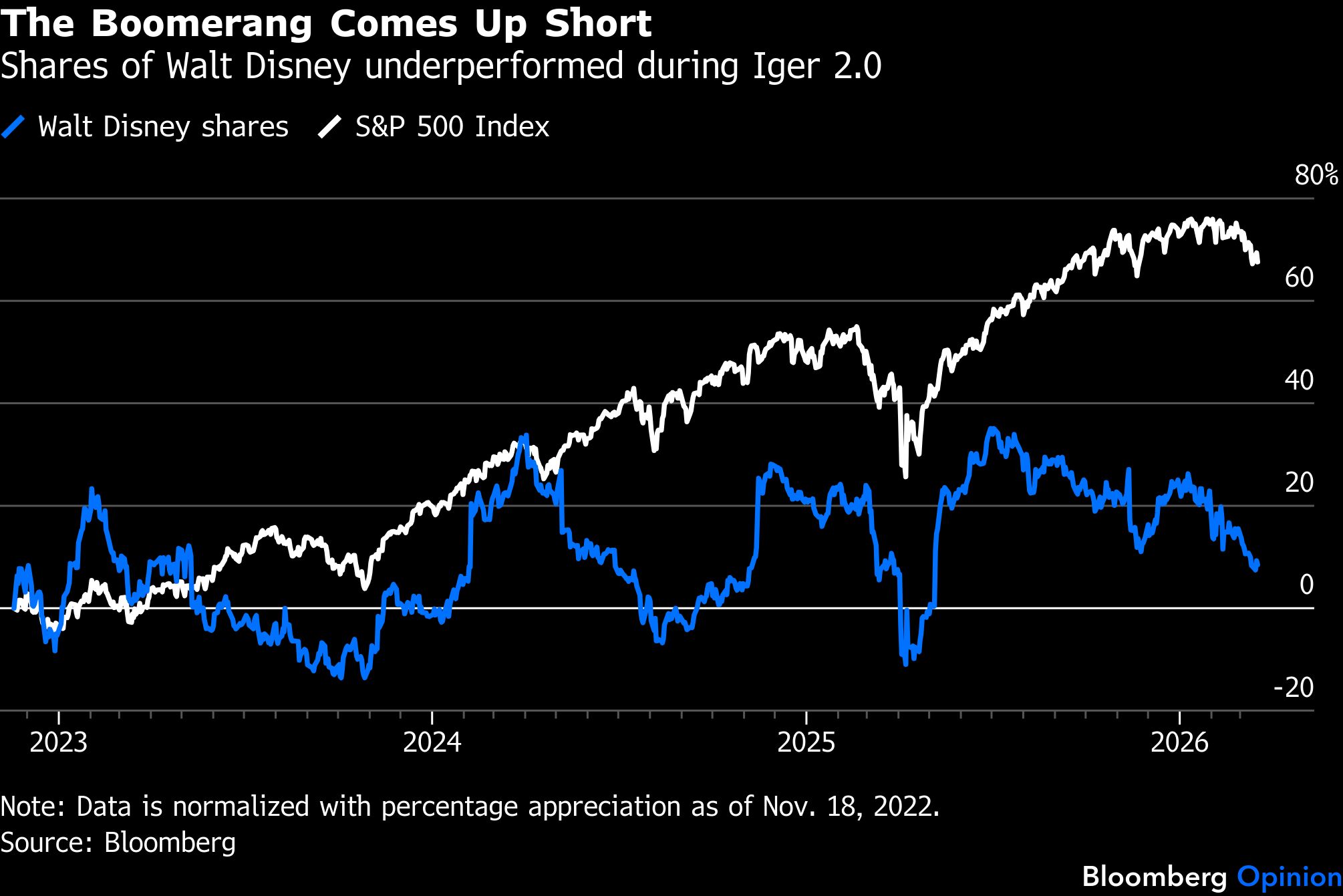
What complicates the narrative, however, is that Iger largely accomplished what the board brought him back to do. He stabilized the company coming out of the Covid-19 pandemic, getting it back on track after the rocky tenure of his handpicked successor, Bob Chapek. He made the streaming business bigger and profitable. He restructured the content segment to help reignite its creativity. He fended off activist shareholder Nelson Peltz and defused a culture war battle against Florida Governor Ron DeSantis. He also tried to correct his biggest failing from his first tenure by helping to find and prepare his successor, Josh D’Amaro, the head of parks and resorts.
The market, however, wanted more — in large part because expectations were so high. During his first run, Iger transformed Disney, buying assets such as Pixar, Marvel, Lucasfilm and 21st Century Fox. He launched Disney+ and opened new markets, expanding the theme park business to Shanghai.













