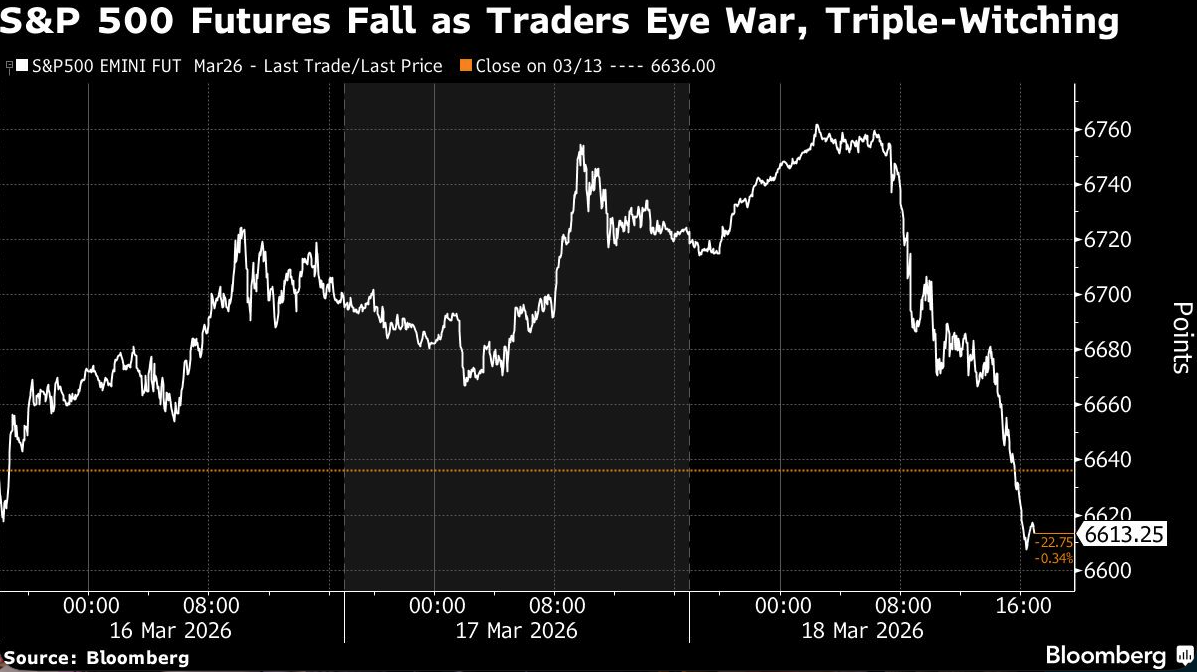
US futures extended a drop on Friday as earlier hopes for a quick resolution to the war in the Middle East faded. Meanwhile, traders braced for a historic amount of March options expiry.
Contracts on the S&P 500 Index fell 0.4% as of 7:27 a.m. in New York, while Nasdaq 100 futures declined 0.6%. Brent crude oil prices reversed earlier gains to decline 0.7% to around $108. The Cboe Volatility Index rose to around 25.
US stocks are on course for a fourth week of losses — the longest losing streak in a year. The benchmark S&P 500 finished under its 200-day moving average on Thursday, a key level of the market’s overall health, which could trigger some forced selling.
“Given recent volatility, today could almost be described as unchanged but clearly the bias has been lower,” said Sameer Samana, head of global equities and real assets at Wells Fargo Investment Institute. “I think the true test of today will be what investors decide to do at the close, before the weekend.”
The market is bracing for an increased market movement as about $5.7 trillion in notional options tied to individual stocks, indexes and exchange-traded funds were due to expire on Friday. The quarterly event that traders called “triple-witching” has a reputation for triggering unexpected price swings as large pools of derivatives exposure abruptly vanish. Friday’s tally is the largest March expiry, according to Citigroup Inc. data dating back to 1996.
Iran went ahead with attacks on Arab states in the Persian Gulf even after Israel signaled it would refrain from hitting the Islamic Republic’s energy infrastructure. Axios reported the US is considering plans to take over Iran’s key oil-export site Kharg Island to add pressure on Tehran to reopen the Strait of Hormuz.
“I think that the market is right now coming to grips with the reality that higher energy prices are going to persist longer than expected,” said Mark Malek, chief investment officer at Siebert Financial. “It is clear that the Iran regime turned to the last page in its playbook: MAD, mutually assured destruction.”
Crude oil prices continued to be traders’ main concern as it affects inflation and consumer sentiment.
The latest oil future curves showed “markets are beginning to price a more persistent ‘higher for longer’ oil backdrop,” Barclays strategists including Emmanuel Cau said in a note. “This dynamic is reinforcing stagflation concerns.”
On Wednesday, Federal Reserve Chair Jerome Powell said officials will not lower interest rates until inflation cools, as it was too early to determine the impact of rising oil prices on the US economy. The central bank left rates steady for a second straight meeting.
“We think the Fed staying on hold remains the most appropriate positioning,” said Deborah Cunningham, chief investment officer for global liquidity markets at Federated Hermes. “The current conflict with Iran is nowhere near the magnitude of the disruptions seen during COVID, nor the 2008 global financial crisis, so there is no justification for cutting rates by hundreds of basis points.”
A message from Advisor Perspectives and VettaFi: Discover something new! Click here to register for our upcoming webcasts.
Bloomberg News provided this article. For more articles like this please visit
bloomberg.com.