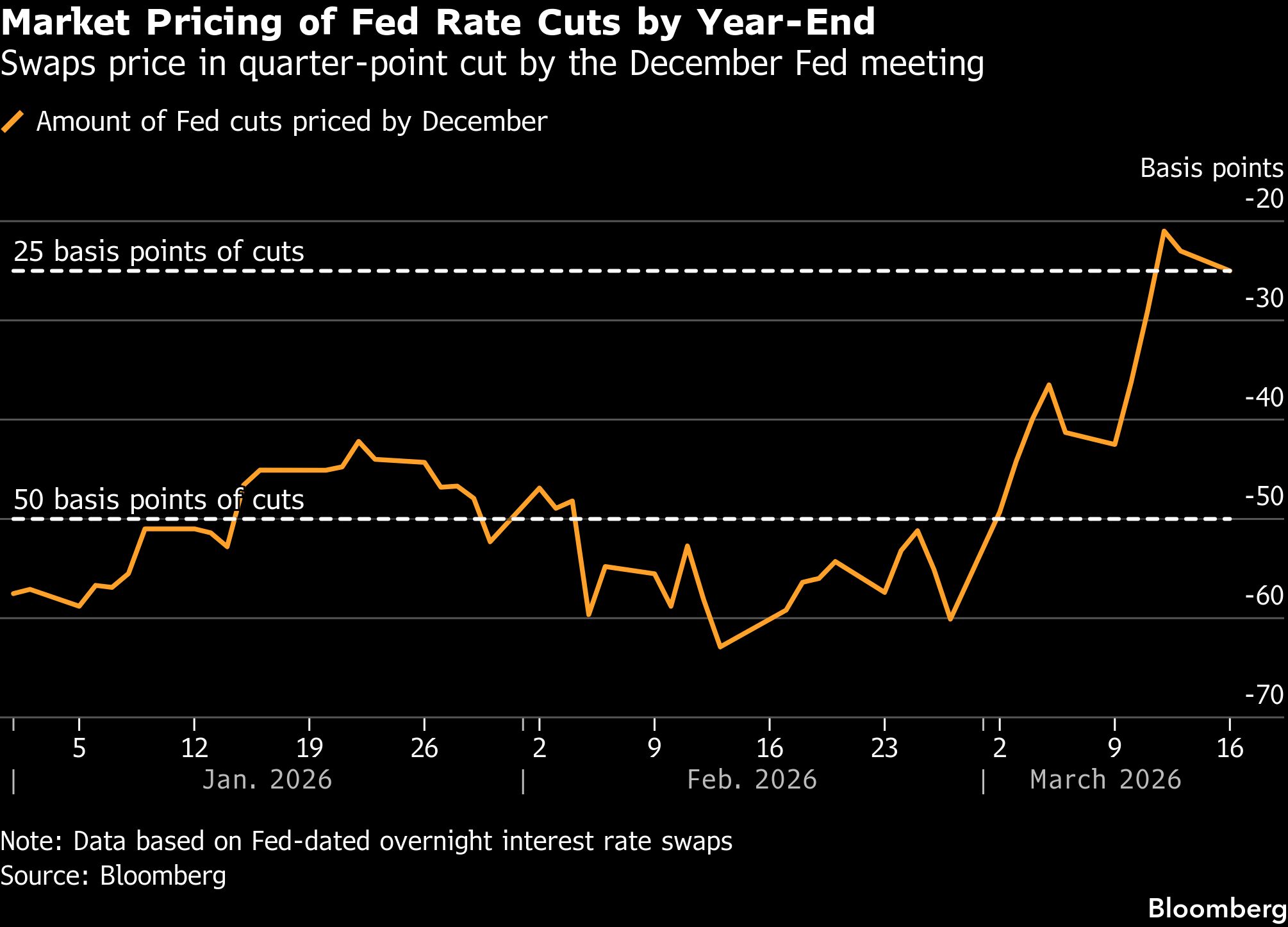
Morgan Stanley is sticking with a forecast that sees the Federal Reserve resuming interest rates cuts in June and delivering another reduction in September, even as soaring oil prices prompt traders to curb bets for how much policymakers will lower borrowing costs this year.
“We’re still on June and September, with the risk that of course it gets delayed,” Michael Gapen, chief US economist at Morgan Stanley told Bloomberg News in a roundtable discussion in New York on Monday.
The forecast is at odds with a market that has rushed to price out rate cuts, as spiking oil prices in the wake of the Iran war threaten to revive inflation and potentially hinder the Fed’s ability to ease monetary policy.
Futures tied to Fed policy rates currently price one quarter-point cut in December, down from at least 50 basis points seen as recently as last month. September odds for a quarter-point cut stand around 60%. Economists at both TD Securities and Barclays last week shifted their forecasts for the next Fed cut to September from June.
Meanwhile, a bout of heavy selling in Treasuries last week took the policy-sensitive two-year yield as high as nearly 3.75%, putting it above the rate paid on reserves by the Fed — a level that is rarely broken. A market proxy for where the Fed will complete its current easing cycle, known as the terminal rate, has risen some 50 basis points from late February to above 3.4%.
“I was a little surprised that the two-year moved as much as it did, I could certainly see maybe longer rates moving, but I am surprised again that the terminal rate has been repriced as high as it has been,” said Gapen.

A sharp jump in the rolling-one-month volatility for the two-year note over the past week reflects the unwinding of options positions as front-end yields sold off, the bank said in a note published Monday.
Of course, there is a possibility that the Fed could either delay its first cut until September or even December, either of which could push the next reduction into 2027, Gapen said.
“The risk to our view is primarily the later and maybe the longer the Fed waits, the more it has to put in maybe an additional rate cut.”
Oil Shock
Brent oil was trading around $103 a barrel on Tuesday, after closing above $100 for the third straight session, the longest such streak since August 2022, as investors weighed signs of ample near-term supplies against rising military threats to energy infrastructure across the Middle East.
Morgan Stanley said an extended period of elevated energy prices between $125 to $150 a barrel would weigh on consumer spending and warrant support from the Fed. The probability of a US recession has increased to around 20%, up from 10% before the military conflict began, according to Gapen.
“The economy can handle $90 to a $100 per barrel prices. You probably do need to get to around a $125 to $150 on a prolonged basis, that’s probably a reasonable recession probability,” he said.
Key Metrics
Seth Carpenter, Morgan Stanley’s global chief economist, said an oil-led inflation spike would likely be only temporary.
“If it’s bad enough that it starts to hit growth, that over time will actually pull down underlying inflationary trends, especially for core,” he said.
Inflation swaps could be one way to gauge how much elevated oil prices are weighing on demand, according to Matthew Hornbach, Morgan Stanley’s global head of macro strategy.
The 1-year forward 1-year inflation swap rate has risen some 20 basis points toward 2.5% since the price of crude oil vaulted above $100 a barrel for the first time since 2022. A fall in the rate would be a signal to buy Treasuries and price in more rate cuts, as the market shifts from concerns over inflation to worries over demand destruction, according to Hornbach.
“It’s the most important metric on your dashboard,” he said.
A message from Advisor Perspectives and VettaFi: Discover something new! Click here to register for our upcoming webcasts.
Bloomberg News provided this article. For more articles like this please visit
bloomberg.com.
Read more articles by Michael MacKenzie