Advisor Perspectives welcomes guest contributions. The views presented here do not necessarily represent those of Advisor Perspectives.
Investors often look to technical indicators like moving averages in equities to assess if markets are overvalued and whether we are in bubble territory. While it is important to consider whether investors are irrationally exuberant when looking at markets, equally important is the question of whether investors have regained their confidence after a market blow-up.
We decided to test this exact question by going back 50 years to explore how long it takes investors to come back to markets with the same gusto after a market collapse. Across a variety of indicators, we find that on average it takes investors around 10 months to hit a previous high in a measure of investor sentiment or inflows.
To expand on our methodology, we went back in time and explored six severe market crashes or downturns: the inflation spike of the late 1970s, the market crash of 1987, the dotcom crash of 2000, the housing collapse of 2008, the COVID crash in 2020, and the inflation spike in 2021/2022.
For each market downturn, we explored how investor sentiment reacted around the event. To gauge investor sentiment, we considered a variety of measures including direct sentiment measures like PMI, consumer confidence index (CCI), business confidence index (BCI), and options-based measures like the put-call ratio. For indirect measures of sentiment, we looked at ETF and mutual fund inflow data and at margin debt.
With each of these measures, we explored how long it took for investors to come back to a previous high. For instance, if the Business Confidence Index was at 100 right before the dotcom crash of 2000, we counted how many months it took to recover and return to that level after the crisis. We then averaged the results across all six market events.
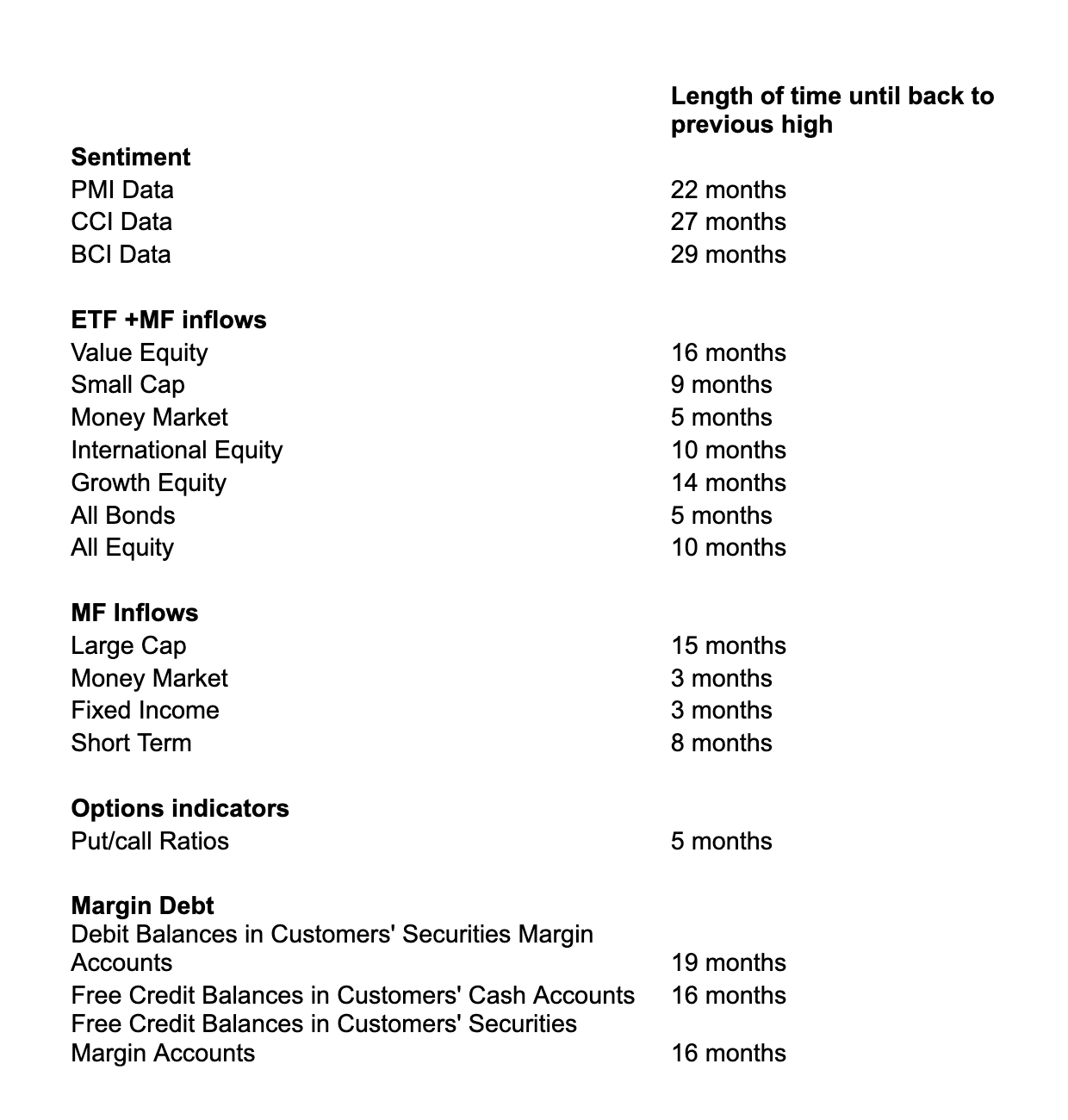
The results are presented in the table below. The first finding is that, on average, direct measures of consumer sentiment (like CCI) take longer to rebound than indirect measures of sentiment (like inflows in small-cap equities). This holds across all of our direct measures of sentiment. In addition, it is interesting to see that options-based measures of sentiment (like the put/call ratio) saw the quickest rebounds in activity after a crisis.
We also found that margin debt takes longer to rebound than inflows, but not as long as direct measures of confidence. This is interesting to consider because investors don’t initially go back into margin use but into an asset class via direct investment (inflows) into that category.
Overall, the results highlight how investors exhibit caution after a crisis. Following a crisis, investors tend to go back into risky assets first, driving inflows into those specific categories. A return to dabbling with margin follows, and finally (20 months after the crash), we see measures of consumer sentiment fully rebound. These results demonstrate how investors differ in their responses to crises from consumers and should inform policy decisions and other responses to these crises.
Ali Al-Hassan is a finance professional currently working in partnership accounting at The Carlyle Group, where he supports fund operations, capital activity, and investor reporting. He previously worked in audit at Ernst & Young, developing a strong foundation in financial reporting, internal controls, and financial statement analysis. Ali graduated magna cum laude from George Mason University. His interests center on capital markets, investor behavior, and portfolio performance.
Lucas Rush is a former U.S. Marine infantryman. After completing his military service, he earned his undergraduate degree at George Mason University with a focus in finance. He is particularly interested in credit, capital structure dynamics, and the intersection of operational performance and financial stability. Lucas is committed to continued service through mentoring fellow veterans as they transition into higher education.
Dr. Derek Horstmeyer is a professor of finance at George Mason University. His research focuses on ETF performance and corporate governance. He also runs the Montano Student Managed Investment Fund.
A message from Advisor Perspectives and VettaFi: Discover something new! Click here to register for our upcoming webcasts.
Read more articles by Ali Al-Hassan, Lucas Rush, Derek Horstmeyer
 Advisor Perspectives welcomes guest contributions. The views presented here do not necessarily represent those of Advisor Perspectives.