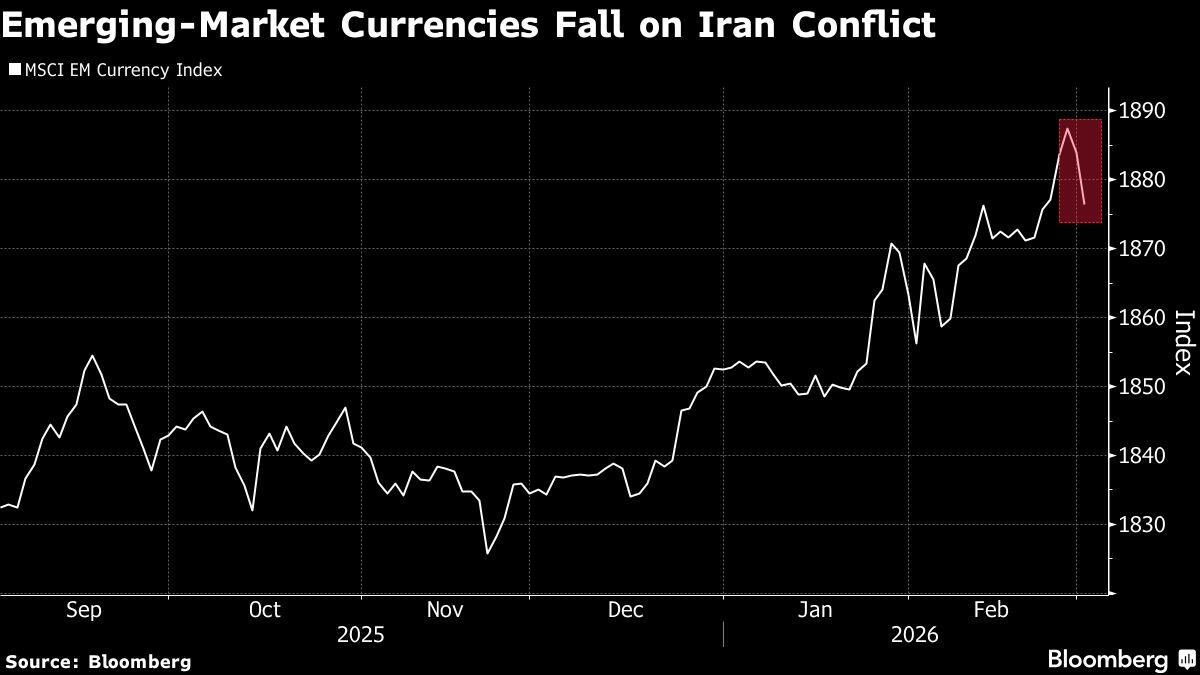
Emerging-market currencies and stocks slumped as US and Israeli strikes on Iran are triggering a jump in energy prices and bring a rally in riskier assets to a screeching halt.
A gauge of developing nations’ currencies, which reached a record high last week, dropped 0.7% as the dollar strengthened. The losses spurred central banks in Indonesia and India to buy local currencies, while in Turkey local lenders helped to stabilize the lira.
EM equities dropped as much as 1.9%, the most in a month, led by tech heavyweights, with the consumer discretionary sector also hit.
The US-led aerial attacks on Iran, which are affecting the broader region, have disrupted sectors from oil and shipping to air travel. Benchmark Brent crude oil surged to its highest level in more than a year, while the greenback and gold jumped as investors piled into safe haven assets, further hurting emerging currencies and fueling inflation concerns.
“This is a shock that pushes EM weaker,” said Brendan McKenna, an emerging-market strategist at Wells Fargo in New York. “That shock, combined with the theme that EM is overvalued and overowned at current levels, should drive a selloff in the early days of the conflict.”

The Hungarian forint, which is sensitive to natural gas prices since the landlocked country is dependent on energy imports, fell the most among peers along with the Thai baht and the Philippine peso.
Middle Eastern countries such as Egypt, Saudi Arabia and Bahrain saw their dollar bonds drop the most among EM peers, while the Israeli shekel and stocks listed in Tel Aviv stood out for their gains.
Monday’s selloff disrupted a record-busting rally across emerging markets, which was fueled by global asset managers redirecting flows from the dollar toward developing nations that offer higher yields or produce key ingredients for the boom in the AI sector.
Calming Panic
Central banks in Indonesia and India had to intervene in the foreign-exchange markets to anchor their currencies. Turkish lenders sold about $5 billion as of Monday morning, according to traders, while Turkish officials announced a slew of measures across the FX market, equities and funds to protect investors against volatility.
“There’s panic selling at first, then normalization,” said Mehmet Gerz, the chief executive officer of Turkish asset management firm Osmanli Portfoy. The lira was little changed against the dollar by mid-day in Europe.
Countries with low currency reserves, such as Argentina, Sri Lanka, Pakistan, and Turkey, face stronger risks of capital outflows and currency depreciation, strategists at Citigroup Inc. said. “Frontier spaces look particularly vulnerable,” Luis Costa wrote in the note.
The yields on local-currency bonds rose in markets where the feeding of higher energy costs into domestic inflation may delay monetary easing.
“A sustained increase in oil prices would also significantly limit the scope for policy rate cuts due to an external inflationary shock,” Barclays strategists including Marek Raczko wrote in a note. “So, front-end rates in economies that are in an easing cycle — South Africa, Poland, Turkey, Hungary — or where the market discounts further cuts — Czechia — should reprice higher, in our view.”
East European bourses recouped some losses after dropping as much as 3%, with oil refiners helping to offset losses. The escalation in tensions lifted energy, shipping, defense and gold shares.
Pakistan stocks plunged the most on record, triggering an hour-long trading halt, as the country’s conflict with Afghanistan added to risks.
Bloomberg Economics said the conflict could lead to an increase in oil prices to as high as $108 per barrel, especially if the confrontation proved longer and “more intense than the 12-day war in June,” analysts led by Dina Esfandiary wrote. Brent jumped 8.6% to around $79 per barrel.
Korean markets, featuring some of the biggest EM corporate names, were closed for a holiday. Stock markets in Dubai and Abu Dhabi were also shut amid concern over retaliatory attacks by Iran.
Global market watchers are likely to remain focused on haven assets for now, passing over many of the details of the Iranian developments, said Charlie Robertson, head of macro strategy at FIM Partners.
“Investors will stick with safe haven Treasuries or Swiss francs, shorter duration bonds, investment grade EM (ex-Gulf),” Robertson said.
A message from Advisor Perspectives and VettaFi: Discover something new! Click here to register for our upcoming webcasts.
Bloomberg News provided this article. For more articles like this please visit
bloomberg.com.
Read more articles by Andras Gergely, Prima Wirayani, Matthew Burgess