A Nobel for the Deep Roots of Growth and Prosperity
Membership required
Membership is now required to use this feature. To learn more:
View Membership BenefitsThe views presented here do not necessarily represent those of Advisor Perspectives.
Source
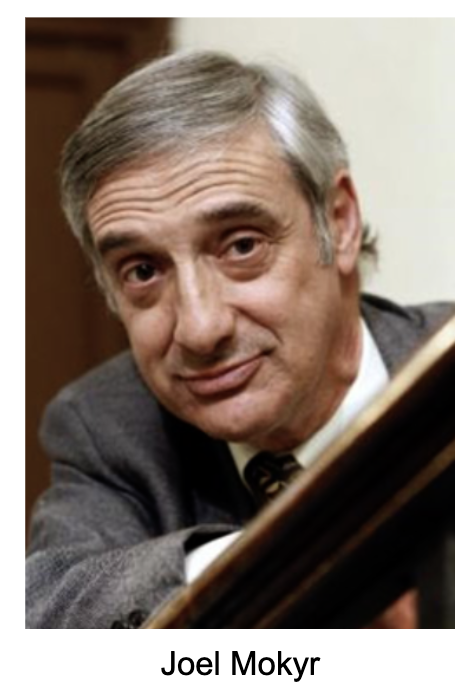
I was tickled pink, to revive an old-fashioned expression, when I found out that Joel Mokyr, the celebrated Northwestern University economic historian, had won the 2025 Nobel Prize in Economics. He won it “for having identified the prerequisites for sustained growth through technological progress," said the Nobel committee. (He shared the prize with two other scholars who also specialized in history.)
Why was this prize special and different? The greatest mystery in economics is why the Great Enrichment — the sea-change in the fortunes of common people that began about 250 years ago in northwestern Europe and that has spread through much of the world since then — occurred at all. Prior to that, the Malthusian curse — the idea that any economic progress would be swallowed up by population growth, leaving people no farther from abject poverty than before — had almost always applied.
So far, the Great Enrichment has made half the world’s population middle class and given the other half hope that they, too, will participate in this unprecedented prosperity.1 Although there have been other prosperous societies at various times, all of the earlier Golden Ages eventually ended.2 The economic miracle of modern times continues to build and diffuse. Nothing like this has ever happened before.
Joel Mokyr has devoted his professional life to figuring out how and why.
Why Economic History Is the Most Important Specialty in Economics
The answers to these questions are centrally important, not just to economics, but to human life. That’s because poverty is the natural state of all living things, human and otherwise. Wealth — not poverty — is the mystery that needs to be explained.3
If economics is going to contribute anything to the world other than a better understanding of the human behavior that we observe, it’s an instruction manual for how to make us all rich — or at least rich by the modest standards of a species for which poverty is the default state of existence.
Economic history is the branch of economics that sheds the most light on this question, which is why I think it is the most important specialty in economics, and is the reason I so pleased when I heard about Mokyr’s Nobel. The Nobel has tended to go to more technical and mathematical economists, and it was time for a historian to receive the prize.4
A Bit About Joel Mokyr’s Life
Mokyr, born in the Netherlands in 1946, came from a family of Holocaust survivors that settled in Israel. He grew up in Haifa and still teaches at Tel Aviv University as well as Northwestern. During Mokyr’s youth, Israel was poor; today, it is rich. It is a natural laboratory for studying economic development. Perhaps if we had more public-facing economists who lived through the astonishingly rapid growth of Israel, Taiwan, South Korea, as well as other places that achieved first-world status in recent times, we’d know more about that process and could apply the lessons to a broader swath of the world’s population.5
“A Culture of Growth”
It wasn’t what happened in these islands of innovation in the 20th and 21st centuries that so piqued Mokyr’s interest; it was a constellation of circumstances four centuries earlier, in northwestern Europe, during the Renaissance. The factor that Mokyr found most essential to the launching of an economic revolution — one that would not make itself visible in the way people lived for two hundred more years — was a change in the culture.
The idea that the roots of the enduring economic growth of the last quarter-millennium are cultural is not his alone — it is shared by his close colleague and friend Deirdre McCloskey, of whom I’ve written glowingly in these pages. It has roots as old as Max Weber’s classic book, "The Protestant Ethic and the Spirit of Capitalism," which was published in 1905.
Paraphrasing McCloskey, the explanation for what she called “the most important event in human history” was none of the following:
- It was not capitalism per se; historian Alan Macfarlane wrote that Britain was just as capitalist in 1215 as in 1715.6
- It was not capital accumulation (Thomas Piketty’s favorite explanation) — the mere abundance of capital, amassed over time, which could be put to work in productive endeavors.
- It was not property rights and the rule of law, which existed in an earlier England that remained poor, and in other societies that did not succeed, or succeeded for a while and then fell apart.
- It was not the philosophical Enlightenment, which came later.
- It was not science, nor was it the technology advanced by tinkerers and artisans whose accomplishments were later studied by scientists who wanted to understand how the new inventions worked.
Those are all stars in the constellation of circumstances, but a catalyst needs to be brought in to make the Great Enrichment happen.
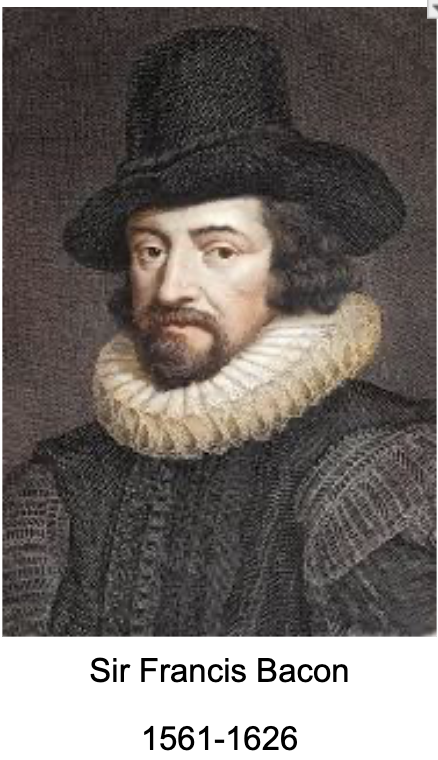
The catalyst, according to Joel Mokyr’s 2016 book, "A Culture of Growth,"7 was the influence of one now half-forgotten man, Sir Francis Bacon.8
Source
Francis Bacon: “Cultural Entrepreneur”
Bacon, an English noble, Lord Chancellor (analogous to attorney general in the U.S.), and contemporary of Shakespeare, strongly advocated the pursuit of “useful knowledge,” in contrast to the abstract ideas and theories with which scientists and philosophers of the time mostly concerned themselves. While Bacon is sometimes credited with inventing the scientific method, Mokyr says that is not quite right:
Bacon was not so much the great advocate of an inductive methodology in science but rather someone who had one great idea: knowledge ought to bear fruit in production, science ought to be applicable to industry, and it was people’s sacred duty to improve and transform the material conditions of life.
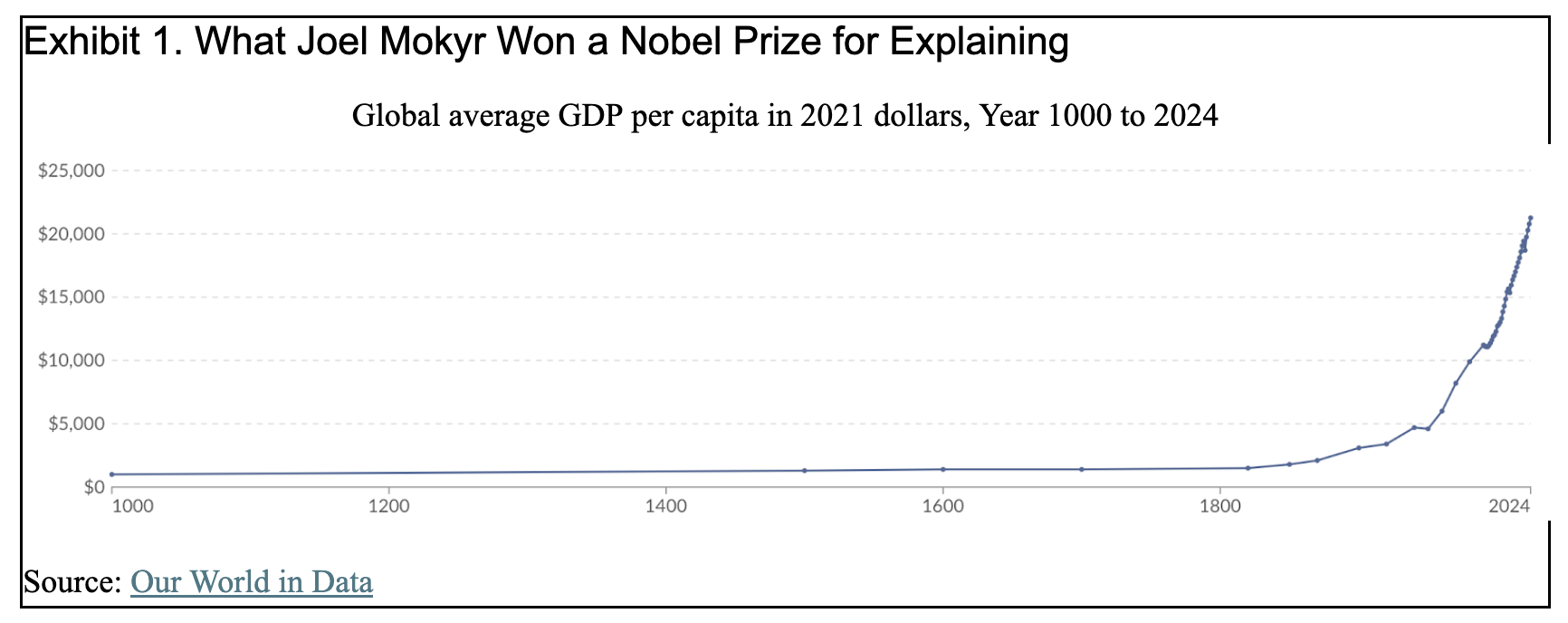
In that one sentence lies the essence of the modern project, which is to build on what has already been achieved to advance human flourishing to previously unattained heights. Despite the many failings of the human race since the 1600s, a quick look at GDP per capita over that long period shows that Bacon’s ideal has more or less been attained.
But Bacon was only one of the many philosophers and writers milling about London in the time of Shakespeare, spouting various views. What made him so influential? Mokyr argues that it was Bacon’s skill as a “cultural entrepreneur,” marshaling the English language to persuade his contemporaries and intellectual descendants that the “Baconian program” was the right path forward.
This argument is a little circular (he was influential because he was persuasive?) and also a little farfetched (how could the writings of one man force a ninety-degree turn in the fortunes of Europe and the world, redirecting four centuries of science and industry?) Mokyr doesn’t reveal the mechanism — maybe nobody knows how it happened — but he clearly shows that Bacon’s connection between scholarship and artisanship was reflected in the words and deeds of innovators for the next two centuries. And, before that amount of time had elapsed, the Industrial Revolution was in full flower and the takeoff to sustained economic progress had begun.
The Emergence of Modernity
What happened after 1750 or 1800 — an escape from Malthusian misery in northwestern Europe, gradually spreading to the Continent and the New World but leaving large swathes of the rest of humanity behind — is well known, as is the recent catch-up in what used to be called the third world. Therefore, we do not need to tell that story, which is outside Mokyr’s area of greatest expertise anyway.
In the work for which Mokyr won the Nobel Prize, he focused his attention on the early modern era, seeking to understand the origin story of capitalism and widespread prosperity. That is his unique contribution.
Exhibit 1 illustrates the takeoff to modernity in a simple picture. Apologies if you’ve seen it too often; however, because it’s the most important news story in history, I think it bears repeating each time I write about growth. While the global inflection point in the exhibit is around 1820, Mokyr is correct in locating the shift earlier in the special corner of the world where the Industrial Revolution began.
It is just as well that Mokyr left the “easy part” — the history of the last quarter-millennium — to other scholars, who have written dozens of books on the topic. While Mokyr’s own prose is aimed more at the academy than a popular audience (the reason I have not reviewed his books here), he is a terrific lecturer who provides great material for others to write about. For those interested, I especially recommend the ouvre of his friend McCloskey. Despite the immense length of her most important books, her style is utterly charming and a model of clarity.9 Her collaboration with Art Carden, “Leave Me Alone and I’ll Make You Rich,” is a brief summary of her endless Bourgeois Era trilogy; it’s the perfect place to start.
Mokyr’s Vision of the Future
“The best is still to come,” Mokyr said in his Nobel lecture on December 8, 2025, in Stockholm.
What is he talking about? Doesn’t he know that we face mammoth social and political challenges, the possibility of environmental disaster, negative population growth, government budgets run amok, and an ever-present threat of war?
Of course he does. And, along with many but not all economists, he thinks that continued and even accelerated economic growth is the solution to these challenges — and that the growth will happen. In a 2014 Advisor Perspectives article,10 I reported on the ongoing friendly feud between Mokyr and his pessimistic Northwestern University colleague, Robert Gordon, who correctly pointed out that no growth rate (of a physical quantity) can continue forever. I wrote:
[I]f an ancient Egyptian consumed one cubic yard of physical materials per year in 1000 B.C. and his consumption grew at only 2% per year, roughly the current rate of global GDP per capita growth, he would be consuming more than the volume of the planet each year by the present time. Such expansion, then, can only continue for a finite amount of time, if consumption of physical materials is what we are talking about.11
However, Mokyr pointed out that consumption of physical materials is not what we are talking about! It’s almost the opposite. Economic growth means a reduction in the effort needed to produce a unit of utility — doing more with less. It takes a thoughtful and broad-minded economist to get this subtlety right. Mokyr got it right and the doom-and-gloomers did not.12
So, what does Mokyr think the future will look like? He makes no specific forecasts — “historians should not predict the future,” he said in his Nobel lecture. Instead, he offers a general forecast: that while technology and past trends point toward a more prosperous and humane future, progress is still shadowed by significant risks.
Mokyr’s litany of risks is a little scary: isolationism; stupidity (he quotes Schiller: “Against stupidity, the gods contend in vain”13); too much government; too little government; “institutions [that are]...slow to adapt”; war; and populism. He is quite a worrier! With all those dragons to slay, it’s a wonder he thinks we will make any progress at all. But he is confident that the cumulative acquisition of knowledge and its application to practical problems is more powerful than the dragons. I can only hope he is right.
Conclusion: Leonardo’s Helicopter
To sum up, Mokyr’s explanation for the uniqueness of the Industrial Revolutions that began around 1750 seems correct but not complete. It is a major, even essential, contribution to the story behind the Great Enrichment, but it is not the whole story.
Admittedly, without a change in culture, none of this would have happened. It’s hard to innovate when your religion tells you that there is nothing new to invent or discover. It’s difficult to get ahead when your culture tells you that the way of life that was good enough for your father and grandfather had better be good enough for you.
Source
But there are factors other than culture that are important too. My favorite, because it is underappreciated, is materials science.
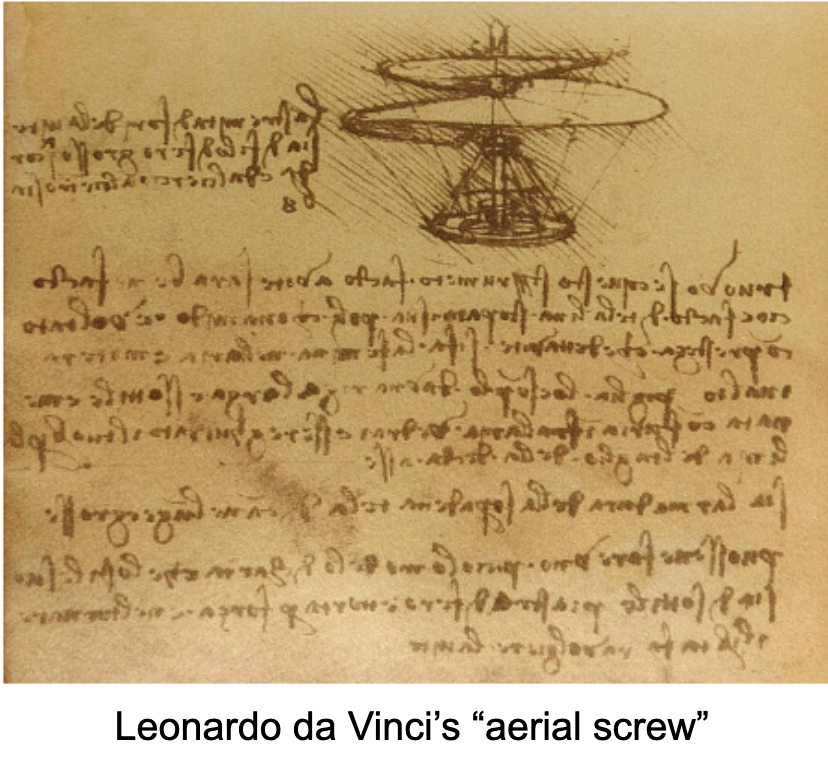
Leonardo da Vinci drew a helicopter in the 1480s. Igor Sikorsky built one in the 1930s. That’s a long wait. What were inventors, engineers, and entrepreneurs waiting for?
Not abstract scientific discovery, which wasn’t really required, and if knowledge of atmospheric pressure was a key to helicoptering, we learned about it in 1643. It was not capital; railroads, which were established around 1820, used vastly more capital.
No — the critical variables were the invention of steel strong enough to withstand the extreme pressure of an internal combustion engine suitable for helicoptering, chrome-molybdenum or fiber-composite parts that are both light and strong so that the helicopter does not weigh too much to fly, and a long list of other materials. What naively looks like the hardest part of the helicopter to invent — the swash plate that changes the angle of the blades individually as they revolve, allowing the ’copter to move in any direction — is actually fairly easy. It could have been built by an early 19th-century artisan if there had been a reason to build one.
A hardcore devotee of Mokyr’s hypothesis would say that all these innovations are downstream of culture, because it’s culture that made possible the concept of innovation, the need for innovation, the economic demand for a flying machine that takes off and lands vertically, the human skill required to fly one, and all the other meta-ingredients of a helicopter. He or she would have a point.
But, as with any multi-variable explanation for a complex phenomenon, it’s hard to say what the single essential ingredient, the “but for” ingredient, is. It’s just as likely that there isn’t one, and that you needed all or most of the ingredients in roughly the same place at the same time.
To get all those ingredients in place by, say, 1750 in Britain and the Netherlands required a large population that included an educated class. This in turn came from advances in agriculture, the efficiency of cities, the existence of universities, a remarkable decline in the price of books, a system of incentives for commercial success, and — we tend to overlook the prosaic — “post-offices and post-roads”14 so that the participants in the Republic of Letters could reach each other. A big pile of materials, including abundant coal and iron, was also required, as was the technical know-how that made the materials useful. To call all these factors cultural requires a very expansive definition of culture. Explaining the Great Enrichment is not simple!
Joel Mokyr has made a valiant and mostly convincing effort — deeply researched and extensively documented — at explaining the Great Enrichment. His Nobel Prize is not only richly deserved but long overdue. But it is not a complete answer to the question of where the Great Enrichment came from, and why it came at the particular time in history that it did.
We may never fully know the answer to that question, but we must keep seeking it, because that is the only way we can gather the knowledge needed to ensure that it continues. And we desperately need it to.
❦
Laurence B. Siegel is the Gary P. Brinson director of research, emeritus, at the CFA Institute Research Foundation; economist and futurist at Vintage Quants LLC; a senior advisor at Quent Capital; and an independent consultant, writer, and speaker. His books, which include Fewer, Richer, Greener and On Progress and Prosperity, explore ideas in economics, investing, the environment, and human progress. His website is http://www.larrysiegel.org. He may be reached at [email protected].
The author thanks Stephen C. Sexauer, CIO of San Diego County Employees Retirement Association, for his generous editorial suggestions.
A message from Advisor Perspectives and VettaFi: Discover something new! Click here to register for our upcoming webcasts.
1 Middle class: https://www.brookings.edu/articles/a-global-tipping-point-half-the-world-is-now-middle-class-or-wealthier/ (2018). Since “middle class” has no agreed-upon meaning, Brookings provides one: “those in the middle class have some discretionary income that can be used to buy consumer durables like motorcycles, refrigerators, or washing machines. They can afford to go to movies or indulge in other forms of entertainment. They may take vacations. And they...can weather an economic shock—like illness or a spell of unemployment—without falling back into extreme poverty.”
2 See my Advisor Perspectives article, “Johan Norberg’s History of the World in Seven Golden Ages (and a Clarion Call for Today).”
3 This thought has been expressed by many, including Thomas Sowell most recently but, unsurprisingly, Jane Jacobs said it best: “Poverty has no causes. Only prosperity has causes.” (The Economy of Cities, 1969, pp. 120-121.)
4 To be fair, Robert Fogel and Douglass North shared the 1993 prize for work in economic history, although 1993 is starting to be a long time ago. Ben Bernanke (2022) and Claudia Goldin (2023) have also made major contributions to economic history, although they did not cover the same topics as Mokyr. The recency of these latter prizes indicates an increasing appreciation of economic history by the Nobel committee.
5 The emergence of self-sustaining, wealthy societies in the U.S., Europe, and Japan has been studied extensively, but at this point can only be examined in retrospect. The countries I mentioned, plus a few others, became rich during the lifetimes of currently active economists, offering a greater opportunity for study. (We are still trying to figure out China which, although not rich, has achieved in less than 50 years the greatest absolute amount of wealth creation in history, and which seems to break all the rules including the one saying that capitalism and freedom are necessary for human flourishing.)
6 Macfarlane, Alan. 1978. The Origins of English Individualism: The Family, Property and Social Transition. (Wiley).
7 Mokyr’s earlier books, The Gifts of Athena and The Lever of Riches, are also crucial to understanding his view of economic history.
8 Bacon is now probably best remembered, at least among non-philosophers and non-historians, as a fanciful candidate for having authored Shakespeare’s plays. The idea is now completely discredited, but was popular a century ago partly because, in 1905, one Isaac H. Platt discovered that the letters in the longest word in any of Shakespeare’s plays, honorificabilitudinitatibus, could be rearranged to spell, in fractured Latin, a phrase that means “These plays, offspring of F. Bacon, are preserved for the world.” (I wonder how many hours it took Platt to make that up.) Later critics and wags pointed out that the same letters could be rearranged to spell a Latin phrase identifying Dante as the author of Shakespeare’s works, or Ben Jonson, or just about anybody.
9 Also partly where I got my own quirky style of self-expression.
10 Reprinted in Business Insider (gated).
11 Thanks to Jeremy Grantham for this illustration. The quote from my earlier article has been edited slightly.
12 For a further discussion of this topic, see Andrew McAfee’s 2019 book, More from Less. My review of the book, originally published in Advisor Perspectives, is at https://larrysiegeldotorg.wordpress.com/wp-content/uploads/2019/11/siegel-blueprint-for-a-prosperous-future.pdf. The theme is also covered in detail in my book, Fewer, Richer, Greener.
13 Mokyr’s 2025 Nobel lecture.
14 U.S. Constitution, Article I, Section 8, Clause 7.
Membership required
Membership is now required to use this feature. To learn more:
View Membership BenefitsSponsored Content
Upcoming Virtual Events View All













