Advisor Perspectives welcomes guest contributions. The views presented here do not necessarily represent those of Advisor Perspectives.
Did you know there is a type of technical analysis that shares structural similarities with hurricanes, nautilus shells, sunflowers, music, and human dimensions? These examples — along with countless others — follow proportions related to the sequence of numbers: 0, 1, 1, 2, 3, 5, 8, 13, 21, 34, 55, 89...
This endless sequence of numbers that form ratios, known as the Fibonacci sequence, provides a technical analysis tool for managing financial securities. Before you assume we've lost our minds —relying on biology or, even worse, mysticism to predict stock prices — let us explain.
Fibonacci Surrounds Us
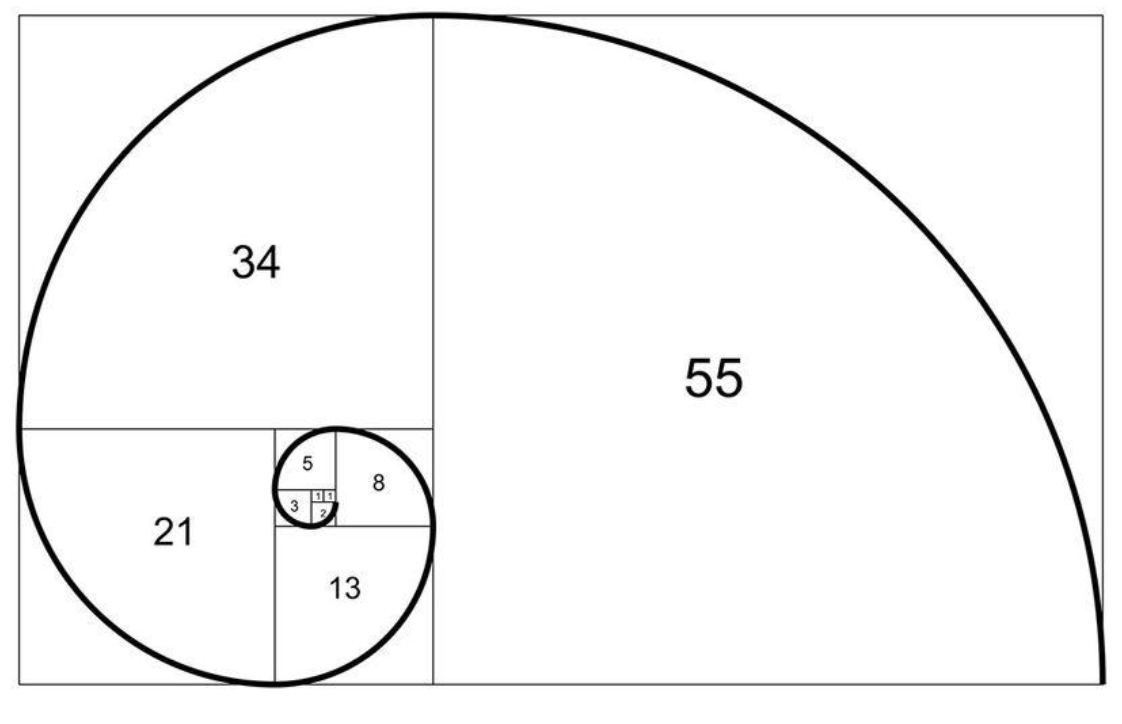
If you draw quarter-circle arcs connecting the opposite corners of squares with side lengths following the Fibonacci sequence (1, 1, 2, 3, 5, 8, 13, 21…), you generate a spiral that expands outward, resembling a nautilus shell. Each number in this sequence is the sum of the two preceding numbers.
Notably, the ratios of consecutive Fibonacci numbers approach the golden ratio, 1.618, represented by the Greek letter Phi. To arrive at Phi, divide a number in the sequence by its predecessor; conversely, dividing a number by the one following it approaches 0.618.
Below are a few other examples of natural occurrences following the Fibonacci sequence and the golden ratio:
- Spiral galaxies: Some galaxies have arms that extend outward at distances resembling the Fibonacci spiral.
- Sunflower spirals: Seed spirals in a sunflower — 34 clockwise; 55 counterclockwise (or sometimes 55 and 89).
- Cauliflower florets: Count the spiraling florets, which are often five, eight, or thirteen per cluster, reflecting Fibonacci growth.
- Piano keys: In an octave, there are a total of 13 keys (8 white and 5 black, arranged as 2 and 3).
- Mona Lisa, according to Math Central:
The Mona Lisa has many golden rectangles throughout the painting. By drawing a rectangle around her face, we can see that it is indeed golden. If we divide that rectangle with a line drawn across her eyes, we get another golden rectangle, meaning that the proportion of her head length to her eyes is golden. There are other golden rectangles that can be drawn on the rest of her body, like from her neck to the top of her hands.
Furthermore, it’s widely believed that the Fibonacci sequence and the golden ratio form the foundation of the brain's structure and thought processes.
Professor Adrian Bejan of Duke University, published in The Atlantic magazine, noted:
This is the best flowing configuration for images from plane to brain and it manifests itself frequently in human-made shapes that give the impression they were 'designed' according to the golden ratio.
Market Prices and Fibonacci Sequences
Our brains are wired to seek, recognize, and respond to patterns. Therefore, it’s logical that we subconsciously look for Fibonacci patterns and the golden ratio. This explains why some popular art, music, and poems often follow the Fibonacci sequence and incorporate the golden ratio. It also clarifies why Fibonacci patterns can help market technicians accurately predict support and resistance levels and breakout profit targets.
Retracements & Support
Fibonacci sequences, especially the golden ratio, help technicians identify potential support or resistance levels within a specified range.
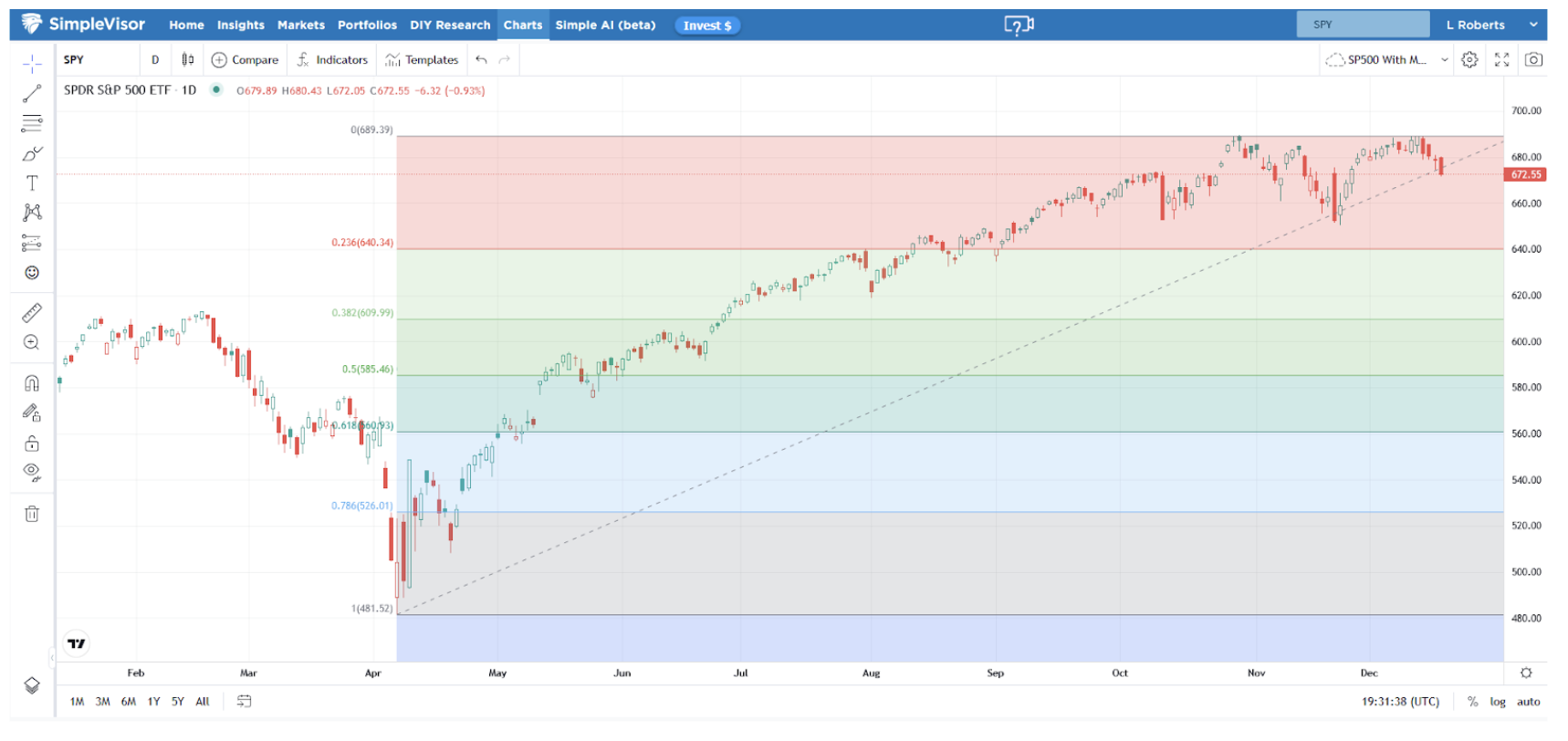
For example, the selected range shown in the graph below begins at the lows in early April 2025. We use the peak set in October and December as the endpoints. With the range established, we then use the Fibonacci sequence to determine support levels. The percentages listed below refer to the percentage of the range that should serve as Fibonacci support.
- 78.6%: This is the square root of the Golden Ratio (61.8%). While not in the sequence, it is commonly used in Fibonacci analysis.
- 61.8%: The Golden Ratio or the step down from 55 to 34 (34/55).
- 50%: This is not a Fibonacci retracement; however, the midpoint is often a key psychological level and is frequently incorporated into Fibonacci retracements.
- 38.2%: This is like 61.8% but a double step down from 55 to 21 (21/55).
- 23.6%: Similarly, this is a triple step down from 55 to 13 (13/55).
In the example above, the S&P 500 ETF (SPY) should find support at 640.34, the initial retracement level. The next support level is at 609.99, corresponding to the 61.8% Golden Rule.
The Fibonacci graphic we shared above is from SimpleVisor’s charting tool.
Fibonacci Extension & Profit Targets
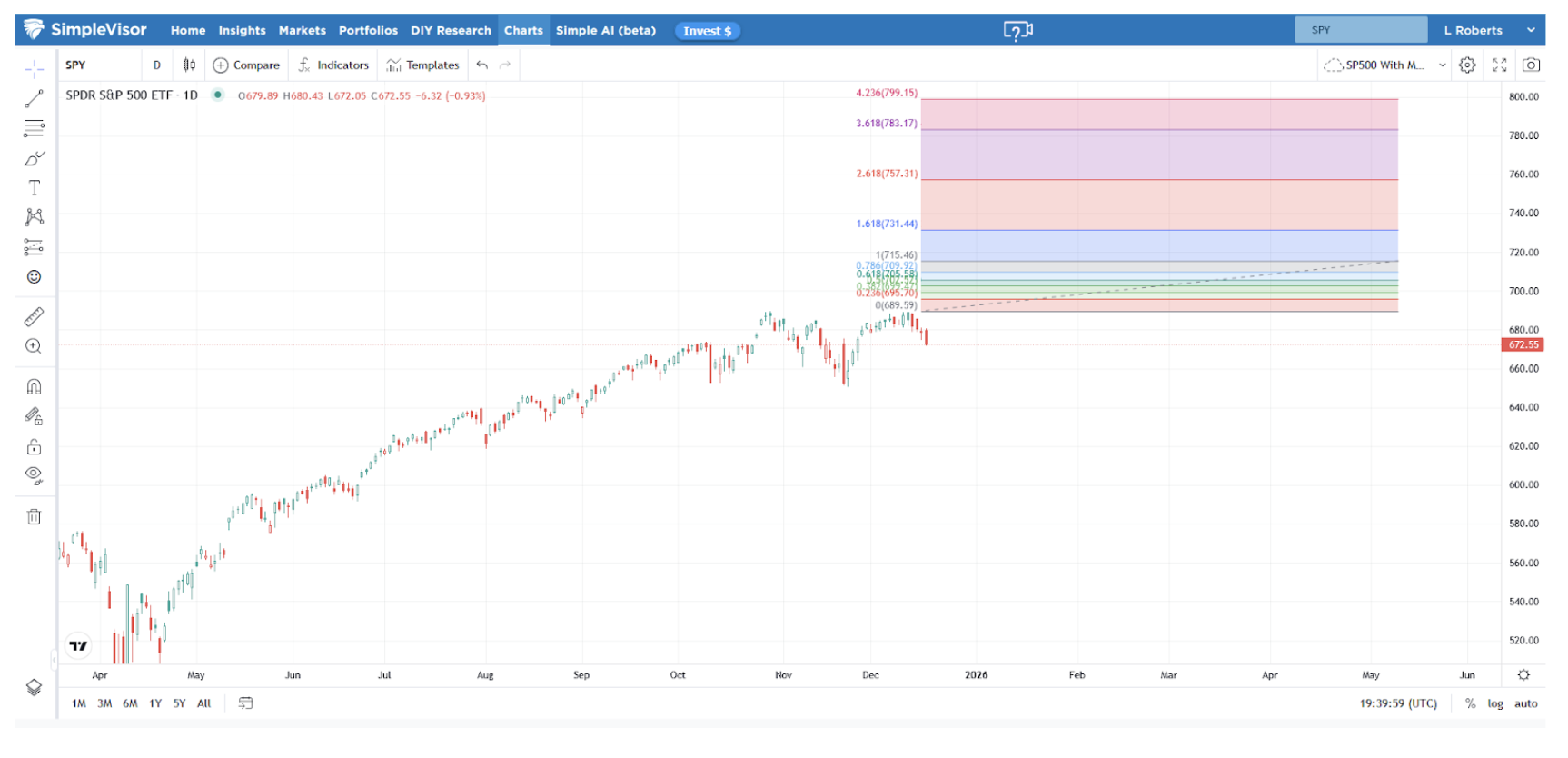
Fibonacci analysis can also identify potential resistance after reaching a new high. The limitation of this analysis is that the user must estimate where the trend will end. Thus, it’s not as reliable as the prior resistance analysis we shared.
As the graph shows, we apply the same ratios to the chart below based on the bullish trend extending from the recent high to 800.
Summary
You should never rely on one form of technical analysis. The best technical guidance comes from combining different types of patterns and indicators. Nothing is foolproof, but the more analyses align with similar expectations, the higher the chances of success.
While Fibonacci skeptics claim it’s merely pattern-seeking, its widespread application in financial markets demonstrates its enduring appeal as a blend of mathematics, psychology, and market rhythms.
Michael Lebowitz is a portfolio manager with RIA Advisors and author for Real Investment Advice. For more information, contact him at [email protected] or 301.466.1204.
Join RIA Advisors and elevate your career within a deeply experienced team focused on innovation. Our collaborative environment is built on a foundation of advanced technology and effective investment models, designed to enhance your ability to serve clients and grow your practice. Benefit from a supportive culture that encourages professional development and fosters a forward-thinking approach. By joining our team, you’ll be part of a group dedicated to excellence and continuous improvement, empowering you to focus on building meaningful client relationships and pursuing your business ambitions. Discover the advantages of working with our accomplished advisory team by starting your conversation today.
A message from Advisor Perspectives and VettaFi: Discover something new! Click here to register for our upcoming webcasts.
Read more articles by Michael Lebowitz
 Advisor Perspectives welcomes guest contributions. The views presented here do not necessarily represent those of Advisor Perspectives.