Big Tech’s ‘Spend Little, Earn Lots’ Formula Is Threatened By AI
For two decades, the playbook for Big Tech was fairly simple and extremely successful: Create disruptive innovations, deliver blinding growth rates and keep a lid on spending.
A handful of behemoths like Alphabet Inc., Amazon.com Inc., Meta Platforms Inc. and Microsoft Corp. used this formula to seize market share from legacy businesses and power the US stock market to record after record. But a key part of the program — the relatively small amount of capital required to generate those huge profits — is increasingly under threat from the race to develop artificial intelligence.
“They’re some of the best business models the market has ever seen,” said Jim Morrow, chief executive officer at Callodine Capital Management, which oversees $1.2 billion in assets. “Now you’ve seen this explosion in capital intensity to the point where it’s now the most capital intensive sector in the market. That’s just a radical change.”
Those four companies alone are expected to devote more than $380 billion combined to capital expenditures in their current fiscal years, with most going to chips, servers and other data center-related expenses. That’s a more than 1,300% jump from a decade ago. And they’ve all pledged to spend significantly more in the year after that.
Microsoft’s capex is now 25% of its revenue, more than three times what it was 10 years ago, according to data compiled by Bloomberg. The software and cloud-computing giant’s spending-to-sales ratio is among the top 20% in the S&P 500, as are Alphabet’s and Amazon’s, well above companies in traditionally capital-intensive industries like oil and gas exploration and telecommunications.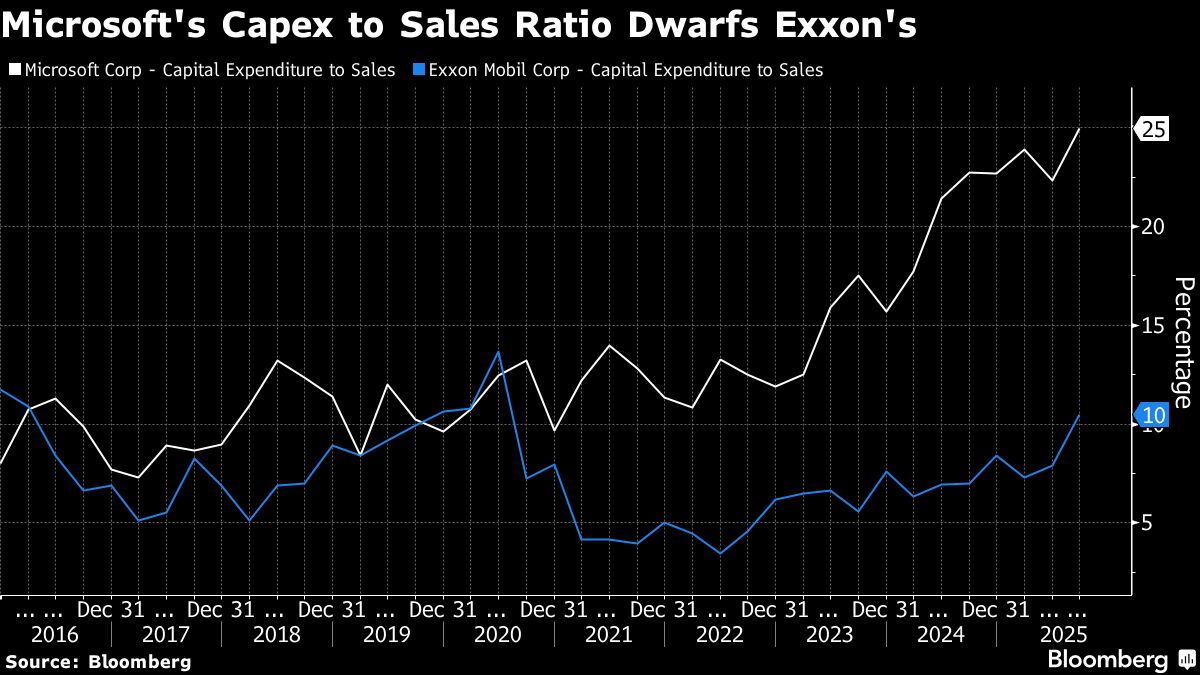
Despite the uncertainty of future payoffs, investors are giving the tech giants the benefit of the doubt on their AI plans, at least so far. Almost all of the big spenders have seen their stock prices rise this year, and their valuations are elevated. For example, Microsoft shares are up 15% in 2025, and the stock is priced at more than 28 times profits projected over the next 12 months, higher than its 10-year average of roughly 27 times and the S&P 500’s multiple of 22, according to data compiled by Bloomberg.
But there are creeping signs of doubt. Meta, which owns Facebook and Instagram, was punished after its third-quarter earnings report because Chief Executive Officer Mark Zuckerberg failed to chart a convincing path to bigger profits from rising AI spending. The stock had its worst session in three years on Oct. 30, plunging 11% the day after Meta reported earnings, and it has lost an additional 3.8% since then. After soaring 25% through the first three quarters, the shares are now up 9.5% for the year, underperforming the S&P 500.












