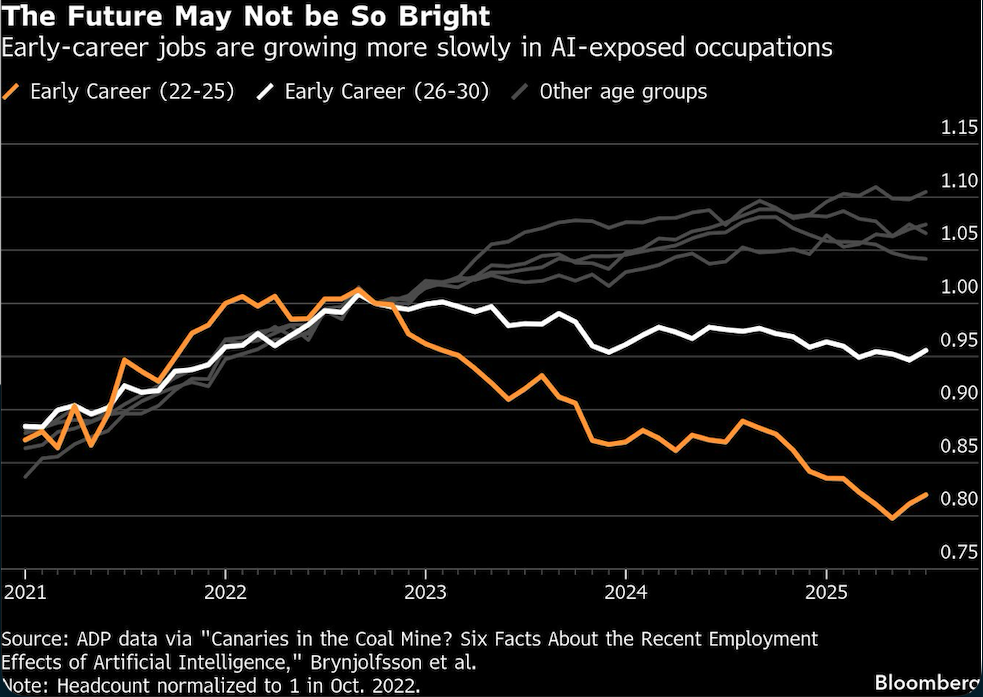
There are two big worries when it comes to the rapid advances in artificial intelligence. The first is that it will lead to robot overlords that will eradicate humanity. The second is that AI will eliminate many jobs. The more likely scenario is that it creates a labor shortage, or at least a dearth of skilled workers who can make the most of the new technology.
I recently spoke to the head of the informatics program at a large university and asked her about training undergraduates for this future. The biggest obstacle, she explained, is that many students do not have thenecessary math skills for a world where AI will dominate our lives, especially those who don’t plan to specialize in the field.
But what about those who do plan a career in AI? Technology has always made labor more valuable because it allows workers to become more productive. The concern now is people will use AI to do their thinking for them, thereby making themselves redundant. That will probably be the case for some, but using AI in a productive manner involves employing the technology to develop novel ideas, and that requires at least some human input.
For example, large language models work by taking lots of data to not only answer a question, but finding the answer that is most common, or average. Sometimes that is adequate, but what distinguishes people in a work situation is often coming up with an exceptional answer. AI can help you get there but is rarely sufficient on its own; it also takes an ability to assess the output and push further. Or often the answer from AI is inadequate because it lacks the context that makes a certain situation unique.
Suppose you attempt to get a simple statistic from a large trove of data. It is not enough to get a statistic thrown back at you; you need to understand the limitations of the data your model is working with, where it comes from, when it is from, if it is relevant to your problem and what specification did the technology use to provide the statistic. Making sense of the results takes both decent statistical and analytic skills.
In the meantime, we are witnessing a collapse of standards and some student’s ability to do even basic math in some of America’s best universities and secondary schools. Perhaps only a fraction of students at Harvard University need remedial math. But the fact that this is even a population at such a school suggests standards across the board are weakening, not only for math but reading as well. Even exceptional students are getting less rigorous training in how to think critically during this crucial time in their lives and brain development.