The views presented here do not necessarily represent those of Advisor Perspectives.
To invest or not to invest in alternatives; that is the question for anyone involved in the business of retirement planning.
The last half decade has seen an unprecedented surge in individuals who want to expand their investment set beyond traditional bonds, cash, and stocks. Service providers are happily obliging by creating retail-friendly products. And why not? The U.S. retirement market is huge, with $8.4 trillion in 401(k) plans, $3.71 trillion in company-sponsored defined benefit plans, $10 trillion in state and local government plans, and $11.48 trillion in IRAs.
Defining Alternatives
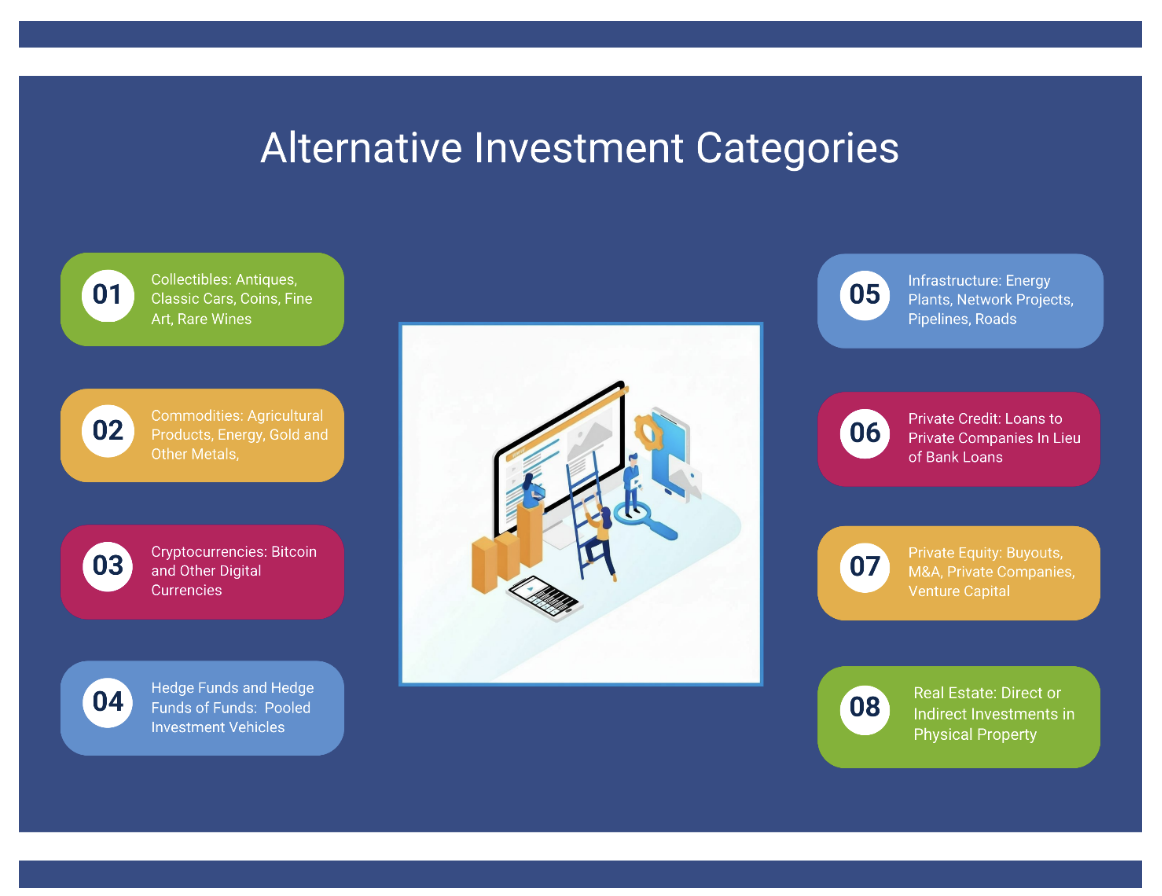
According to “Democratizing Access to Alternative Assets for 401(k) Investors,” an Executive Order signed on August 7, 2025, the term “alternatives” refers to “private market investments, including direct and indirect interests in equity, debt, or other financial instruments that are not traded on public exchanges, including those where the managers of such investments, if applicable, seek to take an active role in the management of such companies.” It also includes direct and indirect interests in real estate, digital assets, commodities, infrastructure, and lifetime income arrangements such as “longevity risk-sharing pools.”
Whether alternatives are appropriate for any one investor depends on their goals, time horizon, risk tolerance, and product attributes such as expected cash flows, fee structure, legal rights, liquidity, redemption provisions, regulations, reporting frequency, and valuation transparency. As an advisor, you are tasked with accessing relevant data and fully understanding what that data represents. Unlike publicly traded funds, data about alternative investment funds is not always readily available nor easy to interpret.
Complicating matters is the reality that alternative investments are not uniformly structured. They don’t all behave in a similar manner when economic conditions shift. The risk-return profile of a merger arbitrage hedge fund differs from the risk-return profile of an infrastructure fund. Private credit opportunities are distinct from commodity funds. Crypto investing contrasts with investing in real estate. Even within a single category, variations exist. A direct investment in a commercial building will yield a different outcome than an investment in a non-exchange traded Real Estate Investment Trust (REIT), real estate derivatives, or a real estate fund managed by a private equity firm.
The Face of Change
As a new study by Cherry Bekaert shows, institutional interest remains the primary driver of growth in the alternatives industry. Assets under management (AUM) are forecasted to rise to $29.2 trillion by 2030 from $19.5 trillion in 2024, $9 trillion in 2018, and $3.4 trillion in 2008. Whether the retail sector’s reliance on alternatives will eventually match institutional levels remains to be seen, but its escalating interest is undeniable. Like large pension funds, endowments, and foundations, high net worth investors and plan participants want a chance to earn positive alpha, garner tax advantages (depending on a fund’s jurisdiction), diversify their portfolios by adding low correlation funds, and hedge against inflation.
Cerulli Associates estimates a current retail investor allocation to alternative investments of about $1.9 trillion with an expected increase to $3.7 trillion through 2029. The Financial Planning Association attributes the buoyant interest in alternatives to both economic uncertainty and market volatility. While this surging non-institutional interest is real, hurdles still exist in the form of what some decry as opaque or convoluted product designs. As FINRA’s website reads, “Alternative and emerging investment products tend to be inherently complex because they often involve novel, complicated or intricate features that can make them hard to understand and evaluate.”
Regulations are another perceived impediment, although the DOL’s August 12, 2025 guidance implies a step in the right direction for the proponents of alternatives in retirement plans. The DOL’s declared intent is to return to a “neutral, principled-based approach to fiduciary investment decisions, consistent with the requirements of the Employee Retirement Income Security Act.”
“When evaluating any particular investment type, a plan fiduciary’s decision should consider all relevant facts and circumstances and will necessarily be context specific. The department should not single out particular investments or investment strategies for additional or special scrutiny,” the department added.
Acting Decisively
A 2025 PGIM survey finds that more than 250 retirement plan decision makers want alternatives such as commodities and real estate included in Target Date Funds (TDFs) if their inclusion is likely to generate higher long-term returns. Drew Carrington, managing director, alternatives in retirement portfolios at iCapital, believes adoption will take time but is inevitable. He says, “The industry must continue developing and standardizing the tools, approaches, and infrastructure needed to enable broader inclusion of alternative investments within DC plans. In the near term, we’re likely to see alternatives appear primarily within professionally managed structures such as target date funds, managed accounts, and multi-manager white-label solutions.”
John Grady, executive director of the Alternative & Direct Investment Securities Association (ADISA), recently discussed how industry professionals can put DOL and U.S. Securities and Exchange policy shifts into practice. He counsels them to carefully explore the ways private assets can be added to retirement plans and then compare the strengths and weaknesses of each approach.
Tom Bratkovich, chief investment officer at DCA Family Office, understands the past reluctance of defined contribution plans to invest in alternatives. He says, “Unlike defined benefit plans that have long incorporated hedge funds, private equity, and real assets to improve diversification and reduce correlation to traditional markets, it’s a more nuanced reality for defined contribution plans. Historically, they’ve shied away from illiquid or complex assets due to the lack of daily valuations, reporting transparency, the need for liquidity, and the presence of less sophisticated investors in the plans.”
“With the current administration’s push to open 401(k)s to private investments, we may be entering a new era of experimentation. Fiduciaries will need to access adequate training and feel confident that disclosure and liquidity mechanisms are robust enough to protect participants and themselves, especially given the murky legal case outcomes and different regulatory approaches of the last decade to this topic,” he added.
Give and Take
Alternative investment fund managers are banking on an expanded user base to offset lower fees from retail investors. To attract this new and jumbo individual retirement market, asset managers are financially engineering their institutional products. Hedge funds, historically classified as actively managed private investment partnership pools and adhering to specific strategies such as long-short, leveraged, or macroeconomic, are giving way to retail-friendly look-alikes such as specialized ETFs.
The list of hedge fund ETFs in ETF Database, published by VettaFi, refers to these products as permitting “investors to easily access popular trading and investing strategies employed by hedge funds. They are publicly traded, highly regulated, available for small minimums, more liquid, frequently valued, and transparent since they publish daily performance reports. One example is the partnership between State Street Corporation and Bridgewater Associates to launch a new ETF in March 2025, the SPDR Bridgewater All Weather ETF (ALLW). According to the official press release, this ETF “leverages Bridgewater’s deep macro understanding and portfolio construction expertise across a global mix of diversified assets.”
Other fund managers are equally excited about offering retail access to private markets. Earlier this year, BlackRock launched a “first-of-its-kind customizable public-private model portfolio,” delivered within a Unified Managed Account (UMA), in partnership with iCapital and GeoWealth. Evergreen funds offer yet another type of product that seeks to bridge the gap between retail investor demand for alternatives and the supply of products they will reasonably consider. Unlike the typical private equity fund, an evergreen fund does not include a lockup provision. Capital contribution minimums are smaller, and the fund is open-ended, not closed.
Based on data he’s seen, Carrington says, “These evergreen offerings will gain traction with retirement plan investors if embedded within target date funds or collective investment trusts, both of which are well-established vehicles in the DC ecosystem.”
“The development of evergreen structures is an important operational element to including private assets in DC plans, but advisors and plan sponsors still need to do their due diligence to determine what asset class should be introduced to a plan,” David Lytle, FSA, CFA, MAAA, partner and chief investment officer of Conrad Siegel’s Investment Advisory Services, said.
Offerings Vary
Financial advisors have a heavy lift, particularly if they are not familiar with alternatives. They must be able to distinguish between standalone products and the kinds of private market exposures embedded in professionally managed solutions. Carrington cites three popular formats “where fiduciary oversight and participant-level servicing can be more effectively supported.” These are target date funds, managed accounts, and multi-manager white-label solutions.
Jeremy Stempien, managing director, PGIM DC Solutions, adds, “The bulk of DC contributions are in a company plan’s default investment.”
Attorney Stephen Rosenberg, an experienced litigator and partner with The Wagner Law Group, reminds advisors of their responsibilities to avoid undue risk, stating, “Access whatever expertise is necessary to make an informed recommendation to your clients.”
Tyler Hurlbut, director of investor relations with Energea, an energy management platform that invests directly in renewable energy infrastructure projects, recommends going back to basics. “Educate yourself about how adding private markets to your broader portfolio can help reduce risk and stabilize investment returns. Understand the different types of risks that come with these investments. Examine the underlying assets in each sleeve and how they might help you meet your broader investment goals. Make sure you measure performance and risk correctly,” he said.
“We use Internal Rate of Return (IRR) because investments such as solar-powered plants give off long-term, predictable cash flows similar in pattern to real estate,” Hurlbut added.
Back to School
Given the complexity of alternatives and fluctuating rules, the need for advisors as well as plan fiduciaries to educate themselves about how alternatives work cannot be emphasized enough. Fortunately, there are plenty of resources available, including those provided by service providers such as actuaries, attorneys, consultants, and money managers.
As Christian McCormick, CFA and head of client portfolio management for Meketa Investment Group, explains, “I spend the bulk of my time educating my clients through interactive workshops, presentations at CFA Institute and Financial Planning Association conferences, and hands-on meetings. We regularly distribute thought leadership to our clients. We think it’s a win-win for us and for them. It’s critical for everyone to understand how their money is being deployed.”
Meanwhile, Stempien describes education as a “must have” for participants when employers add alternatives to the investment menu of their 401(k) plan.
An upside to education, besides the obvious need for decision makers to be informed, is that it signals you take your duties seriously. If you are sued, evidence of a comprehensive training effort could help ward off lawsuits and onerous audits, or at least lessen the pain. Rosenberg warns those with fiduciary responsibilities to thoroughly document their due diligence process. He says, “This includes documenting any training you’ve completed and your rationale for selecting alternatives on behalf of your advisory clients or employees and retired workers.”
Lytle is another enthusiastic advocate for client education. As a co-fiduciary, his team spends copious time teaching investment committee members and participants about how alternatives work and how their use could impact portfolio performance. He says, “We offer webinars and one-on-one client training workshops in addition to hosting Q&A sessions. If there’s a big shift in the industry, like widespread adoption of private assets into defined contribution plans, we’ll put out a piece specifically addressing the topic and include it in our ongoing education efforts.”
Looking Forward
Financial advisors can help retirement plan participants navigate the brave new world of customized alternatives by doing a deep dive into what’s available and how they compare with traditional bonds, cash, and stock. This is easier said than done. New products won’t have a long track record. Performance metrics will differ. Bratkovich cautions, “Volatility may appear lower due to smoothed private markets valuations. Different types of risk exist for private markets investments. Correlations with public markets need to be understood.”
Reassess your client’s risk tolerance. Hurlburt points out differences in risk investment objectives among generations. He states, “Younger generations tend to have more interest in impact and sustainable investments, and these are the clients who will ultimately inherit the largest transfer of wealth in this country over the next two decades. Advisors would be smart to consider their needs and investment objectives in the future.”
If you are a dedicated and high-integrity financial advisor, carry on with what you are already doing. Inform yourself about products under consideration. Give your clients a logical explanation of why certain products made your short list. Conduct adequate due diligence before committing your client’s money to a specific fund. If alternatives are excluded, justify your reasoning. Focus on communication, education, and research.
After a productive career as a Wall Street trader, testifying investment expert witness, and corporate trainer, Susan Mangiero, Ph.D., CFA®, MBA, MFA currently works as an independent financial journalist, ghostwriter, and content strategist. Her articles, books, and thought leadership work appear in more than 100 business outlets.
A message from Advisor Perspectives and VettaFi: Discover something new! Click here to register for our upcoming webcasts.
Read more articles by Susan Mangiero
 The views presented here do not necessarily represent those of Advisor Perspectives.