In the $150 trillion global bond market, investors are coming to the conclusion that some companies are safer bets than even the most powerful governments.
In corporate boardrooms since the pandemic era, executives have dealt with the rise in interest rates by keeping budgets lean and reducing overall indebtedness. Meanwhile, governments in rich countries continue to spend, with the average debt-to-output ratio across the Group of Seven industrialized nations set to keep rising until the end of this decade at least.
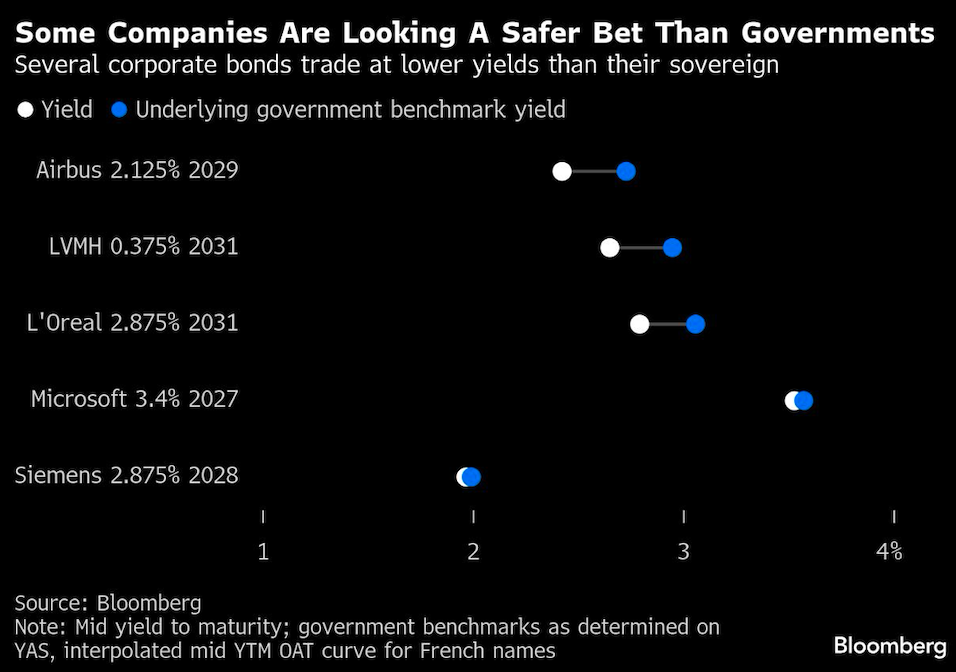
The result: Investors demand lower yields for bonds issued by Microsoft Corp., Airbus SE, L’Oreal SA, and Siemens AG than they do for their countries of origin. While the phenomenon isn’t unprecedented, a combination of huge demand for corporate bonds plus fiscal backsliding is adding more and more companies in developed markets to the list.
A weakening of the safe haven status enjoyed for decades by a small handful of nations — the US foremost among them — is a sign that populist politics is corroding the basis for tough fiscal compromises. Successive French prime ministers have so far failed to pass measures reining in the budget and in the US, the federal deficit is set to remain above 6% for the rest of President Donald Trump’s second term. His moves to bypass convention have unnerved investors.
“It’s the erosion of the perception of rule of law which keeps investors at bay,” said Pilar Gomez-Bravo, London-based co-chief investment officer of fixed income at MFS International, which has around $660 billion under management. “Structurally we do feel that the regime is shifting. People prefer corporate balance sheets which are in better shape than some sovereigns.”
The power to raise taxes and print money has meant that, for decades, the core of portfolio construction in the US or Europe has been Treasury bonds, followed by German or UK sovereigns. Even the best companies have, in developed markets, always been seen as just a little riskier than their sovereign. But debt dynamics have changed to an extent where that’s less and less true.
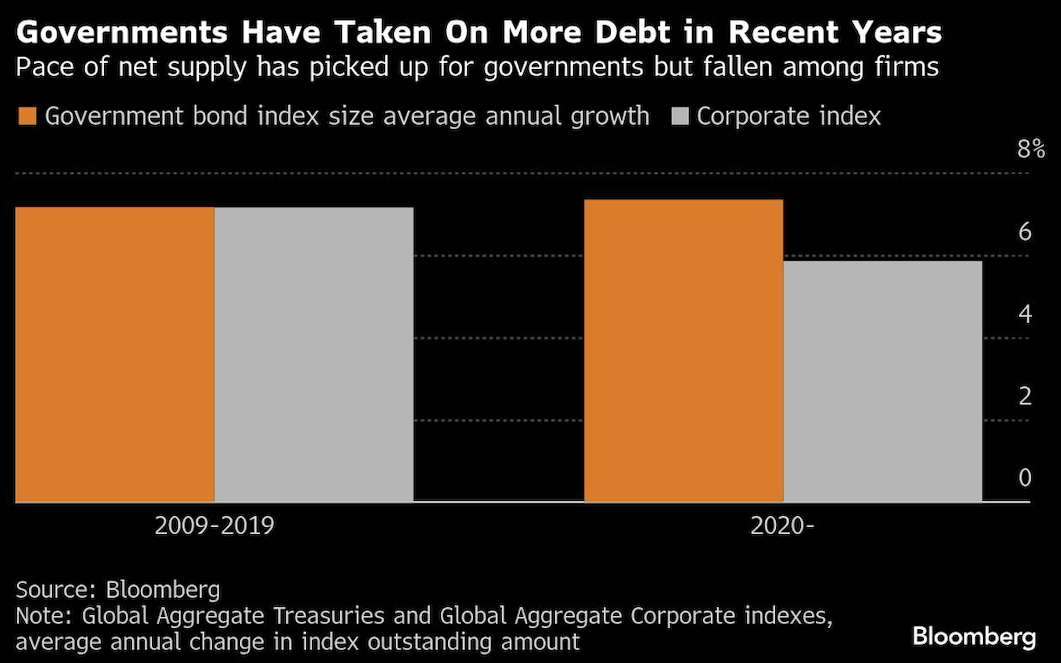
In the 10 years after the global financial crisis, net supply — new debt minus old bonds coming due — grew at similar rates for governments and corporates, according to Bloomberg indexes. Since 2020, sovereign debt issuance has raced ahead after governments introduced expensive policies to buoy their economies during widespread Covid lockdowns.
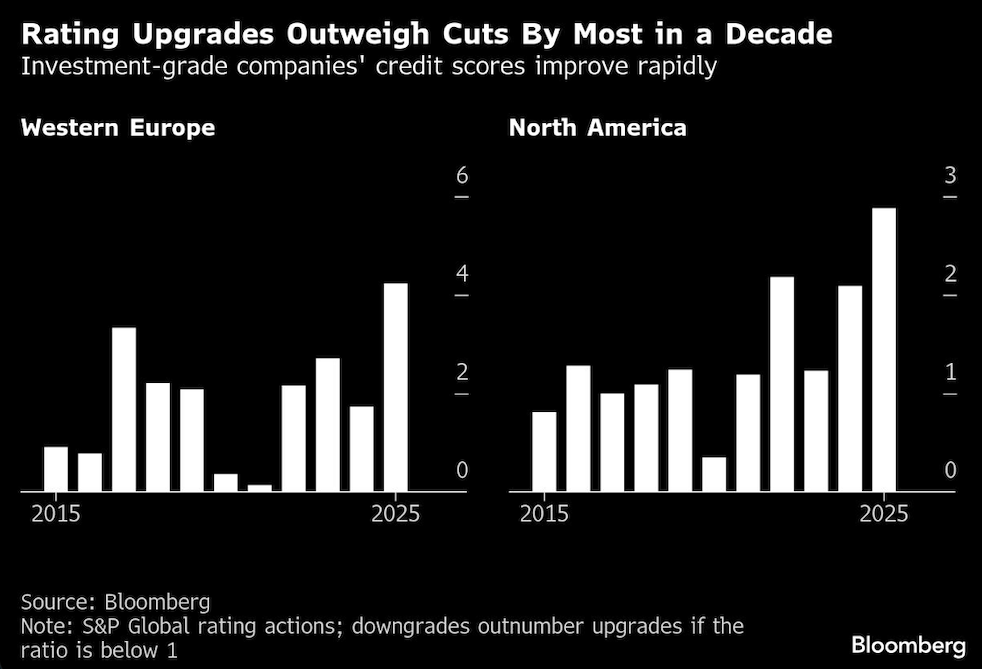
That’s been reflected in credit ratings: the US and France have both faced credit-rating downgrades in recent months, while firms in North America and Western Europe are being upgraded at the fastest clip in a decade.
The gap will likely widen: The Institute of International Finance in September warned over the surge in public indebtedness, arguing that it’s becoming “increasingly difficult for policymakers to take the tough decisions needed to correct course.”
The US Congressional Budget Office in July estimated that tax cuts introduced by Trump this year would add $3.4 trillion to US deficits over the next 10 years. In France, the euro-area’s second-largest economy, deadlock over proposed budget-cutting reforms threatens to keep the deficit above 5% into next year. Even Germany is skirting its own budget rules in order to boost long-neglected defense and infrastructure spending.
“For the government, it’s about getting reelected,” said Hans Mikkelsen, credit strategist at TD Securities USA in New York. “You don’t get reelected if you cut services or you increase taxes. So it’s always about spending more, whereas companies are completely different. It’s about increasing profits.”
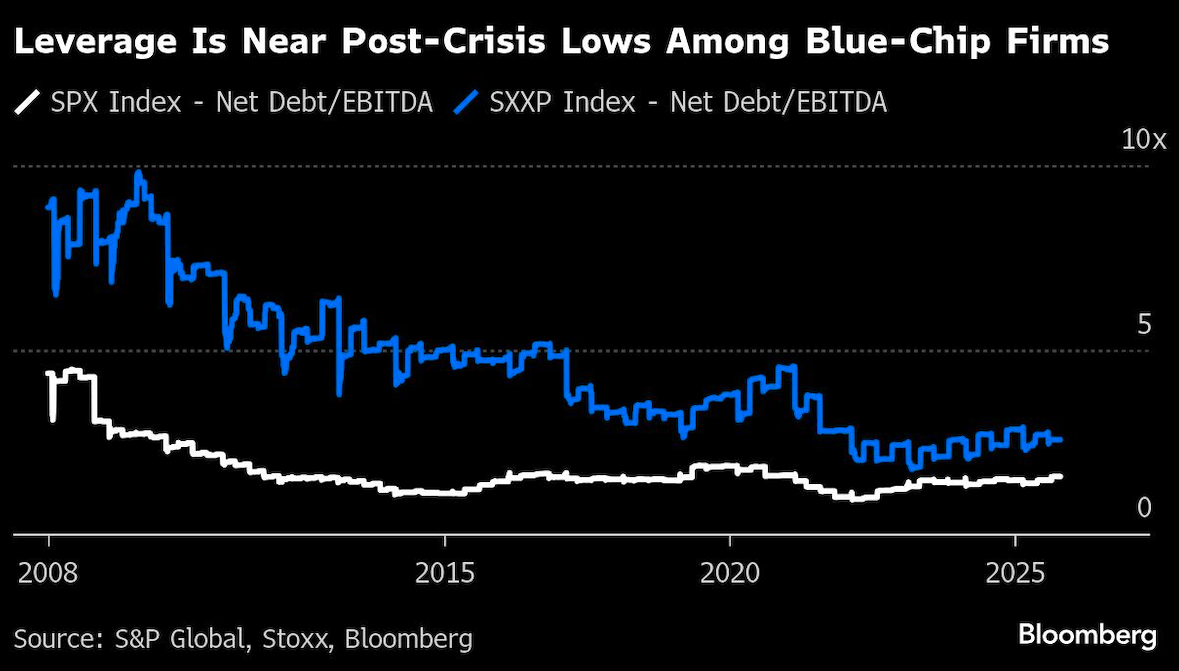
A key measure of corporate creditworthiness — net debt relative to earnings before interest, taxes depreciation and amortization — has hovered near its lowest post-financial-crisis level in recent years, despite higher borrowing costs. For about 2,500 companies in the MSCI ACWI Index, that metric improved to 1.74 times on average in the first half of this year from an average of 2.53 a decade ago, data compiled by Bloomberg show. A lower reading signals stronger balance sheets.
By contrast, the debt-to-gross domestic product ratio across major economies has been going up, and the International Monetary Fund estimates it’ll rise every year through 2030 to about 137%.
Microsoft Corp., a tech leader with almost $4 trillion in market capitalization and a triple-A credit rating, has such strong earnings that its net debt is just a 10th of the last 12 months’ earnings. And in France, Orange — formerly known as France Telecom and a classic case of corporate deleveraging — is being rewarded by traders with a lower risk premium. Around 5% of French investment-grade notes trade at yields less than government debt, data compiled by Bloomberg show.
Bank of America European credit strategists led by Barnaby Martin wrote in September that the view that corporates are “safer” than sovereigns has become more widespread and that markets have “crossed the Rubicon“ by starting to price some tighter than their respective government’s bonds.
“Runaway levels of debt, and the question of how they can be contained, could well be the defining macro story of the next decade,” wrote Joe Sullivan-Bissett, an investment director at M&G Investments, in a note to clients on Wednesday. “This not only has implications for public finances, but also the trajectory of yields, inflation, and the credibility of future policy.”
The extra spread investors demand to hold global investment-grade corporate debt over government benchmarks fell last month to the lowest since 2007, according to a Bloomberg index. US firms account for more than half of that gauge and despite the flood of sales this year, BNP Paribas SA estimated in September that demand for US corporate bonds is considerably bigger than net supply.
Meta Platforms Inc., and Alphabet Inc., Google’s parent, have shown recently how strong appetite can be for high-grade paper sold in massive quantities. Meta’s $30 billion offering got about $125 billion in bids, the highest of any corporate sale ever, while Alphabet saw about $90 billion of bids for its $25 billion offer. The spreads on all tranches for both firms were tighter than similarly-rated US corporate bonds.
Read More: Why Fears of a Trillion-Dollar AI Bubble Are Growing: QuickTake
That’s despite investor jitters over tech firms’ plans to spend big on artificial intelligence. Earlier in October, Meta sealed a $30 billion private capital transaction for a data center in Louisiana which is structured to stay off the firm’s balance sheet. The deal underlined concern over how companies are financing AI build-outs.
For all the excitement over company bonds, it’s unclear whether they’ll prove attractive to investors seeking safety during volatile times. Liquidity remains lower than in the government bond market, and the risk premium investors demand to hold top-tier corporate debt is larger at greater maturities — suggesting their perceived creditworthiness vis-à-vis governments declines over time.
Tax Power
The rise of developed-world central banks as powerful actors in their own countries’ bond markets is a factor that has kept bond vigilantes somewhat at bay in recent years, letting governments get away with laxer fiscal policy. Crucially, governments also have the power to tax and they may use that power to raise funds from the richest firms in a crisis.
“For years, we’ve had countries like Japan and the US, which are running very profligate fiscal policies and nothing has happened, which has given comfort to a lot of politicians — and also the electorate — that fiscal concerns are overblown if you are a powerful nation,” said Mathieu Savary, chief strategist for developed markets ex-US at BCA Research.
What remains is that bond traders are beginning to ascribe an elevated level of risk to debt-saddled governments, and are turning to companies as they expect the situation to get even worse. That’s a fundamental change in sentiment which looks more likely to continue than recede.
“Governments just sit there, carry on and nothing happens,” said Steffen Ullmann, senior portfolio manager for investment-grade at HAGIM GmbH in Frankfurt. “Corporates have done their job. They de-levered and remain cost-disciplined.”
A message from Advisor Perspectives and VettaFi: Discover something new! Click here to register for our upcoming webcasts.
Bloomberg News provided this article. For more articles like this please visit
bloomberg.com.