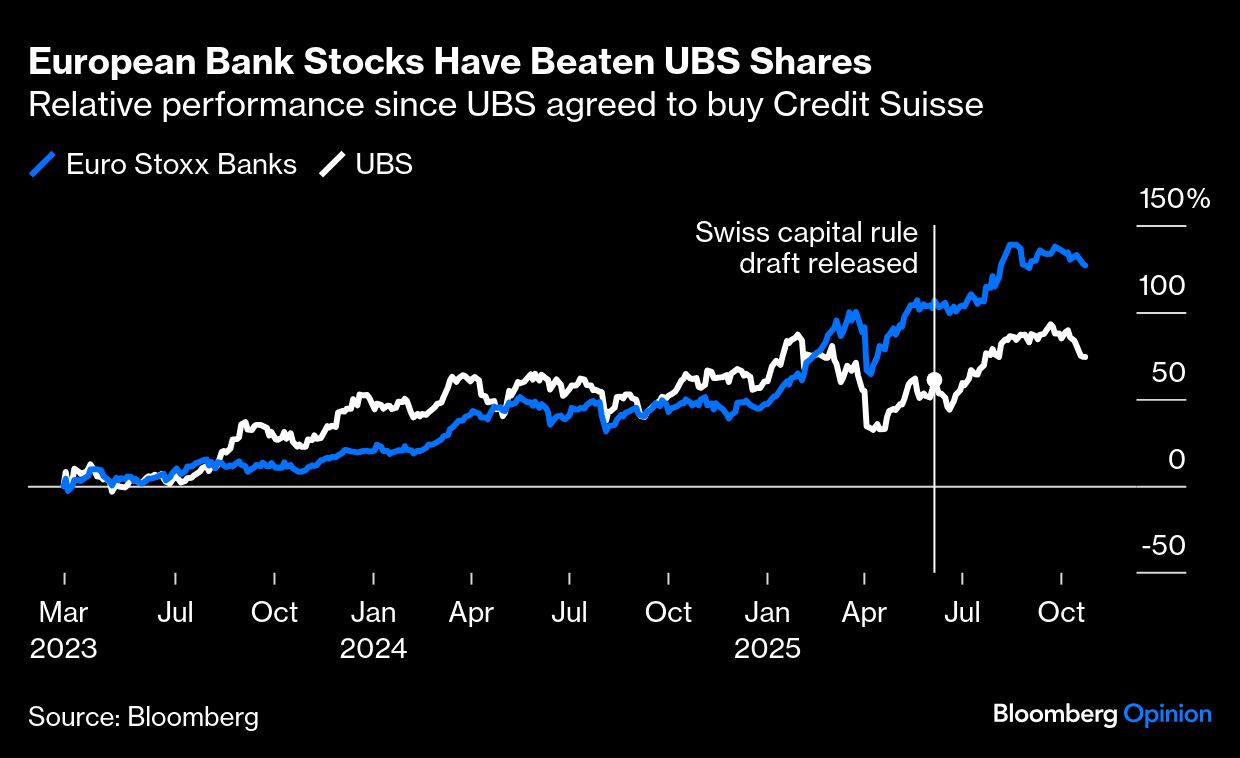
Money can’t buy you love and right now no one knows that better than UBS Group AG. Since the Swiss bank helpfully rescued its cockroach-riddled rival Credit Suisse in a state-brokered emergency takeover, its reward has been government plans to whack it with punishing new capital rules and a lagging stock price.
On top of that, other misfortunes are piling up. Losses from the bankruptcy of autos-supplier First Brands hit its hedge fund arm and a court denied its efforts to recover money linked to the earlier failure of Greensill Capital. Yet the worst threats come from the Swiss regulatory overhaul and another court ruling that could reverse the writedown of $16.5 billion of Credit Suisse bonds.
No matter how well its operations perform or how much it pays out in buybacks and dividends, UBS shares will struggle until this is all fixed. Unless its home country can clean up the mess left behind by its solution to the Credit Suisse crisis, and compromise on its fear of ever allowing a repeat at UBS, the bank will face major changes in its profitability and the very shape of the business.
One important investor says the bank’s only option is to leave Switzerland. If nothing alters soon, this radical idea may become realistic.
Let’s enumerate UBS’s woes. It has about $500 million in exposure to First Brands, which collapsed in September. Slightly more than a fifth of that is in the bank’s O’Connor hedge fund unit, which UBS agreed to sell to Cantor Fitzgerald in May. That deal might need to be renegotiated, Bloomberg News has reported. UBS hasn’t commented and should update investors at quarterly results this week. All told, it’s an additional pain.
Also this month, UBS lost a London lawsuit against SoftBank Group Corp. where it was trying to recoup up to $440 million related to former Credit Suisse funds that bought the debt of infamous trade-finance firm Greensill. UBS has taken charges for compensating investors in those funds already, but getting some of that back would have been nice.

Another case this month worries investors more. The Swiss Federal Administrative Court ruled that the Swiss government’s decision to write off junior Credit Suisse bonds to ease its sale to UBS was unlawful. Claimants hope they could get back some of the nearly $17 billion of losses they suffered, although how that might happen is unclear right now.
Several outcomes are possible, according to Bloomberg Intelligence. Two of these cost UBS nothing: The Swiss regulator successfully appeals the ruling and it gets overturned, or Swiss taxpayers pick up the tab.
The other prospects are bleak. The government could pay the compensation and recoup the cost through a special tax on banks, of whom UBS is the biggest. Or the bill could be handed directly to UBS. BI reckons this would be costly for investors and bondholders, although it deems it the least likely outcome.
UBS would almost certainly fight hard against being landed with any of these costs, which could tie things up in court for years and make relations with regulators and politicians worse. And they’re already pretty bad.
The government is pushing UBS out of the country, according to Lars Foerberg, co-founder of activist investor Cevian Capital, an important shareholder in the bank despite its relatively small 1.4% stake. The Swiss parliament is debating stiffer “too big to fail” rules and other changes, which would increase UBS’s capital requirements by up to $26 billion. That’s equivalent to more than a third of the bank’s common equity today.
Foerberg surmises that Swiss lawmakers and regulators know the new rules will stop UBS from operating as a large, global investment bank and wealth manger from the country. He argues that Switzerland doesn’t want a lender whose balance sheet is twice the size of its gross domestic product, and efforts to change politicians’ minds are futile. It therefore has to leave or be taken over.
Moving a banking titan like UBS to the US, for example, would be a monumental job. Such relocations are extremely rare. Nordea Bank Abp did switch from Sweden to Finland in 2018 to change regulators. But that’s a universe away from rehousing UBS.
The bank might hope to be taken over by a Wall Street firm like Morgan Stanley, where UBS Chairman Colm Kelleher spent most of his career, or JPMorgan Chase & Co. Neither has shown an interest yet. Alternatively, it could look for a smaller US bank or wealth manager to buy as an American foothold to help move itself there. Stifel Financial Corp. or Raymond James Financial Inc. could be options, but M&A dealmakers question whether they’d really fit UBS in any way other than as an expensive bridge to the US. That could end up being more costly and disruptive than it’s worth.
There are things UBS could do to adapt to the stiffer Swiss rules, as I’ve written before. But politicians could also meet it halfway by easing back on some of their harshest measures.
Ultimately, UBS wants to stay at home and Switzerland wants to keep its haven status for the world’s rich — even if it’s no longer a tax-dodgers' hidey-hole. There’s some mutual interest at play. But investors are getting impatient, and the bank’s executives ultimately will, too. If there’s no give in the Swiss position over the next 12 months, don’t be surprised to hear UBS publicly consider moving out.
A message from Advisor Perspectives and VettaFi: Discover something new! Click here to register for our upcoming webcasts.
Bloomberg News provided this article. For more articles like this please visit
bloomberg.com.
Read more articles by Paul Davies