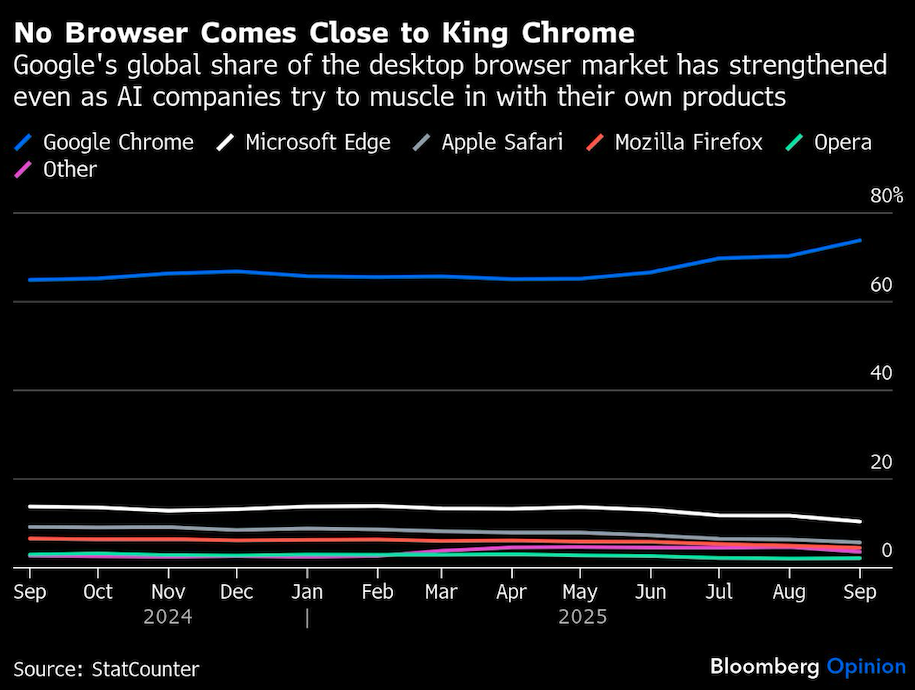
Just before lunchtime on Tuesday, Alphabet Inc.’s stock price took a sudden 4.8% tumble. The bad news? OpenAI was about to announce its long-awaited — some might say late — entry into the AI browser wars.
But as OpenAI co-founder Sam Altman and his colleagues ran through their browser’s features on a livestream, Alphabet’s stock was retracing its losses. Shares ended the day down 2.2% on a flat day for the overall market — perhaps an indication that investors weren’t as troubled by OpenAI’s play as they might have been.
The product, named ChatGPT Atlas, has bells and whistles powered by its market-leading chatbot. As interesting as they are, they stand little chance of persuading a meaningful number of Chrome users to switch. Consumers will be even more turned off when they learn that the best features of ChatGPT come at a cost. To engage Atlas’ agent — where the AI takes control and handles tasks through the browser — users will need to be $20-a-month ChatGPT Plus subscribers, Altman said (though he did add “for now”).
This agent aspect is what OpenAI thinks can differentiate the ChatGPT Atlas from other browsers. OpenAI lead researcher Will Ellsworth called it “vibe lifing” — a play on the term “vibe coding,” used to describe software code generated with plain language prompts. In a demonstration, the company showed ChatGPT Atlas analyzing an online recipe and ordering the ingredients by browsing Instacart’s website, searching for the right products and ordering the correct quantity of each.
Cool. But such uses for AI are surely only a temporary hack, like an ’80s kid holding a tape recorder up to a speaker to record songs off the radio. OpenAI clearly understands this, given its recent announcement of its Instant Checkout tool and a partnership with Walmart that will allow for ordering without leaving the ChatGPT conversation window at all. That’s a far better way to perform tasks than through the slow and essentially manual process of having your AI click around a website, a method that seems inherently vulnerable to breaking or behaving unpredictably. Earlier versions of the same system were described as “glitchy,” though I’ll hold back on further judgment until I’ve tried it extensively myself.