In just two years, India has gone from being the best-loved emerging market to the most sold, and now investors are bracing themselves for yet another quarter of disappointing corporate earnings.
Globally, excitement is concentrated in AI, but as Bloomberg Intelligence strategist Nitin Chanduka points out, India has limited representation in this high-growth area. In fact, AI is forcing its once-celebrated software export industry to shrink. Amid its steepest-ever job cuts, Mumbai-based Tata Consultancy Services Ltd. missed profit estimates for the three months to Sept. 30.
In addition to artificial intelligence, services outsourcers like TCS are also grappling with the Trump administration’s clampdown on immigration and a $100,000 fee on new H-1B work visas for programmers. Meanwhile, the outlook for goods exports is clouded by the White House’s punitive 50% tariffs. Prime Minister Narendra Modi’s government responded by reducing domestic consumption taxes last month, though surveys show that outside of automobiles and home appliances, companies are yet to fully pass on the benefit of lower prices to buyers.
The central bank has slashed the benchmark cost of money by 1 percentage point this year, and although lower consumption taxes and slower inflation may allow it to prune rates still further, that won’t do much to boost investment.
Banks’ net interest income growth, which has been slowing for more than two years, may revive only with faster credit uptake to create new assets. Until then, private credit will rule, with global asset managers, sovereign wealth funds, and insurers frantically chasing Indian business owners who are looking to refinance existing loans, pay for acquisitions, or preserve their control.

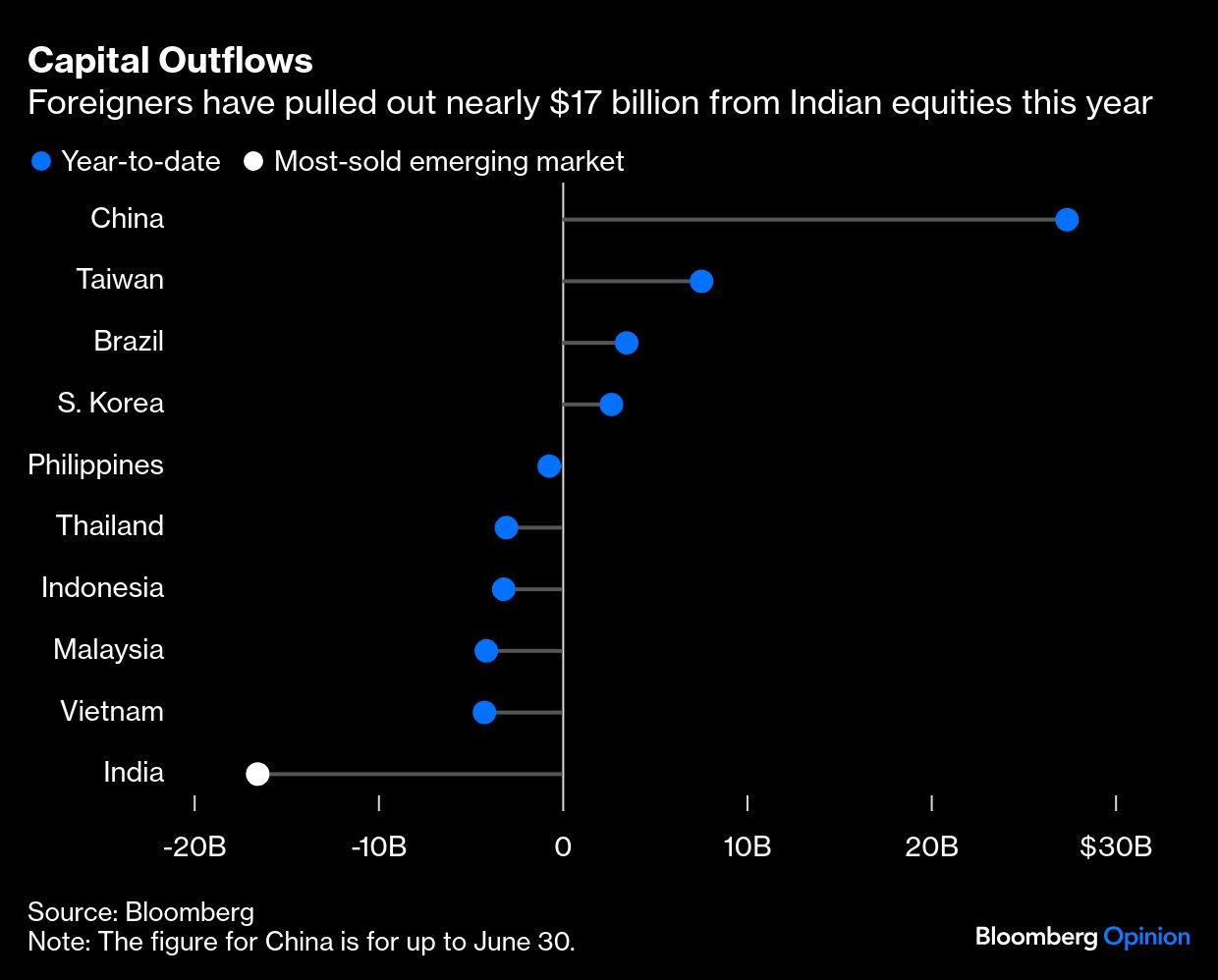
Foreigners have pulled out nearly $17 billion so far in 2025 from the share market, more than any other emerging economy. Local bonds have also disappointed. A sliding rupee, Asia’s weakest currency this year, has cut into returns for overseas investors. While a 14% drop against the euro might help Indian exporters offset some of the pain from losing access to the US, it won’t spur them to put up new factories.
Given a tepid job market, households, which may be feeling richer thanks to the soaring values of their generational holdings of gold, aren’t likely to splurge, either.
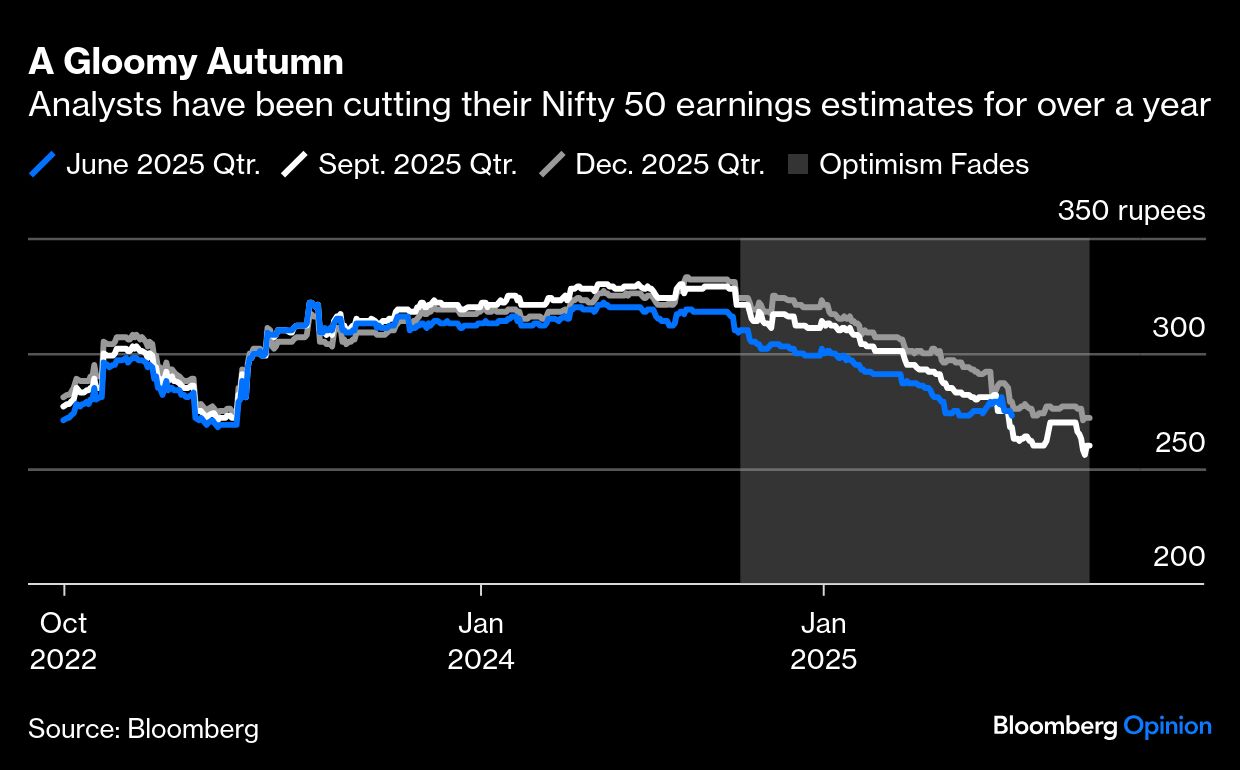
Corporate profits are facing a squeeze. For the September quarter, analysts’ expectation is for 260 rupees ($2.94) of earnings per share for stocks in the benchmark Nifty 50 Index, rising to 272 rupees in the three months to Dee. 31. A year ago, these estimates were 20%-24% higher. With the near-term outlook for India Inc. under pressure, investors are shifting their horizon to January-March.
Maybe Trump and Modi would do a trade deal by then, and a truce will encourage more US investment, igniting domestic animal spirits just as the full benefit of lower consumption taxes start to make households more confident about spending.
On current evidence, however, much of this is still wishful thinking. The US seems in no hurry to renew its quarter-century-long courtship of India, conducted in the hope that it would be an ally in its efforts to contain China’s rise. Now Washington is cultivating Islamabad, while New Delhi is getting pushed toward mending a fraught relationship with Beijing — an overture that may not mean much to corporate sales and profits as China buys very little from India.
Despite foreigners pulling out capital, Indian stocks are frothy. The Nifty 50 trades at 20 times its 12-month forward estimated earnings, practically unchanged from a year ago. To put it in perspective, the Chinese market hasn’t witnessed such aggressive valuations since the end of the Global Financial Crisis in 2009.
The exuberance is partly because of liquidity. Capital controls don’t make it easy for the mass affluent to deploy their pandemic-era savings in assets overseas. As a result, Indian cement makers are more expensive than Chinese tech stocks in Hong Kong.
A glut of domestic money chasing stocks is keeping the market attractive for initial public offerings. Listing-day pops — like this week’s 48% post-IPO jump for LG Electronics India Ltd., a unit of South Korea’s LG Electronics Inc. — are drawing in more punters. The wealth management industry is booming, with $47 billion coming into equity mutual funds last fiscal year, a fourfold jump from before the Covid-19 pandemic.
At some stage, the supply of new stocks may overwhelm demand, especially if foreign institutions keep giving India a miss because they find better opportunities elsewhere. To get them to fall back in love, it’s crucial to reverse the profit crunch.
A message from Advisor Perspectives and VettaFi: Discover something new! Click here to register for our upcoming webcasts.
Bloomberg News provided this article. For more articles like this please visit
bloomberg.com.
Read more articles by Andy Mukherjee