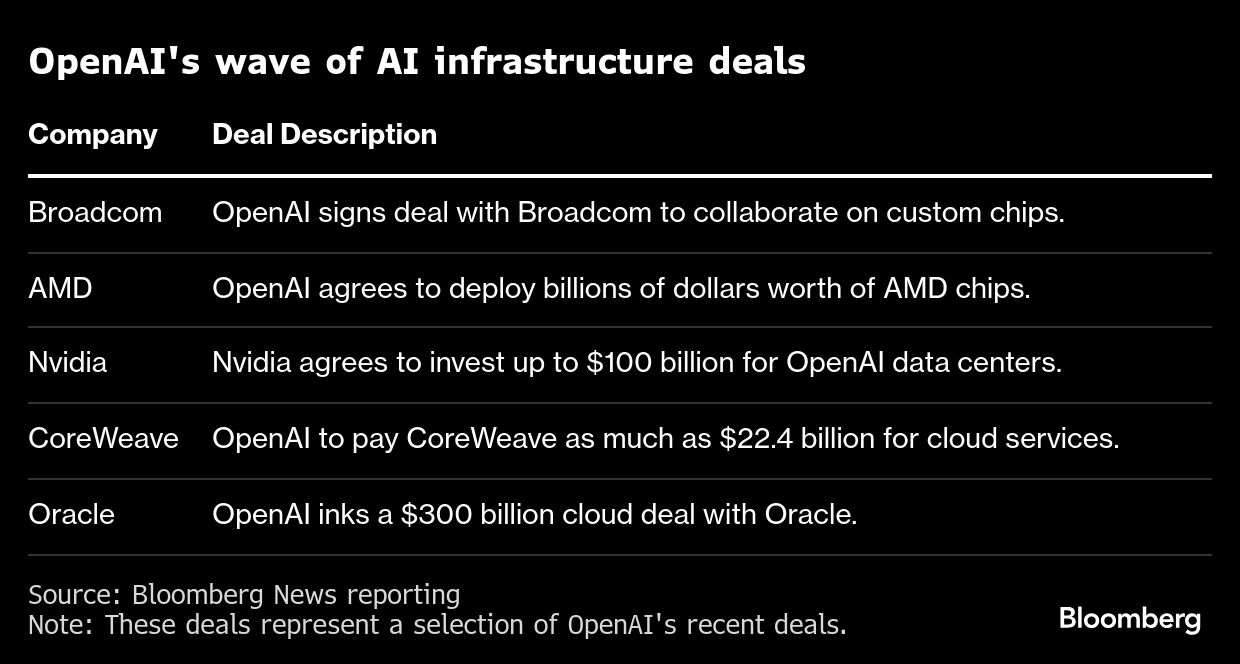
OpenAI signed a multiyear agreement with Broadcom Inc. to collaborate on custom chips and networking equipment, marking the latest step in the startup’s ambitious plan to add computing infrastructure. Broadcom shares jumped.
As part of the pact, OpenAI will design the hardware and work with Broadcom to develop it, according to a joint statement on Monday. The plan is to add 10 gigawatts’ worth of AI data center capacity, with the companies beginning to deploy racks of servers containing the gear in the second half of 2026.
By customizing the processors, OpenAI said it will be able to embed what it has learned from developing AI models and services “directly into the hardware, unlocking new levels of capability and intelligence.” The hardware rollout should be completed by the end of 2029, according to the companies.
For Broadcom, which makes components for everything from the iPhone to optical networking, the move vaults it deeper into the booming AI market. Monday’s agreement confirms an arrangement that Broadcom Chief Executive Officer Hock Tan had hinted at during an earnings conference call last month.
Shares of Broadcom rose as much as 11% after markets opened in New York.
OpenAI, the creator of ChatGPT, has inked a number of blockbuster deals this year, aiming to ease constraints on computing power. Nvidia Corp., whose chips handle the majority of AI work, said last month that it will invest as much as $100 billion in OpenAI to support new infrastructure — with a goal of at least 10GW of capacity. And just last week, OpenAI announced a pact to deploy 6GW of Advanced Micro Device Inc. processors over multiple years.
As AI and cloud companies announce large projects every few days, it’s often not clear how the efforts are being financed. The interlocking deals also have boosted fears of a bubble in AI spending, particularly as many of these partnerships involve OpenAI, a fast-growing but unprofitable business.
While purchasing chips from others, OpenAI has also been working on designing its own semiconductors. They’re mainly intended to handle the inference stage of running AI models — the phase after the technology is trained.
There’s no investment or stock component to the Broadcom deal, OpenAI said, making it different than the agreements with Nvidia and AMD. An OpenAI spokesperson declined to comment on how the company will finance the chips, but the underlying idea is that more computing power will let the company sell more services.
A single gigawatt of AI computing capacity today costs roughly $35 billion for the chips alone, with 10 gigawatts totaling upwards of $350 billion. But a chief reason OpenAI is working to develop its own chip is to bring down its costs, and it’s unclear what price Broadcom’s chips will command under the deal.
OpenAI CEO Sam Altman said that his company has been working with Broadcom for 18 months.
This is a modal window.
The startup is rethinking technology starting with the transistors and going all the way up to what happens when someone asks ChatGPT a question, he said on a podcast released by his company. “By being able to optimize across that entire stack, we can get huge efficiency gains, and that will lead to much better performance, faster models, cheaper models.”
When Tan referred to the agreement last month, he didn’t name the customer, though people familiar with the matter identified it as OpenAI.
“If you do your own chips, you control your destiny,” Tan said in the podcast Monday.
Broadcom has increasingly been seen as a key beneficiary of AI spending, helping propel its share price this year. The stock was up 40% so far this year through Friday’s close, outpacing a 29% gain by the benchmark Philadelphia Stock Exchange Semiconductor Index. OpenAI, meanwhile, has garnered a $500 billion valuation, making it the world’s biggest startup by that measure.
By tapping Broadcom’s networking technology, OpenAI is hedging its bets. Broadcom’s Ethernet-based options compete with Nvidia’s proprietary technology. OpenAI also will be designing its own gear as part of its work on custom hardware, the startup said.
Broadcom won’t be providing the data center capacity itself. Instead, it will deploy server racks with custom hardware to facilities run by either OpenAI or its cloud-computing partners.
A single gigawatt is about the capacity of a conventional nuclear power plant. Still, 10GW of computing power alone isn’t enough to support OpenAI’s vision of achieving artificial general intelligence, said OpenAI co-founder and President Greg Brockman.
“That is a drop in the bucket compared to where we need to go,” he said.
Getting to the level under discussion isn’t going to happen quickly, said Charlie Kawwas, president of Broadcom’s semiconductor solutions group. “Take railroads — it took about a century to roll it out as critical infrastructure. If you take the internet, it took about 30 years,” he said. “This is not going to take five years.”
A message from Advisor Perspectives and VettaFi: Did you know that we provide daily updates when key market and economic indicators change? Visit the AP Charts and Analysis site to get our expert insights.
Bloomberg News provided this article. For more articles like this please visit
bloomberg.com.