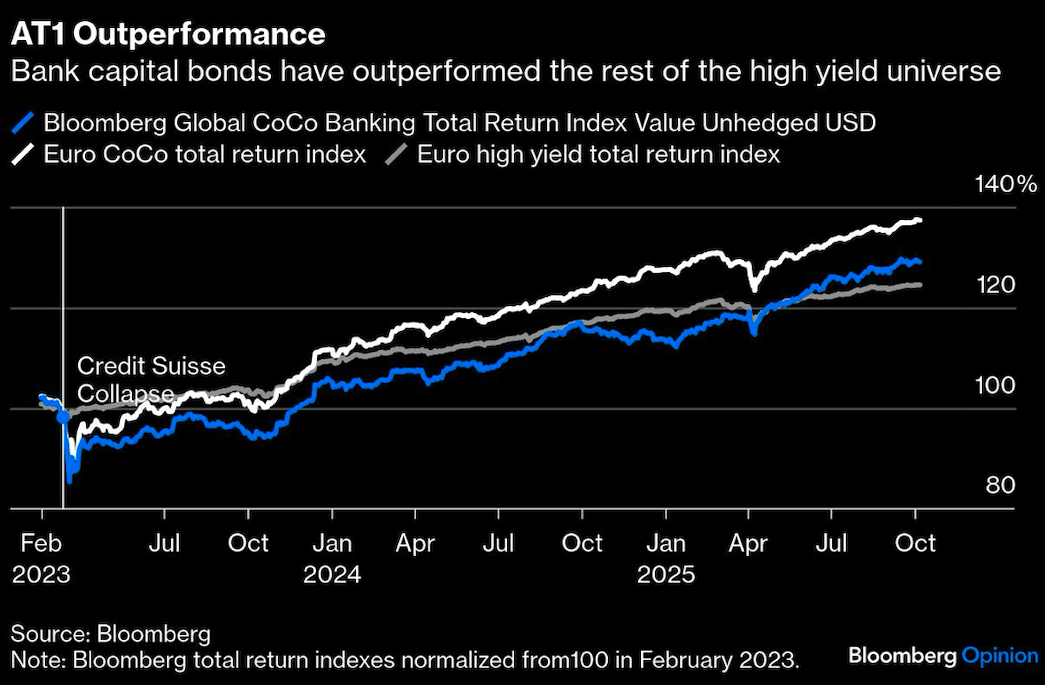
What’s the canary in the overpriced-asset coal mine? One obvious tweety bird is the riskiest type of bank debt, known as perpetual additional tier one bonds. These securities allow regulators to wipe out investors if a bank fails, but to compensate they offer the highest yields for lending to financial firms. This specialized asset class’s credit spreads are tightening despite a surge in issuance. But it’s not the red flag you might at first think.

I have argued previously that worsening government finances are propelling allocation out of theoretically risk-free sovereigns into corporate and financial debt. Yields in certain markets, particularly in the UK or US, are high because nations are borrowing so much.
For bank debt, strong equity markets are probably the more powerful influence. The European bank stock index is up more than 240% since the demise of Credit Suisse Group AG in March 2023, when $17 billion of its AT1 bonds were zeroed. So it's not surprising that the euro bank AT1 index has delivered a total return of nearly 50% since then. It was a major stress test, but the asset class has weathered it.
There's a lot more of a capital buffer before we approach anything like the euro crisis of more than a decade ago, which spawned these instruments. Regulators have fought hard to persist with the AT1 regulated debt structure to absorb capital losses. It may not be perfect but it's here to stay as switching to any alternatives would be too disruptive for debatable benefits.
Former Barclays Plc credit analyst Zoso Davies, in his Macro Credit Thoughts Substack, makes an interesting case that there is nothing really concerning in the credit space. He views systemic risk lying elsewhere, perhaps in an AI bubble. Though as AI investment is largely being financed via equity or cash flow it's also not an obvious red flag yet.
Davies points to three main drivers of credit crises: quality deteriorating, a sudden shift to risk aversion and technical logjams such as liquidity drying up. But with recession not on the horizon in developed markets, default rates low and staying subdued, and even the euro zone committing to huge defense and infrastructure spending, investor exuberance for AT1s isn’t unreasonable. The balance of credit rating upgrades to downgrades is the strongest since 2014.
With higher yields come bigger coupon streams, in turn needing to be reinvested, thereby creating natural demand. No wonder euro syndicated issuance is running 10% higher than last year to a new record. Credit portfolio managers are broadly sanguine about how tight overall credit and AT1 spreads are. The go-to measure is the "breakeven," a yield and duration calculation of how much a corporate spread can widen over its underlying government benchmark before the investment becomes unprofitable. Duncan Lamont, an analyst at Schroders Investment Management Ltd. puts it simply: “will I lose money...on the total return...even if the spread part of it isn’t where I’d like it to be.”
But there's a second positive kicker for credit, including the riskier elements like AT1s particularly of bigger banks, and that is the flight-to-safety dynamic. If the early warning signal box of equity markets starts turning turtle, then asset allocators will flock into fixed income - and notably corporate and bank credit as any sign of an economic downturn will do deeply unpleasant things to governmental budgets. So, in theory, there will be plenty of time to exit a broad portfolio of credit risk. In the meantime, if central banks accelerate interest-rate cuts, bonds will come along for the ride.
Sure, there are some worrying signs. Auto-finance companies are suddenly issuing a flood of their own AT1 style regulated bonds, when that industry is under intense pressure from China. There have been a raft of European bank names coming to the perpetual debt market I have never previously heard of. Furthermore, the spread between national champions and niche banks has halved in the past three years.
But in any expensive market there's always areas of concern. Bloomberg Intelligence euro bank credit analyst Jeroen Julius describes succinctly that AT1 spreads are "just a bit tight, that's all."
A message from Advisor Perspectives and VettaFi: Discover something new! Click here to register for our upcoming webcasts.
Bloomberg News provided this article. For more articles like this please visit
bloomberg.com.
Read more articles by Marcus Ashworth