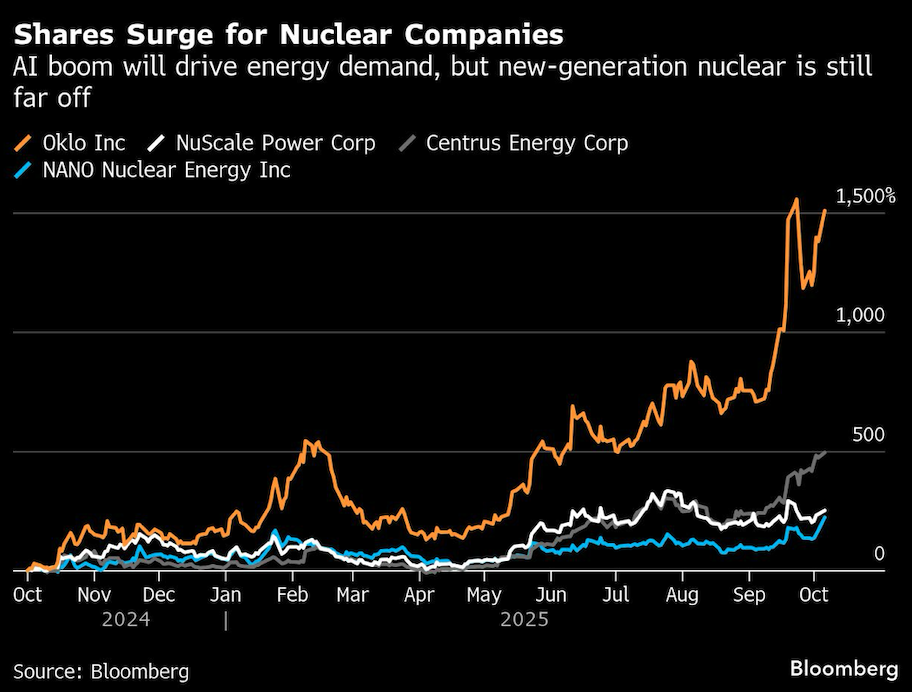
Nano Nuclear Energy Inc. has no revenue, no license from the US Nuclear Regulatory Commission and no operating power plant. Yet investors have driven its valuation past $2.3 billion, a figure that may be built more on optimism than fundamentals.
The company is being lifted by Wall Street’s latest obsession: the idea that artificial intelligence will require vast new sources of electricity. As tech giants race to build data centers capable of running machine-learning systems, they’re driving up power contracts and making anything linked to nuclear look like a ticket to the future.
The enthusiasm stretches beyond a single stock. Backed by OpenAI’s Sam Altman, Oklo Inc.’s shares have soared more than 1,000% in the past year, while NuScale Power Corp. and Nano Nuclear have both tripled in value. Centrus Energy Corp., which sells reactor fuel, is up over 400%.

To some analysts who’ve followed the sector for years, that optimism seems premature. Bank of America’s Dimple Gosai downgraded both Oklo and NuScale last week, warning that their valuations are “running ahead of reality.” She pointed to long lead times, persistent regulatory hurdles and an uncertain fuel supply that could delay commercial projects well into the next decade.
In her view, the timeline for companies that are pursuing the next generation of nuclear energy remains far in the future: widespread deployment by 2035 at the earliest, and true mainstream adoption only around 2040. “Intellectually, it doesn’t make sense to buy the stocks right now,” Gosai said. “Common sense must prevail at some point.”
The demand story is compelling, yet the obstacles are just as apparent. Jefferies analyst Paul Zimbardo said tech companies want power immediately, not in five or ten years. “The hyperscalers are willing to pay almost any price for power in the near term. But that’s not what new nuclear offers,” he said. “New nuclear doesn’t offer you speed. That’s where it breaks down.”
Zimbardo called the current window of premium pricing “one that will close” once supply-chain delays ease for natural gas power-plant components and other sources of new generation become more easily available.
Nuclear power plants have been feeding the grid for decades, but these companies are pursuing a new path. Rather than building massive, conventional reactors, they’re developing small, modular versions, or SMRs, that are expected to be manufactured in factories and assembled on site. The aim is to cut costs and speed up construction, but the strategy is untested. Only a few have been built, mostly in China and Russia. It will be years before any go into service in the US, yet investors are already betting SMRs will help meet rising demand for clean energy.
That’s because data centers are driving up both demand for power and prices. Those servers consume large amounts of electricity, and big technology companies are willing to pay hefty premiums for energy. Data centers could account for 7% of the country’s electricity demand by the end of the decade, according to BloombergNEF, from around 4% currently.
A similar dynamic is playing out in the hydrogen industry, where rising electricity prices and AI’s power needs have boosted share prices for once-struggling companies. Shares of fuel-cell maker Bloom Energy Corp. edged higher this month, and Plug Power Inc., a supplier of hydrogen, surged about 70% — both helping to lift the WilderHill Clean Energy Index to over 60% this year, even as President Donald Trump scales back support for renewables.
Oklo broke ground last month on its first commercial system in Idaho and says it could be operational by 2028, though it still needs NRC approval before construction can advance. The company plans to use a new uranium fuel known as HALEU that isn’t yet widely available, a challenge Gosai said could slow Oklo’s plans. Despite those headwinds, Oklo has been selected for two key US Energy Department programs aimed at accelerating the deployment of advanced nuclear plants and supplying the fuel they’ll need.
“The real proof will be in execution — and that is where Oklo is now focused,” said Bonita Chester, the company’s head of communications.
NuScale, meanwhile, remains the only small-modular-reactor developer with an NRC-approved design. Its first US project was canceled in 2023 after costs ballooned. Nano Nuclear hasn’t announced a firm date for when construction will begin, and has yet to submit a license application to the NRC. None of the three has ever posted a profit.
Centrus Energy, by contrast, already makes money — but even it’s being priced like a startup. Its shares trade at roughly 67 times earnings, a multiple more common in Silicon Valley than the power sector, as investors bet its early production of HALEU fuel will eventually supply the nascent SMR industry. Vice President Dan Leistikow said demand for clean power has transformed how investors view the industry.
“Nuclear was, for many years, an undervalued and underappreciated asset,” he said. “That’s beginning to change now as we face surging demand for electricity and huge new power requirements for AI and data centers.”
A Nano Nuclear executive wasn’t available to comment, and NuScale declined to do so.
Energy investor Rob Thummel, senior portfolio manager at Tortoise Capital, has been watching the nuclear industry closely. His firm recently filed to launch a nuclear-focused exchange-traded fund as part of its energy-infrastructure lineup. For now, he’s more interested in veteran reactor owners like Constellation Energy Corp. and Vistra Corp., which are already operating existing nuclear plants. But he’s bullish on nuclear’s long-term potential as data centers drive up demand for carbon-free electricity.
“They’ve got some work ahead of them,” he said. “But if you think about what they could do, it’s pretty remarkable.”
A message from Advisor Perspectives and VettaFi: Discover something new! Click here to register for our upcoming webcasts.
Bloomberg News provided this article. For more articles like this please visit
bloomberg.com.
Read more articles by Will Wade