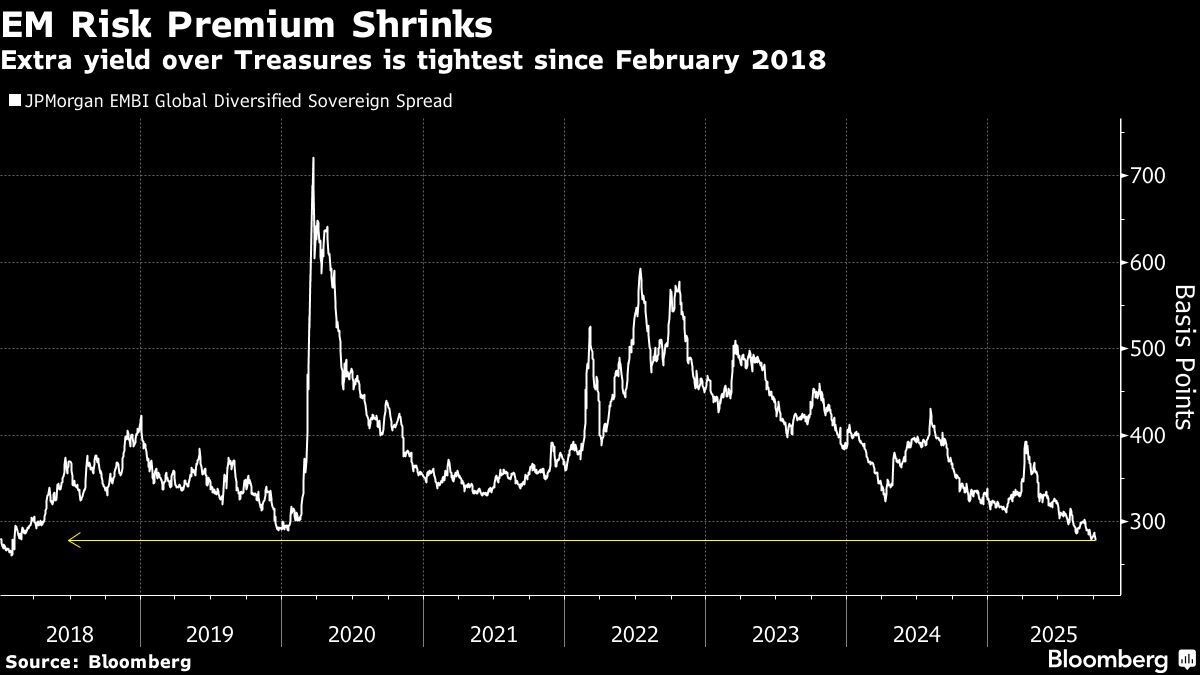
The extra yield investors demand to own dollar bonds of emerging market sovereigns rather than US Treasuries has shrunk to the least in seven years — and the rally is set to run further.
Yield hunters have reduced the so-called EM sovereign risk premium to 278 basis points on Monday, data from JPMorgan Chase & Co. showed. That’s the least compensation for risk in this asset class since a previous flare-up in US-China tensions in 2018.

Global investors are pumping capital into emerging markets to diversify away from US assets and pick up higher yields from riskier securities. The focus is on locking in current returns before the Federal Reserve’s easing reduces yields around the world.
Also helping the EM bond rally are turnaround stories from junk-rated borrowers, credit-rating upgrades and stabilizing fundamentals including in public-debt ratios.
“We are obviously aware of how tight spreads are on a historic basis,” said Anders Faergemann, head of EM sovereigns at PineBridge Investments in London. “But talking to EM experts and running our own numbers, we feel spreads are justified by the improvement we have seen in a number of indicators.”
EM Craze
The improvement has come across the board. Spreads on high-yield sovereign issuers are trading near the lowest since 2020, while investment-grade spreads have fallen near levels seen before the global financial crisis of 2008. Asia is currently trading at levels showing least risk since the 1997 currency crisis.
Emerging-market sovereign dollar bonds have given investors a total return of almost 10% in 2025, the best year-to-date performance since 2019, according to the Bloomberg benchmark for the asset class.
The rally has been led by high-yield borrowers. Seven countries that have witnessed some fiscal or debt strain in the past few years — Lebanon, Bolivia, Ecuador, Mozambique, Pakistan, Ghana and Panama — have yielded more than 20% each.
The craze for EM bonds has become evident in the Middle East, where several sovereigns tapped markets. Bahrain, a B+ borrower, drew $8.5 billion in investor demand for its $2.5 billion Islamic bond issuance, even after rising debt and budget deficit pushed Fitch Ratings to turn the country’s outlook to negative.
The region’s higher-rated sovereigns witnessed runaway demand, with Abu Dhabi selling a 10-year bond at 18 basis points above Treasuries, the tightest EM spread on record for that tenor.
“The region is not rich versus similar-rated Asia credit or lower-rated and more volatile EM credit,” said Fady Gendy, a fixed-income portfolio manager at Arqaam Capital Ltd. in Dubai. “On a yield basis, all-in yields are still decent for a highly-rated space with net creditor positions for the main countries in the region.”
Post-Distress Rallies
In Asia, investors are demanding 84 basis points of additional yield over Treasuries, down from 176 basis points in April and as high as 421 basis points three years ago. The last time the spread was this narrow was in March 1997.
Sri Lanka, which defaulted on its bonds, and Pakistan, which witnessed a period of distress, are both proving investor darlings — returning 16% and 23% so far this year, respectively.
Emerging markets have seen more upgrades than downgrades over the past 12-18 months and that momentum may continue amid robust current-account balances, stabilizing debt ratios and an improving growth outlook, Faergemann said.
This, along with global monetary easing, could keep the rally going despite already historically thin risk spreads, he said. For traders, the opportunity will lie in a global macro environment where the easing may provide a platform for moderate growth, he said.
A message from Advisor Perspectives and VettaFi: Discover something new! Click here to register for our upcoming webcasts.
Bloomberg News provided this article. For more articles like this please visit
bloomberg.com.
Read more articles by Srinivasan Sivabalan