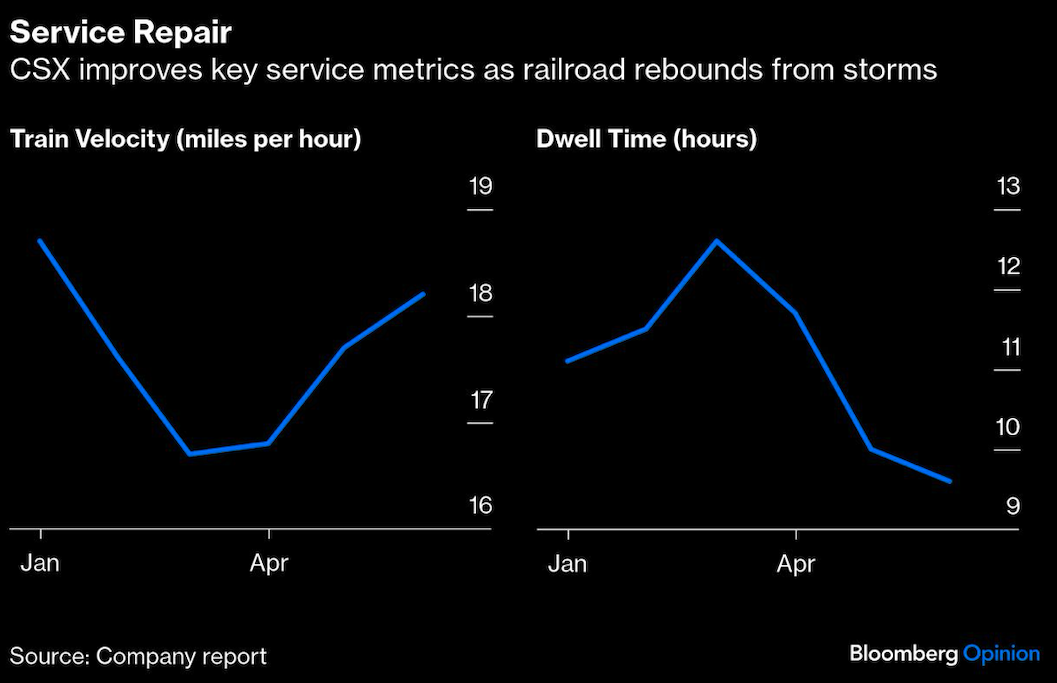
CSX Corp. had a rough go this year, but it’s starting to see the light at the end of the tunnel.
Hurricanes Milton and Helene washed out tracks and rail bridges, cutting a main line. The company had to move forward on a scheduled tunnel expansion in Baltimore that crimped port traffic beginning in February; it reopened last week. The good news is that CSX is well on its way to recovering from these external factors.
The company’s operating margin recovered to 36% in the second quarter from 30% in the first but was still down from 39% in the second quarter 2024 before all the disruptions. The key service metrics — dwell time at switching yards and train velocity — have all rebounded.

That’s why it was a bit odd that the CSX board decided to oust Chief Executive Officer Joe Hinrichs, a former executive of Ford Motor Co. Analysts agree that CSX was recovering nicely and regaining its position as one of the most profitable railroads. The new CEO hired by CSX’s board, Steve Angel, doesn’t have railroad experience, so it likely wasn’t about the railroad’s operations.
“As we have highlighted over the last few weeks, fundamentals at CSX are showing strong momentum into year-end with service at the best level in years, weekly volumes accelerating as a result of recently announced partnerships, and infrastructure project headwinds in the rear view,” Stephanie Moore, an analyst with Jefferies, wrote in a note on Monday after the news of the management change.
The move has everything to do with CSX shareholders wanting BNSF Railway Co. — which is owned by Warren Buffett’s Berkshire Hathaway Inc. — to make an acquisition offer to counter the merger plans that Union Pacific Corp. and Norfolk Southern Corp. unveiled at the end of July. But BNSF, which competes directly with Union Pacific in the West while Norfolk and CSX are competitors east of the Mississippi River, can’t be compelled to make an offer, nor should it be rushed.
The CSX board dropped hints that it dumped Hinrichs in favor of Angel, the chairman of Linde Plc, to prepare for a potential merger. John Zillmer, chairman of CSX’s board, said in a statement that Angel is “an expert in guiding companies through significant transformation.”
Angel, who spent two decades early in his career at General Electric, was CEO of Praxair when the provider of industrial gases doggedly pursued and pulled off a merger in 2018 with Linde. Zillmer said that the board is “laser-focused on advancing CSX’s strategic priorities and maximizing shareholder value” and that Angel is the right executive to do that.
The much cruder version comes from activist investor Ancora. The group began attacking Hinrichs in an August letter for having to “play catch up” to the announcement of the Union Pacific-Norfolk Southern deal and made the absurd suggestion that CSX should seek a merger with Canadian Pacific Kansas City, which would throw the North American rail industry out of balance, as a way to pressure BNSF to acquire CSX. Ancora Advisors has about a $72 million stake in CSX, or 0.1% of outstanding shares, according to Bloomberg data based on a second-quarter 13F filing. Its stake in Norfolk Southern is about $343 million.
In a letter on Monday, the investor group took credit for the firing of Hinrichs and seemed to relish it by calling his time as CEO a “value-destructive tenure” based on cherry-picked data. The letter also said Hinrichs “botched the opportunity” to participate in the “tailwinds of consolidation.” The opportunity, I suppose, was to apply Jedi mind tricks to force Buffett to greenlight BNSF to buy CSX.
Changing CEOs won’t change the fact that the decision to pursue a merger lies with BNSF and Berkshire. Buffett and his management team are unlikely to be impressed by threats of proxy fights nor shareholder-activist bullies. It’s fairly clear that if the rail regulator, the Surface Transportation Board, approves Union Pacific’s acquisition of Norfolk Southern, then the most logical next step would be for BNSF to purchase CSX. That would be the capstone of transcontinental rail consolidation.
Time is on BNSF’s side. There are three more years of the Trump administration, which is seen as much more favorable to unleashing the final round of rail mergers. BNSF benefits by waiting to see the contents of the Union Pacific-Norfolk Southern merger application to the STB, which has the sole power to approve a deal. As a railroad affected by the merger, BNSF could clamor for the STB to force divestments or impose rights to use tracks. In other words, BNSF will be able to see Union Pacific’s cards before having to make a move.
Hinrichs had already signaled to BNSF that CSX was open to talks. The two railroads announced a partnership in August to create coast-to-coast service for intermodal maritime shipping containers on some routes. This preliminary dance can be seen as a prelude to a potential marriage. BNSF will choose its timing. Unless Angel, the new CSX CEO, has some cool Jedi mind tricks, he will have to abide by Buffett time.
A message from Advisor Perspectives and VettaFi: Discover something new! Click here to register for our upcoming webcasts.
Bloomberg News provided this article. For more articles like this please visit
bloomberg.com.
Read more articles by Thomas Black