Are We Running Out of People?
Membership required
Membership is now required to use this feature. To learn more:
View Membership BenefitsThe views presented here do not necessarily represent those of Advisor Perspectives.
In my 2019 book, Fewer, Richer, Greener, I wrote:
I [had] read Ben Wattenberg’s book, Fewer, his elegy for the population explosion. Showing that the explosion was effectively finished in the developed world and quickly coming to an end in the rest of the world, Wattenberg wrote in funereal tones, lamenting the end of an age of youth, exuberance, and innovation.
I thought it was the best news I had ever heard.
Maybe I was wrong.
It’s still true that no physical quantity, including the human population, can grow at a positive rate forever — so population growth has to stop sometime. But any very rapid change, including the sudden halt to the population explosion that we seem to be experiencing, can pose problems. In an interesting but problematic new book, After the Spike: Population, Progress, and the Case for People, two economists, Dean Spears and Michael Geruso, warn that the switch to a population implosion, currently underway, could have catastrophic consequences for human well-being and even survival.
While there is much valuable information in the book, they’ve presented it in a sensationalized and biased way. The old Club of Rome forecasts from the 1970s — that the likely future rates of population growth would result in mass starvation and ecological collapse — were wrong because they assumed that people wouldn’t react to changing circumstances by having fewer children.
Spears and Geruso commit the same sin in the opposite direction. Although they offer suggestions for halting or reversing the population implosion, their main focus is on the terrible consequences of a crashing population, which they portray as a near-certainty or at least the most likely outcome. It isn’t. Contrasting with their doom and gloom is my more economically nuanced view that, faced with plummeting populations, people will react to their newly changed set of incentives by having more children, bringing some stability to the population... eventually. I’ll lay out the case for that outcome later in this essay.
But such natural remedies operate slowly. Meanwhile, we could be in some trouble.
The Spike
The population “spike” on the book’s cover reveals, in a dramatic diagram, the authors’ basic thesis — that the world’s population could decrease as rapidly as it increased and settle, over the extreme long term, at prehistoric (tiny) levels. Exhibit 1 is a version of the spike from an earlier paper by the authors.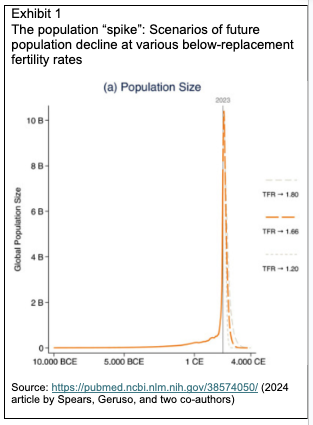
While the authors don’t explicitly say that this dramatic spike is their best forecast — they present and discuss other, more moderate forecasts — the display of the spike on the book’s cover and the extensive discussion of it inside give the impression that they really believe the world’s population will decline as shown in Exhibit 1. This Cassandra-like posture has gotten them a lot of publicity and has sold a lot of books.
But the endless population crash is unlikely to happen. The authors’ “rebounding fertility” scenario (not pictured) results in a much better outcome, with a stable population close to today’s level. That is the outcome the authors, who are “pro-people,” strongly prefer, and they provide suggestions on how to achieve it. But the book’s tone suggests that they are more or less resigned to a dreary (and lonely, and unproductive) future for a vanishing human race.
In critiquing After the Spike, I’ll start with the observation that the spike on the book cover would be more revealing — and more intellectually honest — if they had used a log scale for population and if they had shown the whole distribution of outcomes, not just the worst-case scenario. Exhibit 2, helpfully constructed by the United Nations back in 2004, does the latter: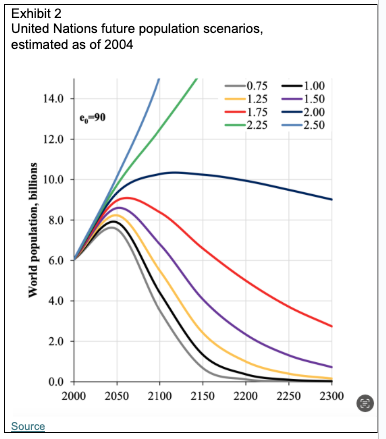
The UN graph doesn’t use a log scale, but since they got everything else right, they’re forgiven. The differently colored lines represent different total fertility rates (0.75, 1.25, and so forth), and e0=90 means that people live to an average age of 90 in this set of scenarios. Other life expectancies give slightly different results.
It is easy to see that any total fertility rate (TFR, the average number of children produced by a couple in a lifetime) below 2 results in a population that declines by a lot, either quickly or slowly. Many countries and regions have TFRs that low already — and are trending lower.
Are We Really Going to Run Out of People? Framing the Question
Many readers who came of age in the twentieth century, when overpopulation was a concern verging on panic, find it odd that we’re now worried about the opposite. But, due to declining birth rates in many parts of the world that have plummeted right through the two-children-per-couple “replacement rate”1 and kept falling, the world’s population is on schedule to top out between 10 and 11 billion around the year 2080 and then decrease. Exhibit 3 shows the evolution of the total fertility rate by continent over time,2 and Exhibit 4 illustrates the current state of fertility in each country.3
These facts are not in doubt. We really are close, in a historical sense (2080 is not that far off), to a reversal of the population explosion.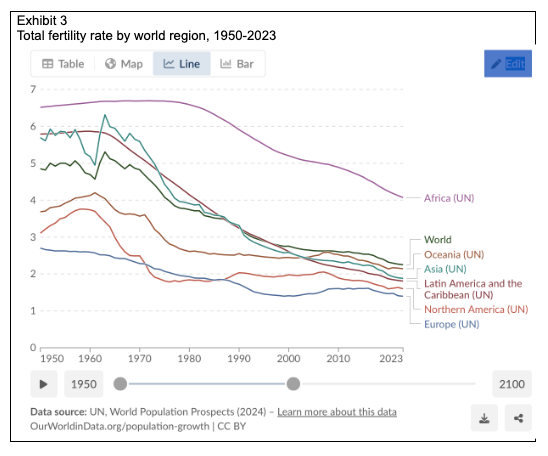
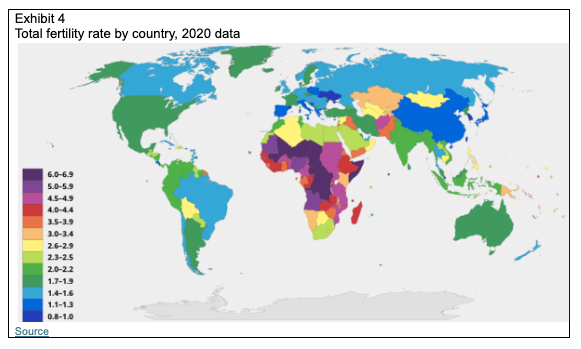
What happens next? Projecting current trends forward (there’s the rub!), China — one northeastern province of which has the lowest fertility rate in the world, at 0.55 children per couple — shrinks to 600 million people by 2100. Meanwhile, Africa balloons to almost 4 billion. The United States continues to grow, albeit very slowly, and India remains large at 1.5 billion.4
But current trends can change! Over the last half-century, the population forecast flipped from hypergrowth to shrinkage. We should not forget that there was a near-universal consensus, in the 1960s and 1970s, that population growth was on a runaway path which threatened our well-being and perhaps our survival. By 2004, the United Nations was drawing charts that included a population implosion as a possible scenario. A more profound change in the zeitgeist can scarcely be imagined.
One of Spears and Geruso’s goals is to provide a roadmap for one more flip, from shrinkage to population stability at something resembling current levels. Their proposals, however, are not very encouraging. Most notably, they do not think there are any “natural stabilizers” that will keep the population from crashing. I do.
Steelmanning and the Case Against People
In organizing After the Spike, the authors follow a formula that I find helpful: They start by setting forth the case against people as a way of introducing the case for a larger, or at least less diminished, population. Philosophers and rhetoricians call this “steelmanning” — making the strongest plausible case against one’s own position so as to understand more fully how the other side thinks and what supporting evidence they have. (The odd term “steelmanning” is a play on “straw man,” where one does the opposite, setting up a straw-man argument that purports to represent the opposing side but actually misrepresents it. A straw man is easy to knock down; a steel man, not easy at all.)
In their steelman section, called “The Case Against People,” Spears and Geruso note several common objections to a large and/or growing population:
- People consume resources;
- People pollute;
- People require the use of someone else’s body to get born; and
- Some people do not want to “add new lives to an imperfect world.”
After presenting a more or less sympathetic a view of each of these objections, Spears and Geruso then do a creditable job of knocking them down. People do consume resources, but they also produce resources, most of which do not occur in nature but are wanted by other people —that’s what an economy is for. People pollute, but the relationship between population and pollution is not linear, as the authors explain:
If one family on one acre is bad, aren’t ten families together on one acre ten times as bad, and a hundred families on one acre – the density of a downtown city – a hundred times as bad? No, because the consequences of people do not scale in straight lines. ...[L]iving together in a dense urban environment generates fewer emissions per person than spreading that same number of people out to far-flung places.
In addition, as the authors emphasize in more detail in later sections, a larger population means more new ideas, which are the key to economic growth.
Regarding birth involving the use of someone else’s body, we’re not going to get around that one easily — nor do we want to. This comment frames the central issue of the book, which is that, under conditions of freedom for women and effective contraception, which are already widespread and becoming more so, people will only have enough children to replace themselves if they want to.
The concern about adding lives to an imperfect world is too complex for me to address here, but Spears and Geruso do a creditable job of it.
The Case for People
While Spears and Geruso are intensely concerned with the moral philosophy behind population growth or shrinkage, those weighty issues are beyond the scope of this essay.5 Let’s move to their central economic argument, which is that larger populations are more productive – more full of new ideas, more prosperous, just better overall. In short, progress and population growth are tightly bound together in a causal relationship.
Is there any evidence of that? Yes. A graph of world population along with some measure of human well-being – say, global GDP per capita in today’s money – would show the tightness of the relationship, but the best I could do is Exhibit 5, which is a graph of these variables for the UK starting in the late 1600s.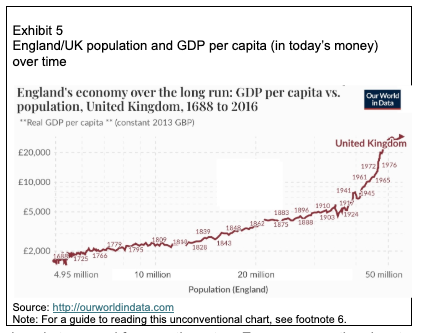
The starting date represents the time when that country began to escape the “Malthusian trap” (the fact that, prior to modern times, economic growth just made it possible to support more people at a subsistence level, so that you almost never got ahead on a per-person basis).6 Such a graph drawn for the whole world would show the escape from Malthus starting later, in the 1800s, as technology and markets spread from northwestern Europe across the planet.
“Progress Comes From People”
But why, in advanced societies, does economic progress move in tandem with population? What is the mechanism by which the existence of a larger population causes wellbeing to improve?
The authors explain that “progress comes from people” (the title of their Chapter 6). Their argument is rooted in basic microeconomics — the gains from specialization and exchange and the special properties of non-rival goods, which they describe as “a fuel that never gets used up.” (Non-rival goods are those that follow Thomas Jefferson’s principle that “he who receives an idea from me, receives instruction himself without lessening mine; as he who lights his taper at mine, receives light without darkening me.” No one has ever said it better.)
But there’s more to the connection between population and progress than what the authors describe. The relationship is not linear but superlinear: As Geoffrey West noted in his classic 2017 book, Scale (which I reviewed here), a 10% increase in the population of a city produces a greater than 10% increase in prosperity. That is why Los Angeles is richer than Tulsa, which is richer than a medium-sized town, which is richer than a village.
Meanwhile, the costs, financial and environmental, of a larger population grow in a sublinear fashion. A 10% larger population requires less than a 10% increase in the use of resources. This double benefit is the key to population and prosperity going together hand in hand.
Yet we still haven’t plumbed the underlying reason why a larger population is beneficial. It is that economic growth emerges, not from population size alone, but from the number, frequency, and intensity of interactions between people. Combinatorial math shows that the number of possible connections among 1,000 people is vastly larger (not just 10 times larger) than among 100 people, and grows to immense sums as the numbers get really big. When you gather a million people in one place, as in ancient Rome at its peak, or any of 54 American or 113 Chinese metropolitan areas today, the likelihood that two people on the frontiers of knowledge in a field will meet and collaborate becomes significant — especially if institutions, such as universities and businesses, are set up to facilitate such collaboration.
In this key aspect of the case for people, the authors could have well afforded to add more nuance and intuition. But they got the basic concept right.
Why Is Fertility Declining Everywhere, All at Once?
One of the biggest mysteries of population is the sharp decline, in this century, in fertility rates to levels below replacement, in many different cultures and locations all at once.
What do Uruguay, Thailand, Croatia, the Bahamas, and Bhutan have in common? “Nothing” would be a reasonable answer, but they all have total fertility rates below 1.5, along with giants such as China, Japan, Russia, and Germany. Don’t see any sub-Saharan or Muslim countries on the list? There aren’t any, but Iran is close, at 1.67, and South Africa is a little farther away at 2.19.
The conventional explanations for low fertility rates include increased freedom for women, education- and employment-related decisions to delay childbearing, and the high cost of children. Another intriguing, if slightly off-the-wall, possibility is that life without children has become so fabulous that young people don’t want to spoil the fun by starting a family. Spears and Geruso write:
[The pleasures that compete with family life are] in the quiet moments with a romantic partner and in the wild times out with friends... wherever any other goal or dream or impulse competes with parenting. The opportunity cost of a kid is growing around the world, not despite the fact that the world is become a better place to live, but because of it.
Maybe so. But while life as a single person or childless couple may be fabulous enough in West London or lower Manhattan to seduce people away from the natural desire to reproduce yourself, we're seeing the same demographic patterns in some pretty poor countries where life may be getting more livable but is pretty far from fabulous.
It’s a stretch to think that the factors to which low fertility is usually attributed have hit so many wildly different countries and cultures at the same time and with the same intensity. And, if culture is the explanation, let’s look at religion, which is a vital part of culture. Low fertility is affecting the deeply religious Indian states of West Bengal and Maharashtra in almost the same way as mostly atheistic China.
I suspect Spears and Geruso are right when they say that “nobody fully understands low birth rates.” Anyone who says they understand current demographic trends, doesn’t.
The Turnaround
Having noted the possibility of a crashing population, is there any way to fix this problem (assuming you consider it a problem and want it fixed)? Spears and Geruso suggest reorienting the culture to be more supportive of parenting and child care, but then emphasize how difficult that is. More cash for parents? Only huge transfers will make a difference, and there’s no ready source of such funding. Government fertility mandates? Almost impossible to enforce and certain to backfire.
So, what can be done to stabilize the population at levels that Spears and Geruso would regard as conductive to ongoing progress and prosperity?
People Respond to Incentives
The authors assert strongly that there’s no “natural stabilizer,” pointing out that almost no country that has gone through the replacement rate on the way down has ever come back above it.7 But there is one possible stabilizer, called “economics,” which is based on the economist Steven Landsburg’s four magic words: “people respond to incentives.” It may or may not work, but let’s go through the logic.
As the population falls, resources become more plentiful and cheaper. The reason is obvious: less demand but not much change in supply. (Yes, fewer people would be available to work in the mines and farms, and to build buildings — but the amount of land, water, air, and other basic resources would remain unchanged.)
Where Is Housing Cheap?
Housing is one resource that is particularly prone to becoming cheaper in a depopulation, because it stays around long after the need for it has disappeared. Look at housing prices in depopulating areas of the Great Plains states of the U.S., or in the villages in southern Italy, where rundown houses are offered for one euro.
Look especially at Japan.
Binyamin Appelbaum, writing in The New York Times, notes:
[Tokyo] has remained affordable by becoming the world’s largest city. It has become the world’s largest city by remaining affordable. Two full-time workers earning Tokyo’s minimum wage can comfortably afford the average rent for a two-bedroom apartment in six of the city’s 23 wards.
Not average wage. Minimum wage.8
I don’t think a pair of minimum wage workers can afford an average two-bedroom apartment in any substantial city in the United States or Western Europe, and certainly not in Canada and Australia. Loose zoning restrictions and building codes are often cited as reasons for the affordability of Tokyo housing, but the small number of young people seeking the housing is an important factor too.
Low Prices = More Children?
As would-be parents survey the conditions with which they are faced, and see low housing prices (especially for large houses) due to depopulation, they may decide to have more children. Anecdotal evidence of this comes from the Great Plains, which has been depopulating for a century, has low housing prices, and boasts the highest birth rates in the country.
The cost of schooling in the United States may also decline as population pressures ease. While the sticker price of university tuition has risen to astronomical heights, average net tuition (the price actually paid) is already falling in many locations. Many colleges will close their doors in the next few decades due to lack of applicants, putting further downward pressure on prices.
The key to a possible fertility turnaround, then, is that people respond to incentives that they are not aware of, not just cash carrots held out in front of them. As young couples of the future face a more favorable cost picture, more room to grow, more empty spaces that need to be filled — all due to zero and then negative population growth — they may find their cost-benefit analysis, conscious or unconscious, tipping in favor of more children.
Conclusion and Advice for Investors
As investors, we want our wealth to compound at a high rate within our risk tolerances. So we, rightly, focus on growth: growth in price, growth in distributions (bond coupons and equity dividends), and growth in the fundamentals behind these numbers. These variables are easy to observe and measure, and the data frequency is high.
Demography is pretty much the opposite: The observations are of very low frequency, the trend is your friend, and (unlike in markets) short- to medium-term outcomes are largely predictable. Getting the change in a demographic trend right is the important part, and that is what Spears and Geruso — and every other writer on demographics — try to do.
The demographic spike upward since the late 1700s changed and reordered the world we live in today. Its path forward, whether continuing up, crashing down, or finding some intermediate path, will also reorder economic life and our investments. We should pay attention. In After the Spike, Dean Spears and Mike Geruso help us to do this, but investors should familiarize themselves with many different viewpoints, not just those of these two authors.
Why? Because no one knows for certain what will happen in the distant future.
Endnotes
1 Actually about 2.1, the extra 0.1 representing children who do not survive to reproductive age.
2 In a major innovation in population research, the University of Chicago’s Anup Malani and Ari Jacob point out that the effective fertility rate (EFR), the per-couple number of children who survive to reproductive age, is a fairer representation of fertility trends and shows a much slower rate of decline – until recently, when fertility rates plunged below replacement in many regions. Until the advent of modern medicine in the last century, child mortality rates were so high that couples often needed to have 7 or 8 children in order that 3 or 4 survive to adulthood.
3 I’ve chosen a chart that uses a lot of color, making it easy to read. Unfortunately it uses 2020 data, and fertility has continued to fall significantly since that date.
4 These projections, from Our World in Data, are based on the United Nations Population Division’s medium-fertility scenario.
5 The authors’ philosophical point of departure is Effective Altruism, a movement which asserts that human life has great intrinsic value (despite the existence of suffering, uncertainty about the future quality of life, and so forth), so that more people are better than fewer people. It’s noteworthy that the Population Wellbeing Initiative at the University of Texas, which Spears serves as director, is infused with the Effective Altruist philosophy and was funded by Elon Musk, who has been active in promoting these views. Some additional comments on Effective Altruism and the ideas in After the Spike are on my website.
6 Exhibit 5 requires an explanation because the x-axis is not a time axis. Each point on the red line, identified by a date, represents the UK population as of that date (shown on the x-axis) and a per capita GDP level (shown on the y-axis). The fact that the red line moves up and to the right over time illustrates the connection between population and per capita GDP in today’s money.
7 Kazakhstan’s total fertility rate fell to 1.90 in 2000 then rose to a very high (for a middle-income country) 3.32 by 2021, then fell, but remains above replacement. The U.S. is an edge case. Fertility fell to 1.77 in 1980 then rose to 2.06 by 2010, possibly due to immigration by high-fertility groups. Because of very low child mortality in the U.S., 2.06 may have been above replacement rate. At any rate, U.S. fertility fell sharply after 2010 and now stands at 1.79.
Note that total fertility rates are estimates (not semi-precise measurements like census data) because they are forecasts of the future — the total number of children a woman will have in her lifetime, including women who have not yet had any children or finished having children.
8 The minimum wage in Tokyo in 2025 is a measly $8.15 (U.S.) per hour. In more-or-less comparably sized Los Angeles, it is $17.87.
Laurence B. Siegel is the Gary P. Brinson Director of Research (Emeritus) at the CFA Institute Research Foundation, economist and futurist at Vintage Quants LLC, the author of Fewer, Richer, Greener: Prospects for Humanity in an Age of Abundance, and an independent consultant and speaker. His latest book, On Progress and Prosperity: Essays 2019-2024, contains many articles previously published in Advisor Perspectives. He may be reached at [email protected]. His website is http://www.larrysiegel.org.
The author thanks Stephen C. Sexauer, CIO of the San Diego County Enployees Retirement Association (SDCERA), for his valuable comments and advice.
A message from Advisor Perspectives and VettaFi: Discover something new! Click here to register for our upcoming webcasts.
Membership required
Membership is now required to use this feature. To learn more:
View Membership BenefitsSponsored Content
Upcoming Virtual Events View All












